Solar troubleshooting gets much easier when you can quickly measure real PV performance instead of guessing from visual checks alone. The right tester helps you verify voltage, current, and power output with far less downtime.
This roundup of 10 solar panel testers for electrical troubleshooting is built for buyers who want practical accuracy, clear displays, and portable tools for field or bench testing.
Best 10 Solar Panel Testers for Electrical Troubleshooting Picks for 2026
Professional PV Testing Pick
ZIBOO FT-1000W Solar Panel Tester MPPT Meter
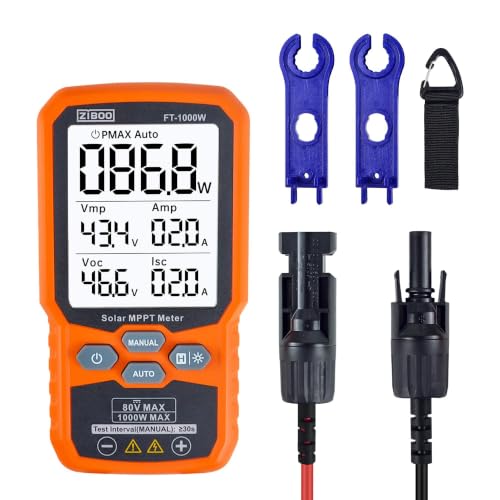
- Measures Pmax up to 1000W, Voc 12-80V, and Isc 35A.
- Tracks Vmp and Amp in real time for troubleshooting.
- CAT-rated, IP54, backlit LCD with data hold.
Best For: Technicians and maintenance teams needing safe, rugged PV validation.
High-Capacity Trouble-Shooting Tool
Elejoy EY-1600W Solar Panel Tester

- 1600W MPPT tester for PV panel data checks.
- Ultra-clear LCD for easier field reading.
- Built for troubleshooting solar modules.
Best For: Installers who want a simple higher-capacity PV tester.
Highest Range Option
UNI-T 2000W Solar Panel Tester

- Measures up to 2000W, 150V Voc, and 45A Isc.
- Shows Pmax, Vmp, Imp, Voc, and Isc on one screen.
- Includes protection features and useful accessories.
Best For: Manufacturers and installers needing a wide-range PV tester.
Portable Dual-Mode Choice
SK-705S Solar MPPT Power Tester
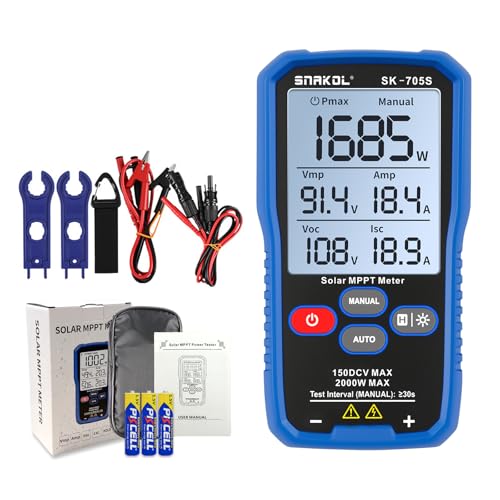
- Auto and manual modes for controlled PV testing.
- 3.2-inch backlit LCD with data hold.
- Measures Pmax, Vmp, Imp, Voc, and Isc.
Best For: Technicians who want portable PV testing with flexible modes.
Compact 800W Pick
800W MPPT Solar Panel Tester with Large LCD

- Measures Pmax, Voc, and Isc at once
- No battery required for solar-powered testing
- Large LCD stays readable in sunlight
Best For: Single-panel troubleshooting up to 800W and 60V
Easy All-in-One Choice

- Measures Pmax, Voc, and Isc with MPPT
- Auto and manual modes for flexible testing
- Large sunlight-readable LCD display
Best For: RV, home, and off-grid panel checks
High-Capacity Troubleshooting Tool
1800W Smart MPPT Solar Panel Tester

- Supports both series and parallel panels
- Wide range up to 1800W, 120V, and 60A
- Includes MC4 and alligator clip cables
Best For: Complex solar systems and higher-capacity troubleshooting
Pro-Grade MPPT Meter
UNI-T UT673PV Solar Panel Tester

- Measures Pmax, Vmp, Imp, Voc, and Isc
- Large screen shows multiple results at once
- Self-powered with MPPT test modes and protections
Best For: Installers and PV pros needing broad diagnostic coverage
Field-Friendly Solar Tester
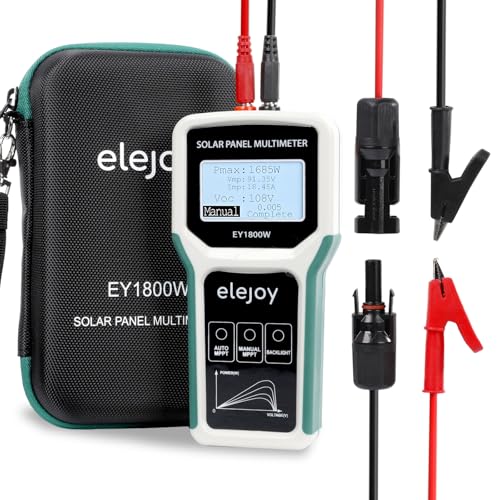
- Measures Pmax, Voc, and Isc in real time
- Includes MC-4 connectors, alligator clips, and EVA toolkit
- No batteries required for direct panel testing
Best For: Quick field diagnostics and spec comparisons
Compact Troubleshooting Meter
UT673PV 800W Solar Panel Tester

- Measures Pmax, Voc, and Isc on one screen
- Ultra-clear LCD is readable in bright sunlight
- No battery required; includes MC4 cables and wrench
Best For: Lightweight troubleshooting for panels under 800W and 60V
Professional PV Testing Pick – ZIBOO FT-1000W Solar Panel Tester MPPT Meter
If you need solar panel testers for electrical troubleshooting that can also validate panel performance in the field, the ZIBOO FT-1000W is built for professional PV checks. It measures Voc, Isc, and maximum power with MPPT-focused testing, while the backlit display and data hold make readings easier on rooftops and in other low-light areas.
Best For: Solar technicians, R&D teams, and field maintenance crews who need a rugged tester for PV performance validation.
Pros:
- Measures Pmax up to 1000W with Voc from 12-80V and Isc up to 35A.
- Supports real-time Vmp and Amp tracking to spot degradation or shading issues.
- CAT III 1000V / CAT IV 600V rating with double-insulated probes for safer high-voltage use.
- Backlit LCD, data hold, IP54 resistance, and auto-off for outdoor work.
Cons:
- Max power is capped at 1000W, so it is not the highest-capacity option here.
- Geared more toward professional PV testing than casual home use.
This is a strong choice when you want a purpose-built tester that balances measurement range, safety, and field usability for solar diagnostics.
High-Capacity Trouble-Shooting Tool – Elejoy EY-1600W Solar Panel Tester
Among solar panel testers for electrical troubleshooting, the Elejoy EY-1600W stands out as a higher-capacity MPPT multimeter for checking PV panel data and system health. Its upgraded design and ultra-clear LCD are aimed at making solar diagnostics easier when you need to review test results quickly in the field.
Best For: Installers and troubleshooters who want a straightforward MPPT tester with a larger measurement ceiling.
Pros:
- 1600W class tester for broader PV testing capacity.
- Built for MPPT-based solar panel data checks and troubleshooting.
- Ultra-clear LCD improves readability during field measurements.
- Designed as an upgraded EY-1600W model for practical use.
Cons:
- Limited supplied details make it harder to compare feature depth.
- No accessory or protection specs were provided in the notes.
If you want a higher-capacity option without a lot of extra complexity, this Elejoy model fits well into a technician’s solar troubleshooting kit.
Highest Range Option – UNI-T 2000W Solar Panel Tester
If you are comparing solar panel testers for electrical troubleshooting, the UNI-T UT673E offers one of the widest measurement ranges in this group. It can display Pmax, Vmp, Imp, Voc, and Isc on one screen, which is useful when you want a quick health check and fault screening for PV components.
Best For: Solar manufacturers, professional installers, and hobbyists who need a high-range tester with easy-to-read measurements.
Pros:
- Measures Pmax from 60-2000W, Voc from 12-150V, and Isc from 5-45A.
- Shows Pmax, Vmp, Imp, Voc, and Isc simultaneously for fast diagnosis.
- Includes reverse polarity, over-temperature, and drop-proof protection.
- Comes with MC4 cord, alligator clips, wrench tool, strap, and batteries.
Cons:
- Heavier accessory set may be more than some users need for simple checks.
- Battery-powered operation means you must keep spare AAA batteries on hand.
This is a versatile pick if you want a broad measurement window and a practical feature set for installation, maintenance, and routine performance checks.
Portable Dual-Mode Choice – SK-705S Solar MPPT Power Tester
The SK-705S is a practical option if you want solar panel testers for electrical troubleshooting with both automatic and manual measurement modes. It focuses on Pmax, Vmp, Imp, Voc, and Isc, and its 3.2-inch backlit LCD helps keep readings visible during outdoor commissioning or service work.
Best For: Installers and service techs who want a portable tester with flexible auto and manual test modes.
Pros:
- Measures Pmax, Vmp, Imp, Voc, and Isc for fast PV performance checks.
- Auto and manual modes add flexibility for commissioning and inspection tasks.
- 3.2-inch LCD with backlight and data hold supports field readability.
- Includes test leads, alligator clips, storage pouch, and user manual.
Cons:
- Supplied notes show a lower power rating than the headline suggests, so capacity expectations should be checked carefully.
- No safety rating details were provided in the notes.
For teams that value portability and mode control, this tester offers a useful mix of visibility, convenience, and core PV measurements.
Compact 800W Pick – 800W MPPT Solar Panel Tester with Large LCD
If you need solar panel testers for electrical troubleshooting, this 800W MPPT model is a simple way to check a panel’s key output data without extra setup. It measures Pmax, Voc, and Isc, uses a large LCD that stays readable in bright sunlight, and runs without a battery, making it practical for quick field checks.
Best For: Technicians and DIY users checking individual panels up to 800W and 60V in bright outdoor conditions.
Pros:
- Measures Pmax, Voc, and Isc simultaneously for fast troubleshooting.
- No battery required, so it is ready for extended use with solar input alone.
- Large LCD is designed for clear reading under strong sunlight.
- Includes MC4 cables and an MC4 connector wrench for easier setup.
Cons:
- Limited to panels up to 800W and 60V.
- Cannot measure multiple panels connected in series.
- Protection guidance requires disconnecting the panel from other loads before testing.
This is a focused troubleshooting tool for straightforward panel checks, especially if you want a portable meter with minimal setup. Its limits are important, but within its rating it covers the core measurements most people need first.
Easy All-in-One Choice – 2000W MPPT Solar Panel Tester
For solar panel testers for electrical troubleshooting, this 2000W MPPT unit is built for users who want a broader measurement range without complicated setup. It reads Pmax, Voc, and Isc, supports auto and manual modes, and uses a 3.2-inch LCD that is meant to stay visible outdoors.
Best For: Beginners and professionals testing RV, home, and off-grid solar panels with a simple plug-and-play meter.
Pros:
- Measures Pmax, Voc, and Isc with MPPT tracking for reliable readings.
- Supports both auto and manual modes for flexible use.
- 3.2-inch LCD is designed to be easy to read in direct sunlight.
- Built-in protection covers over-voltage, over-current, reverse polarity, and overheating.
Cons:
- Voc range is limited to 3-90V, so it may not suit higher-voltage systems.
- Requires MC4 cable connection, so it is not a fully universal clamp-on meter.
- Best suited to panel testing rather than broader electrical diagnostics.
This model balances simplicity and range well for common solar troubleshooting jobs. If you want a meter that is easy to start using but still covers installation and maintenance checks, it is a strong middle-ground option.
High-Capacity Troubleshooting Tool – 1800W Smart MPPT Solar Panel Tester
Among solar panel testers for electrical troubleshooting, this upgraded 1800W model stands out for handling more complex panel setups. It covers power from 5W to 1800W, voltage from 20V to 120V, and current up to 60A, while also supporting both parallel and series-connected panels.
Best For: Users working on larger or more complex solar systems that need broader testing support.
Pros:
- Handles both parallel and series-connected panels.
- Wide range supports 5W to 1800W, 20V to 120V, and up to 60A.
- Large LCD is designed to be easy to read in bright sunlight.
- Includes multiple safety protections plus MC4 and alligator clip cables.
Cons:
- Total panel power must not exceed 1800W.
- Panels must be disconnected from other devices or loads before testing.
- Heavier-duty range may be more than basic single-panel users need.
This is the most flexible option in the group for tougher diagnostic work, especially if your testing involves mixed panel layouts. Its broader compatibility makes it a practical pick when basic meters are too limited.
Pro-Grade MPPT Meter – UNI-T UT673PV Solar Panel Tester
If you need solar panel testers for electrical troubleshooting, the UNI-T UT673PV is built to check key panel performance data in one pass. It measures maximum power, peak power voltage, peak power current, open-circuit voltage, and short-circuit current, while the large screen shows results simultaneously for faster diagnostics.
Best For: Photovoltaic manufacturers, installers, and end users who want a portable, self-powered tester with broad measurement coverage.
Pros:
- Measures Pmax, Vmp, Imp, Voc, and Isc for comprehensive solar panel checks
- Large display shows multiple results at once, with automatic measurement and manual/automatic MPPT modes
- No batteries needed; powered by the solar panel itself
- Includes MC4 test lead, MC4 wrench tool, and protective safety features like reverse polarity and over-temperature protection
Cons:
- CAT 0 60V MC4 test lead limits the included lead rating
- May be more than basic users need if they only want a simple voltage check
Overall, this is the most feature-rich option in the group for hands-on troubleshooting and PV performance verification. The combination of simultaneous readouts, multiple protections, and self-powered operation makes it a strong field tool for solar work.
Field-Friendly Solar Tester – 1800W MPPT Solar Panel Tester
This solar panel tester is aimed at practical troubleshooting, giving you real-time readings for output power at max power point, open-circuit voltage, and short-circuit current. For buyers comparing solar panel testers for electrical troubleshooting, it stands out for its easy interface, portable toolkit, and included MC-4 connectors plus alligator clips.
Best For: Quick field diagnostics and comparing solar panel performance against specs.
Pros:
- Measures Pmax, Voc, and Isc for basic photovoltaic diagnostics
- Portable design with EVA tool kit, MC-4 connectors, and alligator clips included
- No batteries required; connect directly to the solar panel
- Clear LCD display makes readings easy to monitor
Cons:
- Rated for 120V and 60A, so it is not a broad high-voltage tester
- Less feature-rich than models that display more measurement values simultaneously
This is a straightforward option if you want a compact tester that gets to the essentials quickly. It focuses on the core measurements most useful for confirming panel output and spotting obvious performance issues.
Compact Troubleshooting Meter – UT673PV 800W Solar Panel Tester
For solar panel testers for electrical troubleshooting, this UT673PV version focuses on the core checks that matter most: maximum power point, open-circuit voltage, and short-circuit current. Its large LCD is designed for clear viewing even in bright sunlight, and the no-battery, panel-powered setup keeps it ready for outdoor use.
Best For: Solar professionals who want a lightweight tester for panels under 800W and 60V.
Pros:
- Measures Pmax, Voc, and Isc on a single screen
- Large ultra-clear LCD stays readable in bright sunlight
- No battery required; powered directly by the solar panel
- Includes MC4 cables and an MC4 connector wrench for easier setup
Cons:
- Limited to solar panels under 800W and 60V
- Does not support series connections
This is a compact, practical troubleshooting meter for users who work within its power and voltage limits. Its lightweight design and clear display make it a good fit for fast on-site diagnostics and fault checks.
How We Picked These Solar Panel Testers for Electrical Troubleshooting
We focused on tools that make everyday PV diagnostics faster and more reliable: measurable wattage support, Voc and Isc testing, MPPT-based power readings, clear screens, and enough voltage/current capacity for common residential and small commercial setups. Portability, readability, and ease of use mattered too, because troubleshooting often happens outdoors and under time pressure.
Quick Comparison
In this group, the main differences come down to maximum supported power, DC voltage and current limits, display quality, and whether the meter is better suited to compact field checks or broader module testing. Higher-capacity models are a better fit for larger panels and wider system coverage, while smaller testers can be a smart choice for basic inspections and lighter-duty use.
Key Buying Factors for Solar Panel Testers for Electrical Troubleshooting
Voltage and Current Range
Make sure the tester can handle the open-circuit voltage and short-circuit current of the panels you service. If the limits are too low, you may not be able to test modern modules safely or completely.
Power Rating and MPPT Capability
A higher watt rating helps when working with larger modules, but the measurement method matters just as much. MPPT-style testers are valuable because they help estimate maximum power more effectively than basic meters.
Readability and Controls
For field work, a large backlit LCD or similarly clear display can save time and reduce mistakes. Simple controls are also important when you need fast readings without digging through complicated menus.
Portability and Use Case
If you do frequent roof, RV, or remote-site checks, choose a compact tester that is easy to carry and set up. For workshop or service-truck use, a larger meter may be worth the extra size if it offers more capability.
Who Should Buy Which Solar Panel Testers for Electrical Troubleshooting?
Choose a lower-capacity tester if you mainly perform basic checks on smaller panels, portable systems, or occasional maintenance jobs. Step up to a 1600W to 2000W model if you regularly troubleshoot higher-output arrays, want more headroom, or need broader compatibility across different PV modules.
If your work centers on Solar Panel Testers for Electrical Troubleshooting, prioritize accurate measurement, safe operating limits, and fast readability over extra features you may never use. The best choice is the one that matches your panel sizes, testing frequency, and working environment.