Choosing the right tester can make solar inspections faster, safer, and easier to document. The best units help verify voltage, current, and output without guesswork.
This roundup of solar panel testers for home inspectors focuses on practical field use: clear displays, solid measurement ranges, protection features, and portability.
Best 10 Solar Panel Testers for Home Inspectors Picks for 2026
Professional PV Tester
ZIBOO FT-1000W Solar Panel Tester MPPT Meter
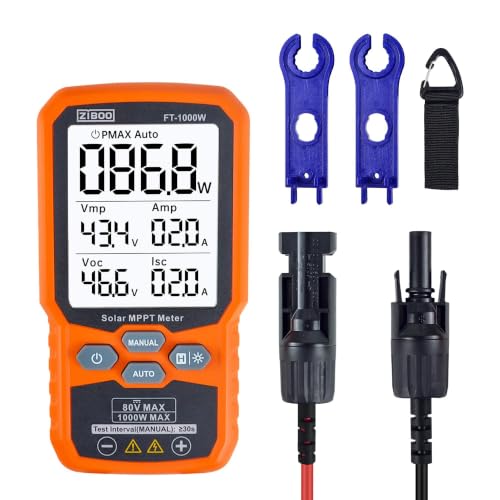
- Measures Pmax, Voc, and Isc up to 1000W
- Real-time MPPT tracking helps spot shading and degradation
- Backlit LCD, data hold, and IP54-rated durability
Best For: Inspectors and solar techs needing a rugged, safety-rated PV tester
Graphical Diagnostic Pick
FLIR PV48 Solar Panel Tester and I-V Curve Tracer

- Reads maximum power, temperature, and I-V curve data
- High-contrast LCD is readable in sun or shade
- Includes MC4 plugs and clips for troubleshooting
Best For: Inspectors who want graphical diagnostics and easy outdoor readability
Battery-Free Field Tool

- Measures Pmax, Voc, and Isc up to 800W/60V
- Runs directly from the panel with no battery required
- Large LCD and built-in protection for field use
Best For: Inspectors wanting a lightweight, battery-free PV tester
High-Range Performance Meter
UNI-T Solar Panel Tester 2000W

- Supports Pmax up to 2000W with Voc to 150V
- Shows Pmax, Vmp, Imp, Voc, and Isc on one screen
- Includes MC4 leads, clips, and built-in protection
Best For: Inspectors handling larger PV systems that need more measurement headroom
Premium High-Voltage PV Analyzer
UNI-T UT673PV Solar Panel Tester

- Measures Pmax, Vmp, Imp, Voc, and Isc
- Large screen shows results simultaneously
- Self-powered with multiple safety protections
Best For: Inspectors needing broad PV diagnostics and portable field use
Rechargeable Field Reporter
XUNTOP 2000W Solar Panel Tester

- Measures Pmax, Voc, Isc, Vmp, and amp
- Saves up to 30 test entries
- Rechargeable battery lasts up to 15 hours
Best For: Field inspectors who want rechargeable, data-saving testing
Budget Compact PV Checker

- Measures Pmax, Voc, and Isc
- Large LCD is easy to read outdoors
- No battery required and includes MC4 tools
Best For: Basic inspections under 800W and 60V
Editor’s Pick
Accurate Solar Panel Tester with MPPT

- Measures Pmax, Voc, and Isc with MPPT tracking.
- MC4 plug-and-play setup with auto/manual modes.
- 3.2-inch LCD stays readable in sunlight.
Best For: Inspectors needing a simple portable tester for quick solar checks.
Value Choice
EY800W Solar Panel Meter with Auto MPPT

- Auto/manual MPPT detection for flexible readings.
- Powered by the solar panel; no battery needed.
- Large LCD stays readable in bright sunlight.
Best For: Moderate-size portable and residential panel checks.
Field Ready
1800W Smart Photovoltaic Multimeter

- Wide 5W–1800W, 20V–120V, 0A–60A range.
- Reads Pmax, Voc, and Isc in real time.
- Portable kit includes EVA case and clips.
Best For: Higher-capacity residential and mixed solar system inspections.
Professional PV Tester – ZIBOO FT-1000W Solar Panel Tester MPPT Meter
If you want solar panel testers for home inspectors that can also handle serious field verification, the ZIBOO FT-1000W is built for measuring PV output quickly and safely. It reads Pmax, Voc, and Isc on a single tool, with real-time MPPT tracking that helps spot shading or degradation issues during on-site inspections.
Best For: Home inspectors or solar techs who need a rugged tester for higher-output PV checks and performance validation.
Pros:
- Measures up to 1000W with Voc from 12-80V and Isc up to 35A.
- Real-time MPPT tracking helps identify panel degradation or shading issues.
- Backlit LCD and data hold make readings easier in dark rooftop environments.
- CAT III 1000V / CAT IV 600V rating with IP54 dust and water resistance.
Cons:
- Best suited to PV professionals; the feature set is more advanced than a basic homeowner meter.
- Accuracy and setup may be overkill for quick, low-detail spot checks.
Overall, this is a strong choice if your inspection work demands a durable tester with safety-focused design and enough range for serious PV diagnostics. It leans more professional than simple, but that is exactly why it stands out for thorough solar checks.
Graphical Diagnostic Pick – FLIR PV48 Solar Panel Tester and I-V Curve Tracer
The FLIR PV48 is a practical pick among solar panel testers for home inspectors who want more than a basic voltage reading. It provides instant maximum power, temperature, and I-V curve data, making it easier to assess panel performance and troubleshoot issues with a clear visual readout.
Best For: Inspectors and solar technicians who want graph-style diagnostics and direct-sunlight readability.
Pros:
- Shows maximum power, temperature, and I-V curve tracing for panel assessment.
- High-contrast large LCD is designed to be readable in direct sunlight or shade.
- Includes MC4 PV plugs and clips for diagnosing and troubleshooting panels.
- Built-in lithium battery supports portable field use.
Cons:
- Panel power support tops out at 800W per panel.
- It is a more specialized diagnostic tool than a simple all-purpose multimeter.
If your inspection workflow benefits from graphical data rather than just pass/fail numbers, the PV48 is a very useful field tool. Its readability and curve-tracing focus make it especially helpful when you need to explain panel behavior on the spot.
Battery-Free Field Tool – UT673PV Solar Panel Tester
For solar panel testers for home inspectors who need a simple, portable meter, the UT673PV focuses on quick PV checks without extra setup. It measures Pmax, Voc, and Isc on a single screen, and because it runs directly from the panel, it is handy for longer on-site testing.
Best For: Inspectors and solar professionals who want a lightweight tester that does not need a battery.
Pros:
- Measures up to 800W and 60V with Pmax, Voc, and Isc shown together.
- No battery required; it powers directly from the solar panel.
- Large LCD is easy to read even in bright sunlight.
- Includes over-voltage, over-temperature, over-current, and over-rated power protection.
Cons:
- Supports parallel testing, but not series connections.
- Lower power and voltage limits than some higher-capacity testers.
The UT673PV is a straightforward choice when portability and convenience matter more than advanced features. It is well suited to routine checks, especially if you want a meter that stays simple in the field.
High-Range Performance Meter – UNI-T Solar Panel Tester 2000W
The UNI-T solar power meter is built for bigger PV jobs, making it a strong option in solar panel testers for home inspectors who encounter higher-output systems. It shows Pmax, Vmp, Imp, Voc, and Isc on one screen, which makes it easier to judge panel health and fault conditions during inspections.
Best For: Inspectors and installers who need a high-range tester for larger PV arrays and more detailed checks.
Pros:
- High range supports Pmax from 60-2000W, Voc from 12-150V, and Isc from 5-45A.
- Displays Pmax, Vmp, Imp, Voc, and Isc together for fast analysis.
- Includes reverse polarity, over-temperature, and drop-proof protection.
- Comes with MC4 test leads, alligator clips, a wrench tool, strap, and batteries.
Cons:
- More capacity than many basic inspection tasks require.
- Battery-powered design adds another component to manage in the field.
When you need extra measurement headroom for larger or higher-voltage PV systems, this UNI-T meter is a sensible choice. It combines a broad measurement range with a clear display and practical protection features for routine field work.
Premium High-Voltage PV Analyzer – UNI-T UT673PV Solar Panel Tester
If you need solar panel testers for home inspectors who want a fuller picture of PV performance, the UNI-T UT673PV is built for broad diagnostic coverage. It measures Pmax, Vmp, Imp, Voc, and Isc, then shows the results together on a large screen, making it easier to spot panel abnormalities during on-site checks.
Best For: Home inspectors or PV technicians who want a portable, self-powered tester with wide measurement coverage and strong protection features.
Pros:
- Measures maximum power, peak voltage, peak current, open circuit voltage, and short circuit current.
- Large display shows all measurement results simultaneously for faster field review.
- No batteries needed; it is powered by the solar panel and includes an MC4 test lead.
- Multiple protections include reverse polarity, over-voltage, over-current, over-temperature, and over-power safeguards.
Cons:
- The listed CAT 0 60V MC4 test lead rating may not suit every higher-voltage inspection job.
- Its advanced feature set may be more than basic users need for simple panel checks.
Overall, this is a strong choice when you want a feature-rich solar panel tester that emphasizes complete PV diagnostics and convenient field use. The multilingual interface and automatic measurement modes add flexibility for repeat inspections.
Rechargeable Field Reporter – XUNTOP 2000W Solar Panel Tester
Among solar panel testers for home inspectors, the XUNTOP 2000W model stands out for its data-saving workflow and long runtime. It measures Pmax, Voc, Isc, Vmp, and amp with MPPT support, and its auto/manual modes help streamline quick on-site testing and reporting.
Best For: Inspectors or solar professionals who want rechargeable convenience, data storage, and built-in safety protections for field testing.
Pros:
- Measures Pmax, Voc, Isc, Vmp, and amp with 200 sampling points for more reliable readings.
- Stores up to 30 test entries and supports automatic or manual measurement modes.
- Built-in 1250mAh battery can run up to 15 hours and charges via Type-C.
- Includes over-voltage, over-current, reverse polarity, and over-temperature protection with automatic disconnect warnings.
Cons:
- It is rated for up to 90V and 2000W, so it is not the highest-capacity option here.
- The notes say the tester does not have backlight or brightness adjustment.
This is a practical pick if you value portability and recordkeeping more than maximum voltage range. The rugged TPR casing, flashlight, and EVA storage box make it a solid field companion for inspections and troubleshooting.
Budget Compact PV Checker – 800W MPPT Solar Panel Tester
If you are comparing solar panel testers for home inspectors and want a simpler option, the FROGBRO FB673PV keeps the focus on the essentials. It measures Pmax, Voc, and Isc, works without a battery, and uses a large LCD screen so readings stay easy to see in bright outdoor conditions.
Best For: Buyers who need a lightweight, no-battery solar tester for basic panel verification under 800W and 60V.
Pros:
- Measures Pmax, Voc, and Isc simultaneously for fast basic checks.
- Large LCD screen improves readability in bright sunlight.
- No battery required; it runs directly from the solar panel.
- Includes MC4 cables and an MC4 connector wrench for ready-to-use setup.
Cons:
- Limited to 800W and 60V, so it is not suited to higher-output systems.
- Does not measure the wider set of values found on more advanced testers.
- Cannot measure multiple solar panels connected in series.
For basic inspection work, this model offers a straightforward way to confirm panel output without extra complexity. Its multi-protection design and light weight make it a sensible entry-level tool for quick PV checks.
Editor’s Pick – Accurate Solar Panel Tester with MPPT
If you need solar panel testers for home inspectors that can deliver quick, practical readings, this MPPT solar power meter is built for straightforward field checks. It measures Pmax, Voc, and Isc, and the built-in MPPT tracking helps provide reliable performance data for solar panel testing, troubleshooting, and system optimization.
Best For: Home inspectors and field users who want a simple, portable tester with clear solar output readings.
Pros:
- Measures Pmax, Voc (3–90V), and Isc (0–40A) with built-in MPPT tracking.
- MC4 plug-and-play setup with auto and manual modes.
- Large 3.2-inch LCD is designed to stay readable in direct sunlight.
- Multi-protection design includes over-voltage, over-current, reverse polarity, and overheating protection.
Cons:
- Voltage and current limits may be too narrow for larger systems.
- Focused on panel testing rather than broader electrical diagnostics.
For inspectors who want a portable, easy-to-use tester for on-site solar checks, this model covers the core readings without a complicated setup. Its sunlight-readable display and protective features make it a practical choice for routine inspections.
Value Choice – EY800W Solar Panel Meter with Auto MPPT
For solar panel testers for home inspectors who want a compact meter that powers itself from the panel, the EY800W keeps the workflow simple. It supports auto and manual MPPT detection, measures panels up to 800W and 60V, and uses a large LCD that remains clear in sunlight.
Best For: Inspectors checking portable, foldable, roof, RV, boat, and kit-style solar panels up to moderate size.
Pros:
- Auto and manual MPPT detection for flexible testing.
- Measures solar panels up to 800W and 60V.
- No battery required; it is powered by the connected solar panel.
- Large LCD is designed for clear outdoor reading.
Cons:
- Power and voltage limits exclude larger installations.
- Best suited to panel-level testing rather than full-system analysis.
This is a smart pick for inspectors who need a lightweight solar meter for common residential and portable setups. Its self-powered design and broad protection features make it convenient for quick job-site checks.
Field Ready – 1800W Smart Photovoltaic Multimeter
Among solar panel testers for home inspectors, this 1800W meter stands out for its wider measurement range and portable build. It measures power, voltage, and current across larger PV setups, while the sunlight-readable LCD and no-battery design keep on-site testing efficient.
Best For: Inspectors who need a portable tester for higher-capacity residential and mixed-use solar systems.
Pros:
- Wide measurement range covers 5W–1800W, 20V–120V, and 0A–60A.
- Captures Pmax, Voc, Isc, and other performance data in real time.
- Lightweight design includes EVA case plus MC4 and alligator clip accessories.
- Built-in protections include overvoltage, overheat, overcurrent, and reverse polarity.
Cons:
- Still limited to 120V maximum operating voltage.
- More functionality may be more than needed for very basic spot checks.
If your inspection work includes larger residential arrays or mixed solar applications, this tester offers more headroom than smaller models. Its portable form factor and wide compatibility make it useful for regular field diagnostics.
How We Picked These Solar Panel Testers for Home Inspectors
We prioritized tools that make sense in real inspection work: readable screens, useful MPPT testing, dependable Voc/Isc measurement, and enough electrical headroom for common residential PV systems. We also looked for safer handling features such as reverse-polarity and overcurrent protection, since home inspectors need tools that reduce risk while speeding up basic diagnostics.
Quick Comparison: What Matters Most
If you are comparing Solar Panel Testers for Home Inspectors, the most important differences usually come down to power range, supported voltage and current, display clarity, and whether the tester can help identify mismatch or performance problems quickly. Higher-wattage models are typically better for larger arrays, while compact testers are often easier to carry from roof to roof and use during walk-throughs.
At-A-Glance Priorities
- Accuracy: Look for reliable Voc, Isc, and MPPT-based readings.
- Range: Make sure the tester can handle the system sizes you inspect most often.
- Display: A large, high-contrast LCD reduces errors in bright outdoor conditions.
- Protection: Overvoltage, overcurrent, and reverse-polarity protection improve field safety.
- Portability: Lightweight, compact testers are easier to carry and deploy quickly.
Key Buying Factors for Solar Panel Testers for Home Inspectors
Start with the electrical specs. If you regularly inspect residential arrays, a tester with enough voltage and current range for modern panel strings is essential. An MPPT-capable meter is useful because it can help determine maximum power output instead of relying only on open-circuit readings.
Next, consider the display and workflow. A clear LCD, intuitive controls, and fast readings matter when you are documenting findings on-site. If you inspect in harsh sunlight or time-sensitive conditions, a unit that is easy to read and simple to operate will save time.
Safety should come next. Features like reverse-polarity protection and overvoltage safeguards are especially valuable for less predictable field conditions. For home inspectors who work around varied rooftop and ground-mount systems, this can help prevent equipment damage and reduce operational mistakes.
Who Should Buy Which Solar Panel Testers for Home Inspectors?
Choose a compact mid-range tester if you mainly need quick confirmation of panel health, string voltage, and basic performance checks during routine home inspections. Pick a higher-capacity model if you often encounter larger residential or light-commercial arrays and want more measurement headroom.
If you need the most advanced diagnostics, a premium tester with I-V curve tracing and temperature measurements is the best fit. That level of detail is especially useful when you want deeper performance analysis or more complete documentation for clients. In short, the best Solar Panel Testers for Home Inspectors are the ones that balance accuracy, safety, and portability for the systems you see most often.