Thermal imaging cameras can reveal heat loss, moisture patterns, overloaded circuits, insulation gaps, and HVAC problems that are difficult to spot with the naked eye. The right model can make routine home inspections faster and help you investigate potential issues without opening walls or ceilings.
Our roundup compares 10 handheld options across image resolution, temperature range, display quality, battery life, measurement tools, and inspection-friendly features. Whether you are a professional inspector, contractor, or careful homeowner, this guide can help you choose a practical camera for your workload and budget.
Best 10 Thermal Imaging Cameras for Home Inspections Picks for 2026
Top Pick

- Large 3.5-inch display with enhanced thermal resolution
- 64GB storage and Wi-Fi reporting support
- IP54-rated, drop-resistant field design
Best For: Home inspectors who want easy viewing and efficient documentation
High-Resolution Choice

- Enhanced 512×384 thermal resolution with 25Hz refresh
- Up to 10.5 hours of battery life
- Wi-Fi, USB analysis, voice notes, and QR file management
Best For: Professionals needing detailed diagnostics and long field runtime
PC Analysis Pick

- 320×240 display with TISR enhancement
- Windows software supports analysis and report generation
- Over 20,000-image internal storage capacity
Best For: Windows users who need detailed post-inspection analysis
Best Overall

- 320×240 display with 240×180 TISR imaging
- Windows analysis software and 8GB storage
- -4°F to 1022°F range with temperature alarms
Best For: Detailed home inspections and report-based analysis
Best for Visual Fusion
- 240×240 TISR with 2MP visible-light camera
- Thermal, fusion, and conventional viewing modes
- Up to 8 hours of runtime with IP54 protection
Best For: Inspections that benefit from thermal and visible imagery
Best Battery Life

- 240×240 TISR resolution at 25Hz
- Up to 24 hours of continuous working time
- IP65 protection and 6.56-foot drop resistance
Best For: Extended inspections and demanding field use
Best Rugged Choice
FLIR TG165-X Thermal Imaging Camera

- MSX-enhanced thermal images
- Bullseye laser marks the measurement area
- IP54, drop-tested construction
Best For: Durable, everyday home inspection work
Best High-Temperature Range
Flagfront YXI96 Thermal Camera

- 240 × 240 super-resolution imaging
- Temperature range up to 1,022°F
- Alarms and six color palettes
Best For: Detailed, varied inspection applications
Best for Long Inspection Sessions

- 8-hour battery and 8GB storage
- Adjustable emissivity and temperature alarms
- 192 × 192 resolution at 25Hz
Best For: Extended inspections and extensive photo capture
Top Pick – TOPDON TC004
For home inspectors who want a large screen and straightforward documentation, the TOPDON TC004 is a capable choice among thermal imaging cameras for home inspections. Its enhanced thermal resolution, laser pointer, generous storage, and wireless transfer support efficient fieldwork.
Best For: Home inspectors who prioritize easy viewing, image storage, and wireless reporting.
Pros:
- 3.5-inch display provides a comfortable view of temperature differences.
- 256×192 infrared resolution can be enhanced up to 512×384 with TISR.
- 64GB storage, Wi-Fi transfer, and an integrated LED light support all-day inspections.
- IP54 protection and 2-meter drop resistance suit routine field use.
Cons:
- The camera weighs 2.11 pounds, which may feel substantial during extended scanning.
- Its listed battery specification is a single included A battery, so charging expectations should be checked before fieldwork.
The TC004 stands out as a balanced documentation-focused option. The large display and built-in storage simplify on-site review, while Wi-Fi and the TopInfrared app can make follow-up reporting more efficient.
High-Resolution Choice – Thermal Master Thor002
The Thermal Master Thor002 is a feature-rich option for thermal imaging cameras for home inspections, combining enhanced 512×384 thermal resolution with a visible-light camera, long battery life, and flexible connectivity. Its measurement tools are suited to inspectors who want detailed diagnostics in a handheld format.
Best For: Professionals handling detailed building, HVAC, electrical, and mechanical inspections.
Pros:
- X³ technology enhances thermal resolution from 256×192 to 512×384.
- Offers a 25Hz refresh rate, 40mK sensitivity, and six-point temperature measurement.
- 5000mAh battery provides up to 10.5 hours of operation and supports 18W fast charging.
- Wi-Fi, USB analysis, voice notes, QR file management, and 32GB storage aid reporting.
Cons:
- At 3.12 pounds, it is heavier than the other listed handheld options.
- The feature set may be more than casual homeowners need for occasional checks.
Thor002 is the strongest fit when image detail, measurement flexibility, and documentation tools matter more than compactness. Its long runtime also helps reduce interruptions during larger inspection days.
PC Analysis Pick – FOXWELL HT280
The FOXWELL HT280 brings useful computer-based analysis to thermal imaging cameras for home inspections. Its 320×240 display, TISR enhancement, temperature alarms, broad field of view, and Windows software make it practical for reviewing and documenting building issues.
Best For: Inspectors who want Windows-based analysis, report generation, and extensive internal storage.
Pros:
- 320×240 display with TISR enhancement to 260×260 provides added image detail.
- Windows software supports point, line, and area analysis, 2D/3D views, and reports.
- Stores over 20,000 images or video recordings in internal memory.
- Temperature alarms, nine color palettes, and a 50°×50° field of view aid scanning.
Cons:
- PC analysis is compatible with Windows but not Mac.
- The measurement range tops out at 932°F, lower than some alternatives listed here.
- The supplied notes indicate an 8-hour continuous operating time, shorter than the longest option.
HT280 is a sensible choice for a Windows-centered workflow. Its software and storage capacity are especially useful when inspection findings need more detailed analysis or formal reporting after the site visit.
Smart Detection Pick – HF96 Thermal Camera
The HF96 adds AI-assisted scene recognition to the core functions expected from thermal imaging cameras for home inspections. It combines automated hot- and cold-spot tracking with live super-resolution enhancement, a laser pointer, long battery life, and Windows analysis software.
Best For: Home energy checks involving insulation gaps, HVAC issues, heat loss, and suspected water leaks.
Pros:
- IntellFault scene recognition is designed to help identify water leaks and insulation gaps.
- Live enhancement produces 240×240 thermal images with below-50mK sensitivity and a 25Hz refresh rate.
- Up to 11 hours of operation and storage for over 30,000 images support extended inspections.
- Windows software offers image analysis, screen projection, real-time monitoring, and 3D plotting.
Cons:
- The device does not provide moisture readings, despite its leak-detection scene feature.
- The listed compact dimensions may still be less convenient than a pocket-sized thermal accessory.
- Its scene-recognition features require a firmware download and setup through the manufacturer’s website.
HF96 is appealing for inspectors who want automated assistance without giving up manual controls. It can help prioritize likely anomalies, but its lack of moisture measurement means suspected leaks still require separate verification.
Best Overall – FOXWELL RT280
For shoppers comparing thermal imaging cameras for home inspections, the FOXWELL RT280 stands out with a large 320×240 display, enhanced 240×180 TISR imaging, and tools for documenting and analyzing inspection findings.
Best For: Home inspectors and maintenance professionals who want PC-based analysis, extensive storage, and broad temperature coverage.
Pros:
- 320×240 display with 240×180 TISR effective resolution and a smooth 25Hz frame rate.
- Measures from -4°F to 1022°F with high, low, and center-point tracking plus alarms.
- Includes Windows PC software for point, line, area, 2D/3D, and report analysis.
- Stores more than 20,000 images and videos on built-in 8GB eMMC storage.
Cons:
- PC analysis software is not compatible with Mac.
- Its 2.8-inch display may feel small for users who prefer a larger viewing area.
The RT280 is a well-equipped choice for detailed inspections, especially when organized records and post-inspection reporting matter. Its laser, LED light, rugged housing, and nine palettes add practical field flexibility.
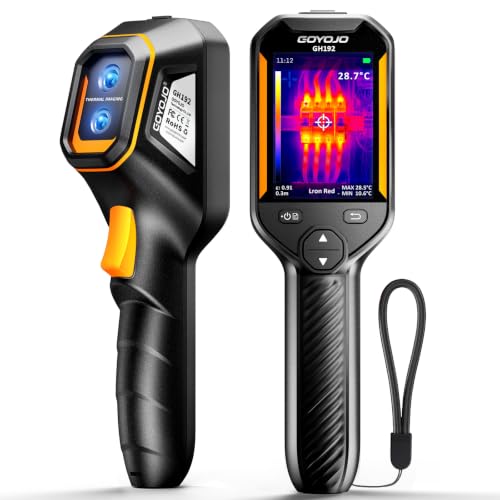
Best for Visual Fusion – GH192 Thermal Imaging Camera
The GH192 is a practical option among thermal imaging cameras for home inspections when identifying the physical location of a heat issue matters. Its thermal and 2MP visible-light cameras combine with fusion imaging to help outline targets during inspections.
Best For: HVAC, electrical, mechanical, and home inspections requiring thermal, conventional, and fusion viewing modes.
Pros:
- 240×240 TISR thermal resolution, 2MP visible camera, and 25Hz refresh rate.
- Offers thermal, conventional-light, and fusion image modes with six color palettes.
- Tracks center, minimum, and maximum temperatures and provides high- and low-temperature alarms.
- Provides up to eight hours of runtime, USB-C charging, IP54 protection, and 6.6-foot drop resistance.
Cons:
- File Transfer must be enabled in settings before exporting images.
- Its stated temperature accuracy is ±2°C, which may be less precise than some specialized instruments.
The GH192 balances inspection-focused imaging with portability and straightforward temperature tracking. Adjustable emissivity and object distance support readings across materials such as wood and brick.
Best Battery Life – AMPBANK H128 Thermal Camera
For extended jobs, the AMPBANK H128 is a compelling entry in thermal imaging cameras for home inspections. It combines 240×240 TISR imaging, 25Hz performance, and a claimed 24-hour battery life with a durable IP65-rated design.
Best For: Long inspection sessions, routine maintenance, and users who prioritize battery endurance and rugged protection.
Pros:
- Enhances 128×128 imaging to 240×240 TISR resolution with 40mK thermal sensitivity.
- Offers up to 24 hours of continuous working time with rechargeable power.
- Supports distance and emissivity adjustments for materials such as concrete and brick.
- Includes temperature alarms, max/min/center tracking, IP65 protection, and 6.56-foot drop resistance.
Cons:
- The supplied notes do not specify a visible-light camera or PC analysis software.
- Its stated measurement accuracy is within ±2%, so material and setup adjustments remain important.
The H128 is especially appealing when recharging opportunities are limited. Its compact body, tripod mount, long battery claim, and stronger IP65 protection make it suited to demanding inspection routines.
Best Rugged Choice – FLIR TG165-X Thermal Imaging Camera
For thermal imaging cameras for home inspections, the FLIR TG165-X combines a 4,800-pixel infrared camera with MSX image enhancement, helping make thermal patterns easier to interpret. Its Bullseye laser indicates the measurement area, while the rugged IP54, drop-tested design suits regular field use.
Best For: Home inspectors who want a durable, straightforward camera for locating temperature differences and documenting findings.
Pros:
- MSX overlays visual details onto thermal images for clearer interpretation.
- Measures temperatures from -13°F to 572°F.
- Bullseye laser helps identify the measurement area.
- Includes a rechargeable battery, USB-C cable, carry pouch, and a 2-10-year warranty.
Cons:
- Its 4,800-pixel infrared resolution is lower than the other listed cameras.
- Temperature response time is listed as 3 seconds.
The TG165-X is a practical pick when durability and easy-to-read thermal images matter more than high-resolution imaging. Its broad warranty coverage and protective enclosure add reassurance for frequent inspection work.
Best High-Temperature Range – Flagfront YXI96 Thermal Camera
The Flagfront YXI96 is one of the more versatile thermal imaging cameras for home inspections, offering 240 × 240 super-resolution imaging and a 25Hz refresh rate. Its temperature alarm, adjustable measurement settings, and wide operating range support inspections involving plumbing, vehicles, and electrical components.
Best For: Users who want higher thermal resolution, broad temperature coverage, and multiple viewing options in a handheld camera.
Pros:
- 240 × 240 super-resolution imaging captures added detail.
- Measures from -4°F to 1,022°F with claimed accuracy within 2%.
- Temperature alarms and highest, lowest, and center readings help flag anomalies.
- Offers a 50° field of view and six selectable color palettes.
Cons:
- The supplied details do not list battery life or onboard storage capacity.
- Its feature set may be more than needed for simple temperature checks.
Choose the YXI96 if inspection flexibility is a priority. The higher resolution, broad temperature range, and alarm functions make it well suited to scanning varied surfaces and quickly identifying unusual heat or cold.
Best for Long Inspection Sessions – MILESEEY TR10 Thermal Camera
The MILESEEY TR10 is a capable option among thermal imaging cameras for home inspections, pairing 192 × 192 infrared resolution with a smooth 25Hz refresh rate. Adjustable emissivity, temperature alarms, and automatic maximum, minimum, and center readings help make surface comparisons and anomaly detection more dependable.
Best For: Inspectors who value extended battery operation, onboard image storage, and configurable temperature measurements.
Pros:
- 192 × 192 resolution and NETD below 50mK support detailed thermal viewing.
- Provides a -4°F to 1,022°F range with stated ±2°C accuracy.
- 8-hour battery life and 8GB storage for more than 30,000 pictures.
- 6.6-foot drop-tested design with recessed lens protection.
Cons:
- Its infrared resolution is lower than the Flagfront YXI96.
- The supplied details identify wired connectivity but do not specify wireless transfer.
The TR10 stands out for inspectors who need to work for long periods without frequent charging or downloading. Its adjustable emissivity and alarm features add useful control when assessing different building materials and potential hot spots.
How We Picked the Best Thermal Imaging Cameras for Home Inspections
We focused on features that matter during real inspections rather than headline specifications alone. The comparison considers infrared resolution, image clarity, temperature-measurement range, refresh rate, visual-camera integration, display size, battery endurance, storage, portability, and useful tools such as laser pointers, image fusion, alarms, and emissivity controls.
We also considered how easily each camera can support common inspection tasks, including locating missing insulation, checking electrical panels, tracing HVAC performance, spotting plumbing temperature differences, and investigating possible moisture-related patterns. Thermal images indicate temperature differences; they do not independently confirm mold, leaks, structural defects, or electrical safety problems.
Quick Comparison
For the clearest images, prioritize higher infrared resolution and a dependable refresh rate. Models with 320 × 240 or 512 × 384 sensors generally show more detail than 192 × 192 or 240 × 240 options, especially when inspecting larger areas or viewing targets from farther away. A visual camera and fusion mode can make thermal findings easier to interpret and document.
For broad temperature testing, check the stated operating range and measurement accuracy rather than relying on resolution alone. Laser pointers help identify the measured area, while alarms and center-spot readings can speed up routine checks. Longer battery life is particularly valuable for professionals working through several properties in one day.
Key Buying Factors for Thermal Imaging Cameras for Home Inspections
Resolution and Image Detail
Higher resolution helps distinguish small temperature anomalies and improves confidence when examining walls, windows, outlets, pipes, and mechanical components. Choose the highest practical resolution within your budget, but remember that focus, distance, emissivity, and viewing conditions also affect results.
Temperature Range and Accuracy
A wide range is useful for HVAC, electrical, and appliance checks, but accuracy and repeatability matter more for most residential work. Look for adjustable emissivity, reflected-temperature settings, and clearly documented accuracy specifications.
Documentation and Ease of Use
A bright screen, simple controls, onboard storage, USB transfer, and a visible laser can make fieldwork more efficient. Image fusion or a built-in visual camera is helpful when reports need to show exactly where a thermal anomaly was found.
Battery, Durability, and Ergonomics
Consider rated battery life, charging time, grip comfort, protective construction, and whether the camera can withstand the dust and handling common on job sites. A compact unit may be preferable for occasional homeowners, while professionals may benefit from a larger display and longer runtime.
Who Should Buy Which Thermal Imaging Cameras for Home Inspections?
Homeowners and occasional DIY users: Choose a straightforward, compact camera with a clear screen, basic temperature readings, and a useful laser pointer. You may not need advanced reporting features.
Professional home inspectors: Prioritize higher resolution, visual or fusion imaging, reliable storage, adjustable measurement settings, and enough battery life for multiple properties.
HVAC and electrical contractors: Look for a broad temperature range, fast refresh rate, accurate spot measurements, alarms, and a durable design suited to frequent troubleshooting.
Value-focused buyers: A 240 × 240-class camera can provide a useful balance of detail and cost for general residential checks. Buy the model that offers the controls and documentation features you will actually use, not merely the largest advertised number.