Refoss Smart Home Energy Monitor review is for buyers who want circuit-level visibility, local control, and automation-ready energy data.
If you are comparing whether the Refoss Smart Home Energy Monitor is worth it, the answer depends on how much you value privacy, load tracking, and solar-aware management.
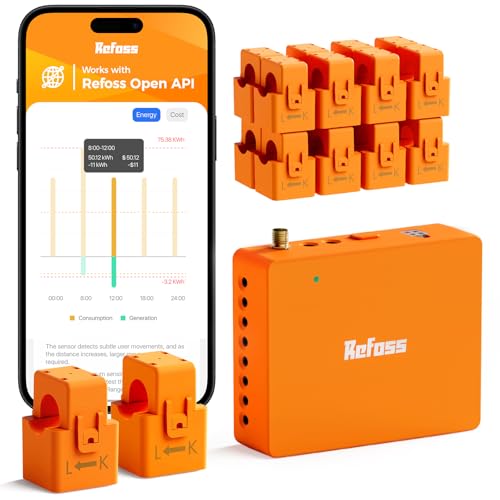
Refoss Energy Monitor Review Summary
The Refoss Smart Home Energy Monitor is a serious fit for homeowners who want to see where electricity goes instead of guessing from a monthly bill.
It is especially compelling if you already use Home Assistant, prefer local-first hardware, or want a monitor that can help you manage solar production, peak usage, and appliance-level waste without tying your data to a cloud-only workflow.
This is not a casual plug-in gadget; it is a whole-home monitoring tool for people who want actionable data.
What stands out in the listing is the combination of 18 monitored circuits, local web UI access, open API support, MQTT, WebSocket integration, and 5 years of stored daily data.
That makes it a better fit for serious energy tracking than a basic smart plug setup.
It also supports single-phase, split-phase, and 3-phase 4-wire Wye systems, which broadens the type of homes and installations it can serve.
The main drawback is the same thing that makes it powerful: this is an installation-heavy product aimed at buyers who are comfortable opening a breaker panel or hiring help.
If you only want a quick consumer gadget, this is likely too much hardware.
But if you want fine-grained insight, local privacy, and long-term usage data, it is well positioned.
Review Scorecard
| Category | Score | Editorial assessment |
|---|---|---|
| Circuit-level visibility | 9/10 | Tracks 18 individual circuits, which is the core reason to buy it. |
| Local control and privacy | 10/10 | Built-in local web UI, open API, MQTT, and WebSocket reduce cloud dependence. |
| Solar and load management | 9/10 | Designed to help direct surplus solar and improve self-consumption. |
| Setup complexity | 6/10 | Capable hardware, but the breaker-box installation will not suit every buyer. |
| Data depth and retention | 9/10 | Minute through yearly views plus 5 years of daily data and CSV export. |
| Compatibility | 8/10 | Supports common residential systems and Home Assistant integration. |
| Practical buyer value | 8/10 | Strong value if you will actually use the data to change habits or automate loads. |
Key Features and Specifications of Refoss Energy Monitor
The Refoss system is built around a whole-home monitoring approach rather than a single-device dashboard.
The listing describes 2 main sensors rated up to 200A and 16 branch sensors rated up to 60A, which gives you a broad view of usage across multiple circuits.
That matters if you want to isolate HVAC, kitchen appliances, laundry loads, or other major consumers.
It also emphasizes local operation.
According to the listing, the monitor includes a built-in Local Web UI, Open API, MQTT, and WebSocket support.
In practical terms, that means it is designed to integrate into a home automation stack instead of forcing you into a closed app experience.
The Home Assistant compatibility via Refoss_RPC is a meaningful benefit for buyers who want energy data to trigger automations.
Other useful evidence-backed details:
- Supports single-phase, split-phase, and 3-phase 4-wire Wye systems
- Records usage by minute, hour, day, week, month, and year
- Stores daily data securely for 5 years
- Supports CSV export without a subscription
- Includes smart alerts for unusual appliance consumption
- Uses an external high-gain antenna for Wi-Fi stability
- ETL certified
- Includes a 2-year warranty
- Lets you flip sensor readings in the app if one is installed backward
The solar angle is another major part of the pitch.
Refoss says the monitor can help direct surplus solar and net metering energy toward medium-power appliances, improve self-consumption, and reduce low-value grid feed-in.
If you have solar, that kind of control can be more valuable than raw monitoring alone because it ties data to decisions.
Pros and Cons of Refoss Energy Monitor
Pros
- Detailed circuit-level insight across 18 monitored circuits
- Strong local privacy story with local UI, API, MQTT, and WebSocket support
- Home Assistant integration for automation-minded users
- Long-term retention with 5 years of daily data and CSV export
- Solar-aware features for households trying to use their own generation more efficiently
- Flexible installation support across common residential electrical systems
- Practical troubleshooting tools like smart alerts and invertable sensor readings
Cons
- Installation is not trivial and may require comfort around breaker-panel hardware
- Likely overkill for renters or casual users
- The value depends on actionability; if you will not change habits or automate loads, much of the capability goes unused
- Branch-sensor setup adds complexity compared with simpler whole-home meters
Who Should Buy Refoss Energy Monitor?
This product makes the most sense for homeowners who want real energy management, not just a rough sense of monthly usage.
It is a strong fit for people with solar panels, anyone trying to reduce peak demand, and buyers who already use Home Assistant or want a local-first smart home stack.
It also suits households that suspect specific appliances are driving bills higher.
The combination of branch-level monitoring and smart alerts can help identify an aging fridge, a failing washer, or a circuit that is using more power than expected.
If your goal is to catch waste early, this kind of visibility is useful.
Skip it if you want a simple, low-effort product.
Apartment dwellers, renters, and buyers who do not want to work inside a live electrical panel should look elsewhere.
If you only need a basic energy estimate, this is more hardware than you need.
Refoss Energy Monitor for Local Energy Management
Privacy-First Monitoring
The strongest theme in the listing is local ownership of data.
A built-in local web interface, open API, MQTT, and WebSocket support make the monitor attractive to buyers who dislike cloud dependence.
That is a meaningful differentiator because energy data is often sensitive and highly personal.
Circuit Tracking and Alerts
Monitoring 18 individual circuits is what turns this from a broad dashboard into a practical diagnostic tool.
The smart alert system adds another layer by calling out unusual consumption, which is useful when an appliance starts behaving badly or a circuit is drawing more than expected.
Solar and Load Shifting
For solar homes, the monitor is positioned as a way to improve self-consumption and guide surplus energy toward useful loads.
That is more valuable than raw monitoring alone because it connects measurement to operational decisions.
If you already think in terms of peak hours, net metering, and load shifting, this feature set is relevant.
Data History and Reporting
The five-year daily storage claim and CSV export support long-horizon analysis.
That matters for users who want to compare seasons, spot gradual changes, or keep records for tuning automations over time.
Short-term graphs are nice; long-term history is what helps you prove whether a change actually reduced usage.
Alternatives to Refoss Energy Monitor
If you want a more established whole-home energy monitoring ecosystem, consider a Sense Home Energy Monitor or an Emporia Vue energy monitor.
Both are credible alternatives for buyers comparing whole-home visibility and app-driven tracking.
If your priority is residential solar and panel-level monitoring, an Efergy energy monitor or other smart electrical monitoring systems may also be worth comparing, especially if your installation and data needs are simpler than full local API control.
If you want fewer parts and a lower-complexity path, smart plug ecosystems such as TP-Link Kasa energy monitoring plugs can cover a limited set of devices.
They will not replace whole-panel insight, but they are easier to deploy.
Is Refoss Energy Monitor Worth It?
Yes, if you want serious circuit-level energy tracking and will use the data to make decisions.
The Refoss Smart Home Energy Monitor is worth considering for homeowners who value local control, Home Assistant integration, solar optimization, and long-term reporting more than simplicity.
It is not the right buy for everyone.
If you do not want to work near your breaker panel, or if you only need a simple view of household consumption, the install and feature depth may be excessive.
For privacy-minded, automation-heavy, and solar-aware buyers, it is a strong and sensible choice.