Hydroelectric power remains the world’s largest source of renewable electricity and a critical flexibility resource for power systems. The sector’s output can swing year to year with hydrology (rainfall, snowpack, drought), while pumped storage hydropower (PSH) is growing in importance as grids add more wind and solar.
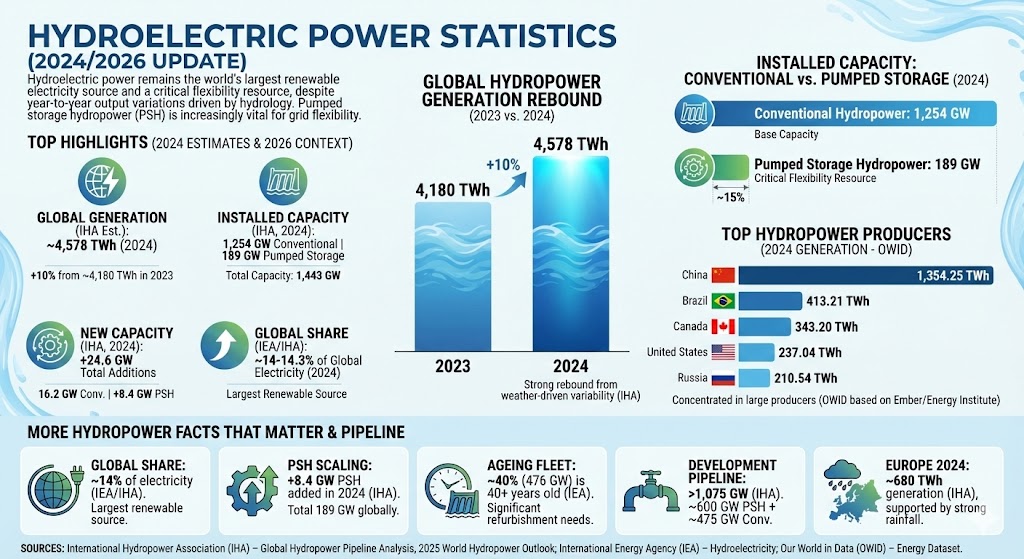
Hydroelectric Power Statistics (Top Highlights)
- Global hydropower generation (estimated): ~4,578 TWh in 2024, up from ~4,180 TWh in 2023 (about +10%). (IHA)
- Global generation benchmark: the IEA estimates hydropower generated around 4,500 TWh in 2024, or ~14% of global electricity. (IEA)
- Installed capacity (2024): 1,254 GW conventional hydropower and 189 GW pumped storage hydropower worldwide. (IHA)
- New capacity in 2024: 24.6 GW total additions worldwide, including 16.2 GW conventional and 8.4 GW pumped storage. (IHA)
- Pipeline scale: the global hydropower development pipeline exceeds 1,075 GW (about 600 GW PSH + 475 GW conventional). (IHA)
Global Hydropower Generation (2023 vs. 2024)
IHA estimates that global hydropower output rebounded strongly in 2024 after a weaker 2023, highlighting how weather-driven variability can move the needle on electricity-sector emissions and fossil generation.
| Label | Bar | Value |
|---|---|---|
| 2023 | 4,180 TWh | |
| 2024 | 4,578 TWh |
Max = 4,578 TWh. Widths: 2023 91.31%, 2024 100.00%.
Installed Hydropower Capacity (Conventional vs. Pumped Storage)
In 2024, IHA reports 1,254 GW of conventional hydropower installed globally and 189 GW of pumped storage hydropower (PSH). While PSH is smaller in base, its growth rate has accelerated recently as grids prioritize storage and flexibility.
| Label | Bar | Value |
|---|---|---|
| Conventional hydropower (2024) | 1,254 GW | |
| Pumped storage hydropower (2024) | 189 GW |
Max = 1,254 GW. Widths: Conventional hydropower (2024) 100.00%, Pumped storage hydropower (2024) 15.07%.
Top Hydropower Producers (2024)
Hydropower generation is concentrated in a handful of large producers. Using the OWID energy dataset (sourced from Ember and the Energy Institute), the largest generators in 2024 were led by China by a wide margin.
| Label | Bar | Value |
|---|---|---|
| China | 1,354.25 TWh | |
| Brazil | 413.21 TWh | |
| Canada | 343.20 TWh | |
| United States | 237.04 TWh | |
| Russia | 210.54 TWh |
Max = 1,354.25 TWh. Widths: China 100.00%, Brazil 30.51%, Canada 25.34%, United States 17.50%, Russia 15.55%.
More Hydropower Facts That Matter
- Hydropower’s global share: IHA reports hydropower supplied 14.3% of global power (report summary). The IEA similarly places hydropower at about 14% of global electricity in 2024.
- Pumped storage is scaling: IHA reports 8.4 GW of PSH added in 2024, bringing PSH to 189 GW globally.
- Ageing fleet: the IEA notes that almost 40% of the global hydropower fleet (476 GW) is at least 40 years old, implying significant refurbishment needs to maintain output and flexibility.
- Europe’s 2024 hydro year: IHA highlights Europe saw ~680 TWh of hydropower generation in 2024, supported by strong rainfall (report summary).
Sources
- International Hydropower Association (IHA) — Global Hydropower Pipeline Analysis (installed capacity and generation estimates for 2023–2024): https://www.hydropower.org/resources/pipeline-analysis
- International Hydropower Association (IHA) — 2025 World Hydropower Outlook (summary page: additions, pipeline, regional notes): https://www.hydropower.org/publications/2025-world-hydropower-outlook
- International Energy Agency (IEA) — Hydroelectricity (global generation and share; fleet age notes): https://www.iea.org/energy-system/renewables/hydroelectricity
- Our World in Data (OWID) — OWID Energy Dataset repository (download link and documentation): https://github.com/owid/energy-data