Choosing among rooftop solar panel kits is easier when you match the system’s output, voltage, controller, and available roof space to your actual power needs. The right setup can support an RV, shed, cabin, backup battery bank, or other off-grid application without paying for capacity you cannot use.
This roundup compares 10 options ranging from compact 200-watt systems to larger 2,400-watt arrays. Use the guide below to narrow your choices by efficiency, controller type, expandability, installation constraints, and long-term value.
Best 10 Rooftop Solar Panel Kits Picks for 2026
Complete MPPT Kit

- 400W from four 100W monocrystalline panels
- 40A MPPT controller with Bluetooth monitoring
- Includes brackets, cables, and adaptor kit
Best For: Complete 12V off-grid installations
Bifacial Shade-Tolerant Pair
Callsun 400W N-Type Bifacial Solar Panel Pair

- Two 200W N-type panels deliver 400W total
- Bifacial design can capture rear-side light
- Dual-module layout helps with partial shading
Best For: Compact RV, rooftop, and off-grid panel arrays
RV-Ready PWM Kit
Renogy 200W 12V N-Type RV Solar Kit
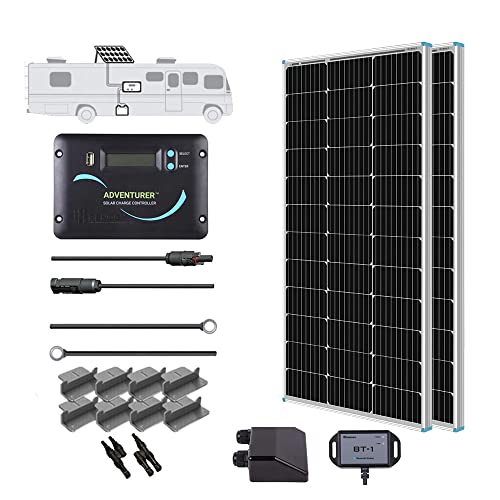
- Two 100W panels provide 200W total output
- Includes flush-mount 30A PWM controller
- Supports lithium, lead-acid, and gel batteries
Best For: Compact RV, camper, boat, and 12V systems
High-Output N-Type Pair
Renogy 640W N-Type 18BB Solar Panels

- Two 320W panels deliver 640W total capacity
- Up to 25% efficiency with N-type 18BB cells
- IP68-rated, rigid panels for permanent installations
Best For: Larger rooftops, cabins, sheds, and off-grid arrays
Best Budget-Friendly Kit
ECO-WORTHY 200W Solar Panel Kit
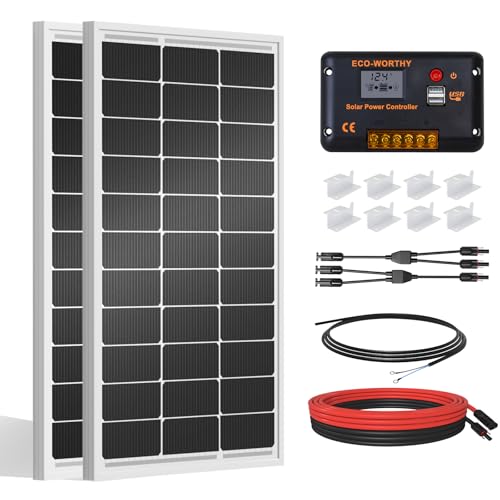
- Complete 200W kit with 30A PWM controller
- Supports 12V parallel or 24V series wiring
- Includes brackets and solar cables
Best For: RVs, campers, cabins, and small off-grid systems
Best Certified High-Efficiency Kit

- Three 200W panels provide 600W total output
- Up to 25.8% efficiency with N-type 16BB cells
- TÜV certified with long-term warranty support
Best For: Rooftops, RVs, cabins, marine, and off-grid systems
Best for Reflective Roofs
Renogy 2400W Bifacial Solar Panels

- Six 400W panels provide 2,400W total capacity
- Bifacial design can capture reflected light
- Dual power zones help with partial shade
Best For: Large rooftops, farms, sheds, and reflective off-grid sites
Best Complete Kit
600W Monocrystalline RV Solar Kit

- Two 300W panels with a 30A MPPT controller
- Up to 25% claimed cell efficiency
- Includes cable and Z-brackets
Best For: 12V RV and off-grid installations
Best Compact Panel
Renogy 200W N-Type Solar Panel

- Compact 200W panel for space-limited roofs
- 25% efficiency with 16BB N-type cells
- 10-year workmanship warranty
Best For: Class B vans and custom off-grid systems
Best Three-Panel Array
600W 18BB N-Type Solar Panel Pack

- Three 200W panels for a 600W array
- 25% efficiency with 18BB N-type cells
- IP68-rated outdoor construction
Best For: Matching RV, rooftop, and marine arrays
Complete MPPT Kit – Renogy 400W Premium Solar Kit
For shoppers comparing rooftop solar panel kits, this Renogy package offers a ready-to-configure 400-watt system built around four 100-watt monocrystalline panels and a 40A MPPT controller. It also includes mounting hardware, cables, an adaptor kit, and Bluetooth monitoring, making it a practical option for a 12V setup.
Best For: Off-grid users who want a complete 12V kit with MPPT charging and phone-based monitoring.
Pros:
- Includes four 100W monocrystalline panels for a 400W total system.
- 40A MPPT controller can improve charging efficiency compared with basic PWM designs.
- Bluetooth module supports monitoring and adjustments from a phone.
- Includes Z-brackets, cables, and an adaptor kit for a more complete installation.
Cons:
- The listed kit weight is 56.4 pounds, so rooftop handling may require planning.
- The supplied specifications identify a 12V output and a 32V maximum battery voltage, limiting compatibility with some higher-voltage systems.
This is a strong all-in-one choice when you value included accessories and MPPT control over a minimalist panel-only setup. Verify battery and mounting requirements before installation.
Bifacial Shade-Tolerant Pair – Callsun 400W N-Type Bifacial Solar Panel Pair
Among rooftop solar panel kits and panel pairs, this Callsun package stands out for its two 200-watt N-type bifacial panels. The panels use 16BB cells, a dual-module design for partial-shade tolerance, and a transparent backsheet intended to capture reflected light when installation conditions support it.
Best For: RV, van, marine, rooftop, and off-grid users who need a compact 400W panel pair and may encounter partial shading.
Pros:
- Two panels provide 400W total output with up to 25.6% stated conversion efficiency.
- Bifacial construction can use light reaching the rear side under suitable conditions.
- Dual-module parallel design helps reduce the effect of partial shading.
- Tempered glass, an aluminum frame, and an IP68-rated junction box support outdoor use.
Cons:
- This is a panel pair rather than a complete kit with a charge controller, cables, or mounting hardware.
- Each panel measures 51.3 by 30.3 inches, which still requires substantial roof or vehicle space.
- Bifacial gains depend on reflected or diffuse light and the installation surface.
Choose this option if panel technology and shade handling matter more than having every system component included. Check the electrical limits of your controller or power station, especially when wiring the panels in series.
RV-Ready PWM Kit – Renogy 200W 12V N-Type RV Solar Kit
This Renogy package is one of the more approachable rooftop solar panel kits for smaller RV, camper, boat, and off-grid installations. It combines two 100-watt monocrystalline panels with a flush-mount Adventurer-Li 30A PWM controller, cables, branch connectors, a Bluetooth module, and a cable entry housing.
Best For: RV and camper owners building a compact 12V system with support for lithium, lead-acid, and gel batteries.
Pros:
- 200W total panel capacity in a relatively compact two-panel configuration.
- Includes a flush-mount 30A PWM controller with LCD-oriented RV installation.
- Supports lithium, lead-acid, and gel battery types.
- Pre-drilled panels, plug-and-play cables, branch connectors, Bluetooth, and cable entry hardware simplify setup.
Cons:
- PWM charging is less sophisticated than MPPT control.
- The stated 800Wh daily output depends on receiving about four hours of sunlight.
- At 22% stated cell efficiency, it may produce less power per roof area than higher-efficiency options.
This kit makes sense for a smaller mobile system where straightforward installation and battery flexibility are priorities. Actual daily production will vary with sunlight, shading, orientation, and system losses.
High-Output N-Type Pair – Renogy 640W N-Type 18BB Solar Panels
For buyers seeking high-output rooftop solar panel kits or panel arrays, this Renogy set includes two 320-watt N-type monocrystalline panels for 640W total capacity. The panels feature 18 busbars, up to 25% stated cell efficiency, pre-drilled mounting holes, and IP68-rated construction for off-grid, rooftop, cabin, and marine applications.
Best For: Larger rooftop, cabin, shed, farm, and off-grid installations where higher output per panel is useful.
Pros:
- Two 320W panels provide 640W total rated power.
- N-type 18BB construction is designed to reduce hot-spot effects and support temperature performance.
- IP68-rated panels use multi-layer encapsulation and an anti-corrosion coating.
- Pre-drilled holes support installation with compatible Renogy mounting systems.
Cons:
- This listing includes solar panels only, not a charge controller, inverter, cables, or mounting hardware.
- Each panel is 64.37 by 34.65 inches and weighs 90.5 pounds, making roof handling and structural planning important.
- The panels are rigid and unfoldable, so they are not intended as a portable folding solution.
This pair is best suited to permanent installations with adequate roof space and a separately selected balance-of-system. Confirm your roof structure, controller or inverter limits, and mounting hardware before buying.
Best Budget-Friendly Kit – ECO-WORTHY 200W Solar Panel Kit
This ECO-WORTHY kit is a practical starting point for shoppers comparing rooftop solar panel kits for RVs, cabins, sheds, and other off-grid uses. It combines two 100W monocrystalline panels with a 30A PWM charge controller, mounting brackets, and solar cables for a relatively straightforward installation.
Best For: RVs, campers, backup power, and small off-grid systems that need a complete 200W setup.
Pros:
- Includes panels, controller, mounting brackets, and multiple cable sets.
- Supports series wiring for 24V or parallel wiring for 12V applications.
- Aluminum frames and an IP65-rated junction box are designed for outdoor use.
- Rated for up to 800Wh daily output under four hours of full sunshine.
Cons:
- The included PWM controller is less advanced than an MPPT controller.
- At 200W total, it may not meet the needs of larger residential systems.
- The kit weighs 31.6 pounds, which may matter for portable installations.
Choose this kit when you want an all-in-one, lower-capacity system with flexible 12V or 24V wiring. Its included hardware and cables reduce the need to source individual components, while the modest output keeps it better suited to smaller loads than whole-home rooftop power.
Best Certified High-Efficiency Kit – 600W TÜV Solar Panel Kit
This three-panel system is a strong option for shoppers evaluating rooftop solar panel kits where efficiency, certification, and available roof space matter. Its 600W total output uses N-type 16BB cells rated up to 25.8% conversion efficiency, along with tempered glass and corrosion-resistant aluminum frames.
Best For: RVs, rooftops, marine setups, cabins, and off-grid installations seeking higher output from three panels.
Pros:
- TÜV certified to IEC 61215, IEC 61730, and UL 61730 standards.
- N-type 16BB cells are rated for up to 25.8% conversion efficiency.
- Series-parallel cell-string design is intended to improve output during partial shading.
- Includes a 25-year performance warranty and 10-year technical support.
Cons:
- The three panels weigh 71.9 pounds in total and each measures about 52.8 by 30.3 inches.
- The supplied notes limit connections to three panels in parallel or three in series.
- Panels and mounting hardware are not presented as a complete charge-controller kit.
This kit stands out when documented testing and long-term support are priorities. Its 600W capacity and high-efficiency cells can make good use of limited installation space, but buyers should plan separately for the controller, wiring, mounting hardware, and system compatibility.
Best for Reflective Roofs – Renogy 2400W Bifacial Solar Panels
For shoppers comparing larger rooftop solar panel kits, this Renogy system emphasizes high output from fewer, higher-wattage panels. The package includes six 400W bifacial N-type panels, with a front-and-back design intended to capture additional reflected light from surfaces such as snow, concrete, white gravel, and light-colored roofs.
Best For: Larger home rooftops, farms, sheds, RVs, and off-grid installations with reflective surroundings or limited mounting space.
Pros:
- Six 400W panels provide a listed 2,400W total capacity.
- Bifacial construction may add up to 30% more energy in reflective settings.
- N-type 16BB cells offer up to 25% efficiency.
- Two independently operating power zones help limit the effect of partial shade.
Cons:
- The package weighs 45.4 pounds per listed panel unit and requires substantial installation space.
- Bifacial gains depend on suitable reflective surfaces and installation conditions.
- The listing describes panels rather than a complete kit with controller, wiring, and mounting hardware.
This is the most suitable choice here for buyers planning a larger solar array and looking to simplify panel counts and connections. Its bifacial design can be particularly useful above reflective surfaces, but the expected energy boost will vary with roof layout, shading, and rear-side light exposure.
Best Complete Kit – 600W Monocrystalline RV Solar Kit
This 600-watt kit is a practical option for shoppers comparing rooftop solar panel kits that include more than panels alone. It combines two 300-watt monocrystalline panels with a 30A MPPT charge controller, solar extension cable, and mounting brackets for 12-volt battery and inverter setups.
Best For: RVs, campers, boats, rooftops, and other 12V off-grid applications where a bundled controller and mounting hardware are useful.
Pros:
- Includes two 300W panels, a 30A MPPT controller, extension cable, and Z-brackets.
- Uses N-type monocrystalline cells with claimed efficiency up to 25%.
- Pre-drilled mounting holes and MC4 connectors simplify installation.
- Supports applications including RVs, yachts, camping, residential, and commercial systems.
Cons:
- The kit is designed for 12V systems, so compatibility should be confirmed before purchase.
- Actual output can vary with sunlight intensity, location, and timing.
- The supplied details do not specify a panel performance warranty period.
Choose this kit if you want a higher-output package with key installation components included. Before buying, verify roof space, mounting requirements, controller compatibility, and your battery and inverter configuration.
Best Compact Panel – Renogy 200W N-Type Solar Panel
For shoppers evaluating rooftop solar panel kits around limited roof space, this Renogy 200-watt panel emphasizes a compact design and high-efficiency N-type cells. It operates at 24V while supporting both 12V and 24V battery systems, making it a flexible component for a custom solar setup.
Best For: Class B vans, RVs, marine installations, cabins, and off-grid systems where space efficiency and long-term rated performance matter.
Pros:
- The panel is described as 7.5% smaller and 11.7% lighter than previous models.
- Advanced 16BB N-type cells are rated at 25% efficiency.
- Designed to maintain performance in high temperatures and cloudy conditions.
- Includes a 10-year workmanship warranty and 25-year performance guarantee at 80% output.
Cons:
- This listing is for one 200W panel rather than a complete kit with controller and mounting hardware.
- Its 49.7-by-30.1-inch footprint still requires careful roof-space planning.
- Battery, controller, mounting, and inverter components must be selected separately.
This is a strong choice when you are building a rooftop system piece by piece and want a compact, warranty-backed panel. Confirm the panel’s electrical specifications with your charge controller and battery configuration before installation.
Best Three-Panel Array – 600W 18BB N-Type Solar Panel Pack
This three-panel pack is worth considering when comparing rooftop solar panel kits for a 600-watt array. It includes three 200-watt panels with 18BB N-type cell technology, pre-drilled mounting holes, MC4 connectors, and a corrosion-resistant aluminum frame for RV, marine, home, and off-grid applications.
Best For: Buyers who want three matching 200W panels for RVs, rooftops, boats, farms, trailers, or 12V/24V off-grid systems.
Pros:
- Three 200W panels provide a listed 600W total maximum output.
- 18BB N-type cells are rated at 25% conversion efficiency.
- IP68 waterproofing and an aluminum frame support outdoor use.
- Pre-drilled holes accommodate adjustable mounting and multiple installation scenarios.
Cons:
- The pack does not list a charge controller, inverter, or mounting brackets among the included components.
- At 57.5 pounds total, the three-panel set requires careful handling and roof planning.
- The notes limit parallel or series connections to three panels and warn against exceeding connecting-material current capacity.
This pack suits a planned 600W array, especially when you prefer matching panels and need outdoor durability features. Check wiring limits, controller specifications, roof load, and available mounting space before connecting the panels.
How We Picked These Rooftop Solar Panel Kits
We selected systems across several common use cases, including RV travel, small cabins, sheds, battery charging, and larger off-grid installations. Our comparison emphasizes rated wattage, panel efficiency, cell design, controller technology, voltage compatibility, included components, and expansion potential.
Specifications such as 16BB or 18BB busbar layouts, N-type cells, bifacial construction, and listed efficiency can indicate strong performance, but real-world output also depends on roof orientation, shading, temperature, wiring, and the battery system. Treat advertised wattage as a peak rating rather than guaranteed daily production.
Quick Comparison
| System type | Typical best use | What to prioritize |
|---|---|---|
| 200W to 240W | Small RVs, vans, and basic battery charging | Compact size, simple wiring, compatible controller |
| 400W to 600W | Medium RVs, cabins, and shed systems | MPPT control, roof layout, battery capacity |
| 640W and above | Large battery banks and higher daily loads | Roof strength, string voltage, protection, scalability |
Key Buying Factors for Rooftop Solar Panel Kits
Power, Voltage, and Battery Compatibility
Estimate daily energy use in watt-hours, then account for cloudy weather and system losses. A 12V system is common for smaller RV installations, while 24V systems can reduce current and cable losses as power increases. Confirm that the panel arrangement and charge controller match your battery bank’s voltage and chemistry.
MPPT Versus PWM Controllers
MPPT controllers generally extract more energy, particularly in colder conditions or when panel voltage is higher than battery voltage. PWM controllers can be economical for smaller, straightforward systems, but they are less flexible when panel and battery voltages differ.
Roof Space, Shading, and Installation
Measure usable roof area before choosing a kit. Consider panel dimensions, mounting clearances, cable routes, roof penetrations, and access for maintenance. Even partial shade can reduce output, so avoid placing panels near vents, racks, chimneys, or other obstructions when possible.
Efficiency and Construction
Higher-efficiency N-type panels can produce more power in limited space. Bifacial panels may provide additional output when their rear side receives reflected light, but the benefit depends heavily on mounting height, surface reflectivity, and installation conditions.
Safety and System Protection
Look for appropriately rated fuses, breakers, connectors, grounding hardware, and weather-resistant cabling. Larger arrays may require a professional review, especially where local electrical codes, roof loading, battery ventilation, or grid interconnection rules apply.
Who Should Buy Which Rooftop Solar Panel Kits?
Choose a 200W-class kit for modest RV loads, lighting, phones, small electronics, and maintaining a smaller battery bank. These systems are easier to fit and typically simpler to install.
Choose a 400W to 600W kit if you need a practical middle ground for refrigeration, fans, laptops, communications equipment, or regular weekend and off-grid use. An MPPT controller is especially useful in this range.
Choose a 640W or larger array when you have substantial daily consumption, a larger battery bank, or limited opportunities to recharge from another source. Confirm that the roof, wiring, controller, inverter, and batteries can all handle the increased capacity.
Before ordering, verify the complete parts list rather than assuming every kit includes mounting hardware, batteries, an inverter, fuses, or roof-specific brackets. A well-matched system will generally outperform a larger but poorly configured array.