The best occupancy sensors for classrooms can reduce unnecessary lighting use while helping teachers and students maintain comfortable, well-lit learning spaces.
This roundup compares 10 ceiling- and fixture-mounted options, including PIR, microwave, and multi-technology sensors for different classroom layouts and electrical systems.
Best 10 Occupancy Sensors for Classrooms Picks for 2026
Best Wall-Switch Upgrade
Leviton App-Configurable Occupancy Sensor

- No neutral wire required
- Manual push-button override
- Adjustable detection and ambient-light control
Best For: Classrooms needing wall-mounted automatic lighting control
Best Small-Motion Ceiling Pick

- 360-degree ceiling coverage
- Detects subtle movement
- 30-second to 20-minute time delay
Best For: Classrooms needing ceiling-mounted small-motion detection
Best Multi-Technology Coverage

- Combines PIR and ultrasonic sensing
- Covers approximately 1,000 square feet
- Self-adjusts sensitivity and time delay
Best For: Larger classrooms with compatible 24VDC controls
Best Large-Area Value
ENERLITES 1200-Sq.-Ft. PIR Sensor

- Up to 1,200 square feet of coverage
- Adjustable sensitivity and time delay
- Works with incandescent, CFL, and LED lighting
Best For: Large classrooms with a compatible low-voltage power pack
Best Value Ceiling Sensor
Leviton PIR Ceiling Mount Occupancy Sensor

- Built-in switching relay simplifies installation
- Adjustable delay and light sensing
- Approx. 530 sq. ft. coverage at 8 ft.
Best For: Small classrooms and indoor institutional spaces
Best Adjustable Budget Option
RAYZEEK Ceiling Occupancy Sensor

- 15-second to 30-minute adjustable delay
- Dual light-sensing and occupancy modes
- Requires neutral wire; rated for 120V loads
Best For: Classrooms with compatible 120V neutral wiring
Best for Large Spaces
SensorSwitch LSXR Fixture Mount Sensor

- High-mount coverage up to 45 feet
- MVOLT 120–277V commercial compatibility
- Interchangeable lenses and test mode
Best For: Large classrooms and high-ceiling commercial spaces
Microwave Coverage Pick
Rayzeek 360° Ceiling Occupancy Sensor

- Microwave radar helps reduce blind spots.
- Works across changing light and temperature conditions.
- Adjustable delay, sensitivity, and light sensing.
Best For: Large or high classrooms needing broad, consistent coverage
Multi-Room Value Pick
ECOELER 360° PIR Sensor 5-Pack

- Includes five ceiling-mounted occupancy sensors.
- Adjustable delay, sensitivity, and light-level settings.
- Compatible with several common lighting types.
Best For: Schools installing sensors in multiple classrooms or rooms
Adjustable Sensitivity Pick
Sensky Triple-Detector PIR Sensor
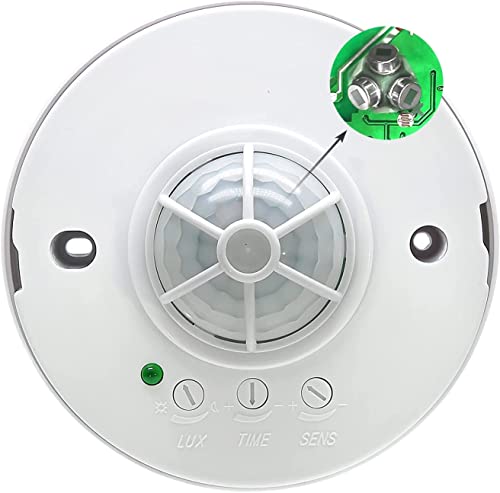
- Three PIR detectors provide overlapping coverage.
- Range adjusts from 3 to 12 meters.
- Light sensing adjusts from 3 to 2000 lux.
Best For: Classrooms needing tunable range and daylight settings
Best Wall-Switch Upgrade – Leviton App-Configurable Occupancy Sensor
For classrooms that need automatic lighting without replacing a standard wall-switch setup, this Leviton sensor is a practical option. It turns lights on when motion is detected, supports manual push-button control, and does not require a neutral wire.
Best For: Classrooms needing a commercial-grade wall-mounted occupancy sensor with manual override and configurable ambient-light behavior.
Pros:
- No neutral wire required for installation
- Supports incandescent and fluorescent lighting
- Adjustable 180-degree detection field with blinders
- Ambient-light override can prevent unnecessary activation
Cons:
- Wall-mounted rather than ceiling-mounted
- Supplied notes do not specify app configuration details or a time-delay range
This is a strong fit when a classroom needs straightforward automatic and manual lighting control at the switch location. Its adjustable detection area can also help limit unwanted peripheral triggers.
Best Small-Motion Ceiling Pick – SensorSwitch 360° PIR Sensor
This SensorSwitch ceiling sensor is designed for commercial spaces such as classrooms and detects subtle movement across a 360-degree conical area. Its adjustable time delay and included mounting hardware make it useful for ceiling-based classroom lighting automation.
Best For: Classrooms that need ceiling-mounted PIR detection for small movements within a 12-foot radial range.
Pros:
- 360-degree PIR coverage for broad room detection
- Optimized for small hand or subtle movements
- Adjustable 30-second to 20-minute time delay
- Mounts to ceiling tiles, grids, octagon boxes, or handy boxes
Cons:
- Low-voltage sensor rather than a standalone line-voltage switch
- Battery is not included
- Specified small-motion range is 12 feet radially at a 9-foot mounting height
With its discreet ceiling form factor and small-motion sensitivity, this model suits classrooms where seated or low-level activity might otherwise be missed. Verify the compatible control and power arrangement before installation.
Best Multi-Technology Coverage – Leviton PIR/Ultrasonic Sensor
For classrooms where reliable detection is more important than using a single sensing method, this Leviton ceiling sensor combines PIR and ultrasonic technologies. It provides approximately 1,000 square feet of coverage and uses self-adjusting circuitry to refine sensitivity and time delay.
Best For: Larger classrooms using a compatible 24VDC low-voltage lighting-control system and needing consistent occupancy detection.
Pros:
- Combines PIR and ultrasonic sensing
- Approximately 1,000 square feet of coverage
- Self-adjusting sensitivity and time delay
- Twist-lock ceiling attachment allows 360-degree rotation
Cons:
- Requires a compatible 24VDC low-voltage system
- Supplied notes list a 180-degree field of view, despite the rotating attachment
- Installation uses a three-wire low-voltage connection
This model is best considered for classrooms already designed around low-voltage controls. Its dual-technology approach and self-adjusting operation can help maintain detection as classroom activity changes.
Best Large-Area Value – ENERLITES 1200-Sq.-Ft. PIR Sensor
This ENERLITES ceiling sensor offers 360-degree, multi-level PIR coverage for up to 1,200 square feet, making it suitable for larger classrooms and commercial spaces. Sensitivity and time delay are adjustable, and it works with incandescent, CFL, and LED lighting when paired with the required power pack.
Best For: Large classrooms or commercial rooms needing broad low-voltage PIR coverage and flexible timing controls.
Pros:
- 360-degree coverage up to 1,200 square feet
- Adjustable 5-second to 30-minute time delay
- Adjustable sensitivity from 50% to 100%
- Compatible with incandescent, CFL, and LED lighting
Cons:
- Requires an ENERLITES MPP-24 power pack
- Low-voltage installation is needed
- Passive infrared sensing may be less suited to detecting very subtle movement than multi-technology models
The MPC-50L is a practical choice when room size and adjustable settings are priorities. Budget for the required MPP-24 power pack and confirm the existing lighting-control setup before purchasing.
Best Value Ceiling Sensor – Leviton PIR Ceiling Mount Occupancy Sensor
Leviton PIR Ceiling Mount Occupancy Sensor, 120-277V, 1000W, 570SF Field-of-View, ODC0S-I1W, White
Check Price On AmazonFor classrooms needing straightforward automatic lighting control, this Leviton ceiling-mounted unit is a practical option among occupancy sensors for classrooms. Its passive infrared detection, built-in switching relay, and adjustable light sensor can help reduce unnecessary lighting without requiring a separate relay.
Best For: Small classrooms, copy rooms, storage areas, and other indoor spaces where a cost-conscious, hardwired ceiling sensor with approximately 530 square feet of coverage is appropriate.
Pros:
- Built-in sensor and switching relay can simplify installation.
- Adjustable off-delay from 20 seconds to 15 minutes supports energy-conscious settings.
- Adjustable light sensing can prevent lights from turning on when natural light is sufficient.
- 360-degree indoor coverage is approximately 530 square feet when mounted at 8 feet.
Cons:
- Hardwired installation may require qualified electrical work.
- Coverage and maximum range are more suited to smaller spaces than large classrooms.
- Indoor use only.
The Leviton is a sensible value pick when easy relay integration and daylight-sensitive operation matter more than extended coverage. Confirm the room size and mounting height before choosing it for a classroom.
Best Adjustable Budget Option – RAYZEEK Ceiling Occupancy Sensor
The RAYZEEK ceiling sensor offers simple controls for classrooms that need automatic lighting without complicated programming. It provides selectable time delay, light sensitivity, and detection range settings, but installation requires a working neutral wire.
Best For: Commercial or institutional rooms with compatible 120V wiring, including classrooms, hallways, storage areas, and other spaces where flexible light-sensing modes are useful.
Pros:
- One-touch setup adjusts delay from 15 seconds to 30 minutes.
- Offers light-plus-occupancy and occupancy-only operating modes.
- Supports incandescent, halogen, fluorescent, LED, ceiling fan, and exhaust fan loads within its ratings.
- Flame-retardant PC construction is intended for continuous commercial or industrial use.
Cons:
- Requires a working neutral wire.
- Limited to 120V and a maximum 10A load.
- Surface or ceiling mounting may not suit every existing fixture layout.
Choose the RAYZEEK when adjustable settings and dual operating modes are priorities. Its neutral-wire requirement and 120V limitation should be checked before purchase, especially in retrofit classroom projects.
Best for Large Spaces – SensorSwitch LSXR Fixture Mount Sensor
For larger classrooms or high-ceiling areas, the SensorSwitch LSXR stands out among occupancy sensors for classrooms because it supports interchangeable lenses and 360-degree detection at either low or high mounting heights. Its MVOLT 120–277V compatibility also suits many commercial lighting systems.
Best For: Large classrooms, gyms, offices, corridors, and other commercial interiors where high-mount coverage up to 45 feet or low-mount coverage from 7 to 15 feet is needed.
Pros:
- Interchangeable lenses support high- or low-mount 360-degree coverage.
- MVOLT 120–277V operation fits a broad range of commercial electrical systems.
- Push-button programming and test mode can speed setup.
- Compact fixture-mount design fits tight installations and carries a five-year limited warranty.
Cons:
- Fixture-mount installation requires a 1/2-inch knockout and wiring work.
- Coverage is optimized for large motion such as walking, which may be less responsive to small movements.
- Lens selection and programming add installation decisions compared with a basic ceiling sensor.
The LSXR is the strongest choice here when classroom dimensions or ceiling height make coverage the main concern. Its commercial features are more capable, though installation planning is important to select the appropriate lens and mounting position.
Microwave Coverage Pick – Rayzeek 360° Ceiling Occupancy Sensor
For classrooms that need broad, consistent coverage, the Rayzeek microwave sensor is a practical option among occupancy sensors for classrooms. Its 360-degree radar detection is designed to reduce blind spots and can detect subtle movement across a room.
Best For: Large classrooms, high spaces, and rooms where reliable coverage in varying light or temperature conditions matters.
Pros:
- Microwave detection provides full-room 360-degree coverage with fewer blind spots than PIR.
- Operates in sunlight, darkness, fog, and temperatures from -10°C to 40°C.
- Offers adjustable delay, light-sensor, and sensitivity settings, plus Energy Saving and Occupancy Only modes.
- Supports LED, incandescent, and other lamp types up to its 5A/120V rating.
Cons:
- Requires a neutral wire for installation.
- Its stated maximum sensing range is 20 feet, which may limit very large rooms.
- Installation involves electrical wiring and ceiling mounting.
The Rayzeek stands out when coverage consistency is more important than a simple PIR setup. Confirm the neutral-wire requirement and 20-foot range before choosing it for a classroom.
Multi-Room Value Pick – ECOELER 360° PIR Sensor 5-Pack
The ECOELER five-pack is a convenient way to equip several rooms with occupancy sensors for classrooms. Its ceiling-mounted PIR design offers 360-degree detection, adjustable settings, and compatibility with a wide range of classroom lighting types.
Best For: Schools outfitting multiple classrooms, hallways, storage areas, or other rooms with similar ceiling-mounted sensors.
Pros:
- Five sensors can support installation across multiple rooms.
- Provides 360-degree PIR detection with a listed detection range of up to 24 feet when installed at 20 feet.
- Adjustable 15-second to 30-minute delay, 20–100% sensitivity, and light-level sensing.
- Compatible with LED, incandescent, fluorescent, CFL, and low-voltage lighting types.
Cons:
- Requires a neutral wire.
- Its operating temperature range is listed as 32°F to 131°F, so it is not intended for freezing conditions.
- PIR detection responds to moving objects and may be less suited to very subtle motion than microwave sensing.
For a school-wide project, the ECOELER pack offers useful adjustability and broad fixture compatibility. Check each classroom’s wiring and ceiling layout before installation.
Adjustable Sensitivity Pick – Sensky Triple-Detector PIR Sensor
The Sensky ceiling sensor gives classrooms flexible control over detection range, light level, and shutoff timing. Its three-detector PIR design is intended to provide overlapping coverage and capture smaller movements within a room.
Best For: Small to large classrooms where administrators want to tune coverage and operation for different room sizes and daylight conditions.
Pros:
- Three overlapping PIR detectors are designed to catch small movements.
- Detection range adjusts from 3 to 12 meters for different room sizes.
- Light-level settings range from 3 to 2000 lux for day-and-night or night-only operation.
- Works with LED, CFL, incandescent lights, ceiling lights, and exhaust fans.
Cons:
- Time delay adjusts from 10 seconds to 7 minutes, offering less maximum hold time than some alternatives.
- PIR sensing relies on movement or heat-source detection.
- Installation requires 110–240VAC electrical wiring and ceiling mounting.
The Sensky is a flexible choice when classroom size and daylight conditions vary. Its adjustable 3–12-meter range is especially useful, but the relatively short seven-minute maximum delay may not suit every scheduling preference.
How We Picked the Best Occupancy Sensors for Classrooms
We focused on sensors suited to educational and commercial indoor spaces, prioritizing detection coverage, electrical compatibility, installation format, and control flexibility. The selection includes line-voltage models for simpler retrofits, low-voltage sensors that work with compatible control systems, and ceiling or fixture-mounted designs for different room layouts.
We also considered features that matter in classrooms: reliable small-motion detection, 360-degree coverage, compatibility with common 120–277V systems, neutral-wire requirements, and suitability for standard or high-bay fixtures. Always confirm local electrical requirements and installation instructions before purchasing.
Quick Comparison
| Sensor type | Best suited to | Main advantage | Check before buying |
|---|---|---|---|
| PIR | Classrooms with clear line of sight | Efficient, proven motion detection | Obstructions and low-motion areas |
| Microwave | Rooms needing broader motion sensitivity | Can detect movement beyond direct line of sight | False-trigger potential and adjustment options |
| Multi-technology | Spaces with varied activity levels | Combines detection methods | Controller and low-voltage compatibility |
| Fixture-mounted | High bays or fixture replacement projects | Compact, integrated installation | Fixture type, mounting, and voltage |
Key Buying Factors for Occupancy Sensors for Classrooms
Detection Technology and Coverage
PIR sensors are a practical choice when desks, doors, and teaching areas remain within the sensor’s field of view. Microwave sensors may be useful where partitions or broader coverage are concerns, but they can require careful sensitivity tuning. Multi-technology units offer another option for rooms where both reliability and small-motion detection matter.
Voltage, Wiring, and Controls
Match the sensor to the circuit and lighting controls. Line-voltage products may simplify standalone retrofits, while low-voltage models generally require a compatible power pack, controller, or building automation system. Check whether a neutral wire is required, whether the unit supports 120–277VAC, and whether it is compatible with dimming or vacancy-mode controls.
Room Size and Mounting Position
Compare the stated field of view with the classroom’s dimensions, ceiling height, furniture arrangement, and likely movement patterns. Ceiling-mounted sensors usually provide more even coverage than wall-mounted units, while fixture-mounted models can be convenient for high-bay or commercial lighting installations.
Occupancy Versus Vacancy Mode
Occupancy mode turns lights on when motion is detected; vacancy mode requires manual activation but switches lights off automatically. Vacancy mode can reduce nuisance activation in intermittently used rooms, while occupancy mode is often more convenient for frequently occupied classrooms.
Who Should Buy Which Occupancy Sensors for Classrooms?
- For a straightforward retrofit: Choose a compatible line-voltage or no-neutral model if the existing wiring and load ratings match.
- For classrooms with low-voltage controls: Select a low-voltage or multi-technology sensor that fits the existing control architecture.
- For high ceilings or fixture upgrades: Consider a fixture-mounted or high-bay-rated sensor with coverage appropriate for the mounting height.
- For rooms with partitions or irregular movement: A microwave or multi-technology model may provide more dependable detection, provided sensitivity can be adjusted.
- For schools standardizing across many rooms: Favor configurable models with consistent voltage support, documented coverage, and accessible replacement parts.
Before ordering, verify the sensor’s load rating, detection range, mounting requirements, certifications, and compatibility with the classroom’s lighting system. Professional installation is recommended for line-voltage wiring.