When it comes to unexpected outages, having the right storm backup power system can make all the difference. You’ll want something reliable and powerful enough to support your needs during emergencies. From high-capacity power stations to compact UPS systems, there are various options available. Each has its strengths, and knowing what to look for is key. So, what should you consider when choosing the best backup power solution for your situation?
EF ECOFLOW DELTA Pro Ultra Power Station

The EF ECOFLOW DELTA Pro Ultra Power Station stands out as an ideal choice for homeowners who need a reliable backup power solution during storms. With a powerful 7200W AC output, it can effortlessly run heavy appliances, including a central air conditioner. Starting with a 6144Wh battery, you’ll enjoy two days of essential power, and you can expand up to 90kWh for over 30 days of backup. Plus, the EcoFlow app lets you manage your power usage smartly, prioritizing circuits and reducing energy costs. It’s perfect for home emergencies, camping, and RV use, ensuring you’re always prepared.
Best For: Homeowners seeking a reliable backup power solution for emergencies, camping, or RV use.
Pros:
- High Power Output: Capable of running heavy appliances like a central air conditioner with a 7200W AC output.
- Scalable Battery Capacity: Start with 6144Wh and expand up to 90kWh for extended power needs.
- Smart Power Management: EcoFlow app allows for efficient power usage prioritization and cost reduction through solar energy.
Cons:
- High Initial Cost: The upfront investment may be significant for some users.
- Weight and Portability: The unit may be heavy and cumbersome to transport for camping or RV use.
- Shipping in Separate Packages: The product may require multiple deliveries, which could lead to delays.
BLUETTI EB3A Portable Power Station

For those seeking a dependable power source during outdoor adventures or unexpected home outages, the BLUETTI EB3A Portable Power Station stands out with its impressive 268Wh LiFePO4 battery and 600W AC inverter. You’ll appreciate its nine outlets for diverse connectivity, allowing you to power multiple devices simultaneously. The ultra-fast charging feature gets you from 0-80% in just 30 minutes using a single cable. Plus, the EB3A supports solar and AC charging, making it perfect for off-grid use. With its uninterruptible power supply functionality, you can rest easy knowing your sensitive devices are protected during grid failures.
Best For: Outdoor enthusiasts and homeowners seeking a reliable backup power source during outages.
Pros:
- Ultra-fast charging capability, reaching 0-80% in just 30 minutes.
- Supports both solar and AC charging for versatile power replenishment options.
- Acts as an uninterruptible power supply (UPS) to protect sensitive devices during power failures.
Cons:
- Limited to a maximum output of 600W, which may not support high-power appliances.
- The 268Wh capacity may not last long for extended use of multiple devices.
- Requires specific solar panels for optimal solar charging compatibility.
CyberPower CP1500PFCLCD UPS Battery Backup and Surge Protector

Looking for a reliable power backup solution during storms? The CyberPower CP1500PFCLCD UPS Battery Backup and Surge Protector is an excellent choice. With a capacity of 1500VA/1000W, it’s UL Certified and works seamlessly with both active PFC and conventional power supplies. You’ll appreciate the 12 NEMA outlets—six with battery backup and six solely for surge protection. Its multifunction color LCD provides real-time updates on battery conditions, while the Automatic Voltage Regulation (AVR) feature helps extend battery life. Plus, it comes with a 3-year warranty and free PowerPanel Management Software, ensuring you’re well-supported during outages.
Best For: Users seeking a reliable power backup solution for home or office use during storms and power outages.
Pros:
- Provides battery backup and surge protection for critical devices with 12 NEMA outlets.
- Multifunction color LCD displays real-time battery and power conditions for easy monitoring.
- Automatic Voltage Regulation (AVR) feature helps extend battery life by correcting minor power fluctuations.
Cons:
- The unit may be overkill for users with low power needs or fewer devices to protect.
- Some users may find the size and weight of the unit cumbersome for small spaces.
- The right angle NEMA 5-15P input plug may not fit all power strips or wall outlets comfortably.
APC Back-UPS Pro 1500VA UPS Battery Backup & Surge Protector (BX1500M)

Designed to support larger setups, the APC Back-UPS Pro 1500VA UPS Battery Backup & Surge Protector (BX1500M) is ideal for anyone relying on multiple devices during power outages. With a capacity of 1500VA and 900W, it’s perfect for PCs with multiple monitors and routers. You’ll find 10 NEMA 5-15R outlets—5 for battery backup and 5 for surge protection—plus 1 GB network dataline protection. Automatic Voltage Regulation guarantees your devices stay safe from fluctuations, while the PowerChute management software makes it easy to monitor performance. Energy-Star certified, it offers efficiency and reliability you can trust during storms.
Best For: Users with larger setups, such as PCs with multiple monitors and networking equipment, who need reliable power backup during outages.
Pros:
- High capacity of 1500VA/900W supports multiple devices simultaneously.
- Automatic Voltage Regulation ensures protection against voltage fluctuations without battery discharge.
- Energy-Star certified, promoting energy efficiency and cost savings.
Cons:
- Replaceable battery needs to be purchased separately, which can incur additional costs.
- Limited outlets for battery backup, with only 5 available out of 10 total.
- Software management may require compatibility checks for users on older operating systems.
CyberPower CP1500AVRLCD3 Intelligent LCD UPS System

The CyberPower CP1500AVRLCD3 Intelligent LCD UPS System stands out as an ideal choice for home office users needing reliable backup power during storms. With a capacity of 1500VA/900W, it offers 12 outlets, six of which provide battery backup and surge protection. The system features a multifunction color LCD panel that displays real-time battery and power conditions, alerting you to potential issues. It includes USB Type-A and Type-C ports for quick charging your devices. Plus, the Automatic Voltage Regulation (AVR) corrects power fluctuations seamlessly. With a 3-year warranty and a $500,000 connected equipment guarantee, you’re well-protected.
Best For: Home office users seeking reliable backup power during storms and power fluctuations.
Pros:
- Automatic Voltage Regulation (AVR) ensures stable power supply by correcting minor fluctuations without switching to battery.
- Multifunction Color LCD Panel provides real-time monitoring of battery and power conditions, helping users stay informed.
- Multiple USB Charging Ports (Type-A and Type-C) offer quick charging options for mobile devices, enhancing convenience.
Cons:
- Simulated sine wave output may not be suitable for all sensitive electronic devices compared to pure sine wave UPS systems.
- Limited battery capacity (1500VA/900W) might not support high-power devices for extended periods.
- Physical size as a mini tower may require more space compared to compact UPS models, potentially affecting placement options.
APC UPS Battery Backup and Surge Protector (BE600M1)
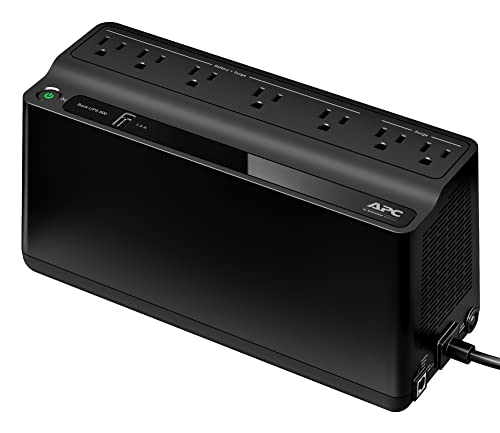
If you’re seeking reliable protection for your home office setup during storms or outages, the APC UPS Battery Backup and Surge Protector (BE600M1) is an excellent choice. With a power capacity of 600VA and 330W, it safeguards your computers, routers, and small electronics. This model features seven outlets—five providing battery backup and surge protection, while two offer surge protection only. Plus, a USB charger port allows you to charge mobile devices easily. Weighing just 7.5 pounds, it’s compact yet powerful, making it a top-seller with a 4.5-star rating. Don’t compromise on safety; choose the BE600M1 for peace of mind.
Best For: Home office users and small businesses looking for reliable battery backup and surge protection during power outages.
Pros:
- Compact design allows for easy placement in any workspace.
- Multiple outlets provide flexibility for connecting various devices.
- High customer rating (4.5 stars) indicates strong user satisfaction and reliability.
Cons:
- Limited power capacity (600VA/330W) may not support larger equipment.
- Battery replacement is necessary after a certain period, adding to maintenance costs.
- USB charger port is limited to 1.5A, which might not be sufficient for rapid charging of some devices.
EF ECOFLOW Portable Power Station DELTA 2

For those seeking a reliable power solution during storms or outdoor adventures, the EF ECOFLOW Portable Power Station DELTA 2 stands out with its impressive 1024Wh capacity and rapid charging capabilities. It charges 0-80% in just 50 minutes and reaches full capacity in 80 minutes using AC input. With a powerful 1800W output, it can run 90% of your appliances quietly and cleanly. Plus, you can expand its capacity up to 3kWh by adding extra batteries. The DELTA 2 also supports solar charging, ensuring you stay powered during camping trips or outages, while its durable design guarantees long-lasting use.
Best For: Those in need of a portable and reliable power source for home backup, camping adventures, or RV trips.
Pros:
- Rapid charging capabilities, reaching 0-80% in 50 minutes and full charge in 80 minutes.
- Powerful 1800W output that can run 90% of appliances quietly and without fumes.
- Expandable capacity from 1kWh to 3kWh by adding extra batteries for extended use.
Cons:
- Initial investment may be higher compared to traditional generators.
- Solar panels are optional and sold separately, adding to overall cost.
- Limited to 15 outlets which may not accommodate all devices simultaneously.
CyberPower EC850LCD UPS Battery Backup and Surge Protector

Designed for home users and small office setups, the CyberPower EC850LCD UPS Battery Backup and Surge Protector stands out with its ability to provide reliable power during storms and outages. With a capacity of 850VA/510W, it features simulated sine wave output to protect your workstations and devices. You’ll find 12 NEMA outlets, six delivering battery backup while the others offer surge protection. The multifunction LCD panel keeps you informed about power conditions, and the ECO mode reduces energy use by powering down peripherals when not in use. Plus, it comes with a 3-year warranty and a $100,000 equipment guarantee.
Best For: Home users and small office setups looking for reliable power backup and surge protection.
Pros:
- Provides 850VA/510W capacity for reliable power during outages.
- ECO mode reduces energy consumption by powering down peripherals when not in use.
- Multifunction LCD panel offers detailed information on battery and power conditions.
Cons:
- Simulated sine wave output may not be suitable for all sensitive electronics.
- Limited to 12 outlets, which may not be enough for larger setups.
- Requires a five-foot power cord, which might limit placement options.
CyberPower ST425 Standby UPS Battery Backup and Surge Protector

The CyberPower ST425 Standby UPS Battery Backup and Surge Protector is ideal for home office users who need reliable power during storms or outages. With a capacity of 425VA/260W, it features eight outlets—four providing battery backup and surge protection, while the other four are surge protected only. Its compact design enhances efficiency and reduces power consumption. You’ll appreciate the LED status light for easy monitoring, and transformer-spaced outlets accommodate larger plugs. Plus, it comes with a 3-year warranty and a $75,000 connected equipment guarantee, ensuring your devices stay safe and powered when you need them most.
Best For: Home office users seeking reliable power backup during storms or outages.
Pros:
- High capacity of 425VA/260W provides ample power for essential devices.
- Features eight outlets, with four providing battery backup and surge protection for critical equipment.
- Comes with a 3-year warranty and a $75,000 connected equipment guarantee for added peace of mind.
Cons:
- Simulated sine wave output may not be suitable for all sensitive electronics.
- Limited to 8 total outlets, which may not be enough for users with multiple devices.
- The design may be bulkier compared to some compact UPS options on the market.
Amazon Basics UPS Battery Backup & Surge Protector (600VA/360W)

When you’re looking to safeguard your home network or entertainment system during storms and power outages, the Amazon Basics UPS Battery Backup & Surge Protector (600VA/360W) stands out with its reliable surge protection and backup capabilities. With a capacity of 600VA and 360W, it features eight outlets—four for surge protection and four for battery backup. Depending on your load, you’ll get approximately nine minutes of backup at half load, or two minutes at full load. Its compact design fits easily in any space, and you can download power management software for added control. Keep your devices safe and powered!
Best For: Those looking to protect their home networks, IoT devices, and entertainment systems from power outages and surges.
Pros:
- Compact design allows for easy placement in homes or offices.
- Provides both surge protection and battery backup capabilities.
- Power management software enhances control over device performance.
Cons:
- Limited runtime of just 2 minutes at full load may not be sufficient for all users.
- Only 8 outlets may not accommodate larger setups needing more connections.
- Recommended load should be kept below 80% for optimal performance, which may reduce usable capacity.
Factors to Consider When Choosing Storm Backup Power Systems
When you’re choosing a storm backup power system, it’s crucial to take into account several key factors. Think about the power output capacity and battery options that fit your needs, as well as how quickly the system charges. Don’t forget to evaluate the size, portability, and connectivity features to make sure it meets your requirements.
Power Output Capacity
Choosing the right power output capacity for your storm backup power system is essential to guarantee your home remains functional during outages. The capacity you need depends on the devices you want to power. For example, a system with 7200W can support heavy appliances like a 3-ton air conditioner. If you want more versatility, look for systems with inverter capabilities that handle both 120V and 240V. Higher ratings, like 21.6kW from triple inverters, provide extensive power for larger household needs. Additionally, features such as Automatic Voltage Regulation (AVR) help manage minor fluctuations without draining your battery. Ultimately, match your system’s output to your household energy demands, with options ranging from portable units at 600W to larger systems exceeding 9000W.
Battery Capacity Options
Battery capacity options play an essential role in ensuring your storm backup power system meets your household needs during outages. You’ll find battery capacity measured in watt-hours (Wh) or volt-amperes (VA), which indicates how long the system can power your devices. Larger batteries, around 12kWh, can keep essential appliances running for extended periods, while smaller options like 268Wh are better for basic devices. Scalability is also important; some systems let you add batteries to reach up to 90kWh for prolonged needs. Consider battery chemistry, too—LiFePO4 batteries offer longer lifespans and increased safety compared to traditional lead-acid types. This way, you can choose a reliable backup to keep your home powered during storms.
Charging Speed and Methods
How quickly can your storm backup power system recharge? Charging speed is essential, as it determines how fast you can get your power station back online. Some units can reach 0-80% in just 30 minutes with fast charging technology. Look for models that support simultaneous charging from both AC and solar sources, enhancing your flexibility. If you’re considering solar options, check for units with MPPT (Maximum Power Point Tracking) controllers, which optimize solar charging and can handle inputs up to 500W. Full charge times can vary greatly—larger capacity units might take around 50 minutes, while smaller ones could take several hours. You can also expand battery capacity in some systems, giving you longer usage times during extended outages.
Portability and Size
When evaluating storm backup power systems, portability and size play a significant role in your decision. You’ll want to reflect on the weight and dimensions, as larger units can be cumbersome to transport or store, especially during emergencies. Portable power stations range from compact models under 10 pounds to larger systems exceeding 50 pounds, impacting their usability in storm scenarios. Keep in mind that higher capacity systems may require sturdier construction, making them less portable. Look for designs with integrated handles or wheels to ease transportation, vital during evacuations. Additionally, evaluate charging options; systems that can recharge via solar panels enhance portability, allowing you to stay powered up in remote areas without traditional power sources.
Connectivity and Outlets
Connectivity and outlets are essential factors to take into account in storm backup power systems. Consider the total number of outlets available; this determines how many devices you can connect at once. Look for systems that combine battery backup and surge protection outlets, ensuring critical devices stay powered and safe during outages. USB charging ports can also be a game-changer, letting you quickly charge your mobile devices without using standard outlets. Additionally, check the outlet configuration, as transformer-spaced designs allow larger plugs to fit without blocking adjacent outlets. Finally, evaluate the power output capacity of the outlets, as this affects the types of devices you can safely power during an outage, ensuring your essential equipment remains operational.
Safety Features and Ratings
Choosing a storm backup power system without considering safety features could leave you vulnerable during an outage. Start by checking for safety certifications like UL (Underwriters Laboratories) or ETL (Intertek) to guarantee compliance with safety standards. Look for units with Automatic Voltage Regulation (AVR), which corrects minor power fluctuations and extends battery life. Models equipped with Battery Management Systems (BMS) are essential, as they monitor battery health and prevent overcharging, overheating, and short-circuiting. Additionally, evaluate surge protection capabilities to safeguard your devices from voltage spikes during storms. Finally, familiarize yourself with warranty offerings, including connected equipment guarantees, to provide financial protection for your devices connected to the backup power system. Prioritize safety, and you’ll be better prepared.
Price and Warranty Options
Price is a critical factor in selecting a storm backup power system, as it directly influences the features and capacity you’ll get. Higher capacity systems often come with a steeper initial cost, so it’s wise to compare what’s offered. Warranty options can vary widely; some products provide extended warranties of up to three years, giving you peace of mind about repairs or replacements. Make sure to check if the warranty covers the battery, as this component greatly impacts reliability. Additionally, look for guarantees that protect connected devices from power surges. When evaluating price and warranty, consider the long-term total cost of ownership, including potential maintenance and replacement expenses, to make an informed decision.