The right conduit bender helps electricians create accurate bends efficiently while reducing wasted conduit and rework. This roundup compares 10 options spanning lightweight aluminum heads, durable ductile iron tools, complete assemblies, and multi-size sets.
Whether you primarily install 1/2-inch or 3/4-inch EMT or regularly work with larger EMT, IMC, or RMC, the best choice depends on compatibility, durability, portability, and the types of bends you make most often.
Best 10 Conduit Benders for Electricians Picks for 2026
Best for Repeatable EMT Bends
Klein Tools 51607 Aluminum Conduit Bender

- Angle Setter supports consistent bends
- Works with 3/4-inch EMT and 1/2-inch RMC or IMC
- Wide pedal and bold markings improve control
Best For: Repeated, accurate bends in 3/4-inch EMT
Heavy-Duty Worksite Pick
IDEAL 1-Inch EMT Ductile Iron Bender

- Ductile iron construction for heavy use
- Handles 1-inch EMT and 3/4-inch rigid or IMC
- Raised markings and anti-slip surfaces aid control
Best For: Frequent, demanding conduit bending
Best Complete Kit
Klein Tools 80148 Conduit Bending Set

- Includes a bender and attachable level
- Large vials cover level, 90, 45, and 30 degrees
- Aluminum head balances handling and strength
Best For: Angle measurement and everyday conduit alignment
Lightweight 3/4-Inch Choice
IDEAL 74-047 Aluminum EMT Bender

- Lightweight aluminum construction
- Heat-treated head with reinforced stress points
- Stable hook and anti-slip step support controlled bends
Best For: Portable 3/4-inch EMT bending on job sites
Best Overall
Klein Tools 51605 Iron Conduit Bender

- Angle Setter supports repeatable common angles
- Ductile-iron construction for job-site durability
- Wide pedal and bold markings improve control
Best For: Frequent bends in 1-inch EMT, 3/4-inch RMC, and IMC
Best for Dual-Size Offsets
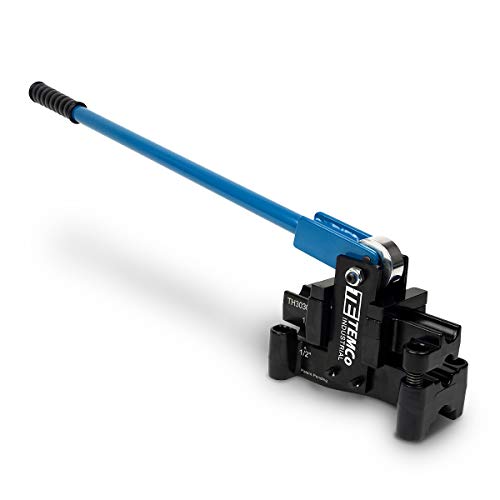
- Handles both 1/2-inch and 3/4-inch EMT
- Makes offsets in one motion
- Tool-free die changes take less than a minute
Best For: Quick electrical-box offsets in two EMT sizes
Best Heavy-Duty Compact Option
IDEAL 74-027 Ductile Iron Bender

- Works with 3/4-inch EMT and 1/2-inch rigid or IMC
- Ductile-iron design supports heavy use
- Raised markings and serrated step improve control
Best For: Conventional bending of smaller conduit sizes
Best Overall Precision Pick
Klein Tools 51606 1/2-Inch EMT Bender

- Angle Setter supports repeatable common bends
- Bold markings aid alignment and offsets
- Wide pedal provides stability and leverage
Best For: Electricians making repeated 1/2-inch EMT bends
Best Multi-Size Value
3-Piece Aluminum EMT Bender Set

- Includes 1/2-, 3/4-, and 1-inch heads
- Carbon-steel handles and reinforced construction
- Serrated grip and engraved angle markings
Best For: Multi-size EMT, IMC, and RMC work
Best for Repeatable EMT Bends – Klein Tools 51607 Aluminum Conduit Bender
For electricians comparing conduit benders for electricians, the Klein Tools 51607 stands out for its 3/4-inch EMT compatibility and Angle Setter technology. The lightweight aluminum head, bold markings, and wide foot pedal are designed to make common bends easier to repeat accurately.
Best For: Electricians who regularly make repeated 10-, 22.5-, 30-, and 45-degree bends in 3/4-inch EMT.
Pros:
- Angle Setter technology helps produce consistent repeated bends.
- Compatible with 3/4-inch EMT and 1/2-inch RMC or IMC.
- Wide foot pedal and interior hook surface improve stability during bending.
- Cast markings support alignment for saddles, offsets, and back-to-back bends.
Cons:
- The supplied configuration is sized around 3/4-inch EMT rather than multiple EMT sizes.
- At 5.12 pounds, it may not be the lightest option for carrying between jobs.
The 51607 is a strong choice when repeatability matters. Its included Angle Setter and clear alignment features add practical value for production-style electrical work.
Heavy-Duty Worksite Pick – IDEAL 1-Inch EMT Ductile Iron Bender
Among conduit benders for electricians, the IDEAL 74-028 is built for demanding daily use. Its ductile iron construction provides added strength, while raised markings, a serrated step, and an internal hook surface help with visibility and grip.
Best For: Electricians who need a durable hand bender for 1-inch EMT and 3/4-inch rigid or IMC conduit.
Pros:
- Ductile iron construction is designed to withstand heavy daily use.
- Compatible with 1-inch EMT and 3/4-inch rigid or IMC.
- Raised markings are cast on both sides for easier viewing.
- Serrated step and internal hook surface help prevent slippage.
Cons:
- At 6.6 pounds, it is heavier than aluminum alternatives.
- It has no supplied warranty according to the product details.
This IDEAL bender prioritizes strength over low weight. It is a sensible fit for electricians who want a robust tool for frequent, forceful conduit work.
Best Complete Kit – Klein Tools 80148 Conduit Bending Set
The Klein Tools 80148 is a two-piece option for electricians shopping for conduit benders for electricians with measuring support included. Its aluminum construction, bold alignment markings, and attachable level are intended to simplify angle measurement and common conduit bends.
Best For: Electricians who want a complete bending set with an attachable level for checking 30-, 45-, 90-degree, and level positions.
Pros:
- Two-piece set offers a ready-to-use bending and measuring setup.
- Rare-earth magnets are secured by a patented magnet track.
- Large vials and top-view windows improve readability from different angles.
- Bold cast markings help align conduit for saddles and back-to-back bends.
Cons:
- The set weighs 6.98 pounds.
- It may offer more measuring capability than needed for buyers seeking only a basic bender.
The 80148 is geared toward convenience and alignment accuracy. Its included level makes it particularly useful when angle checking is part of the bending workflow.
Lightweight 3/4-Inch Choice – IDEAL 74-047 Aluminum EMT Bender
For electricians seeking conduit benders for electricians that are easier to carry, the IDEAL 74-047 uses lightweight aluminum construction for 3/4-inch EMT. Heat-treated material, reinforced stress points, and raised markings provide practical support for routine jobsite bending.
Best For: Electricians who need a portable 3/4-inch EMT bender with visible markings and a stable starting hook.
Pros:
- Lightweight aluminum construction helps with jobsite transport.
- Heat-treated head and reinforced stress points support durability.
- Raised markings on both sides improve visibility.
- Serrated step, grooved hook, and flat hook surface help stabilize bends.
Cons:
- It is designed for 3/4-inch EMT rather than a broader range of conduit sizes.
- The supplied details list no warranty.
The 74-047 is a straightforward portable option for 3/4-inch EMT work. Its combination of low-weight aluminum and anti-slip features suits electricians who move tools frequently between locations.
Best Overall – Klein Tools 51605 Iron Conduit Bender
For electricians who need versatile conduit benders for electricians, the Klein Tools 51605 combines a durable ductile-iron head with built-in guidance for common bend angles. Its included Angle Setter helps make repeated bends more consistent, while the wide pedal and bold markings support controlled job-site work.
Best For: Electricians making frequent, repeatable bends in 1-inch EMT, 3/4-inch RMC, and IMC.
Pros:
- Included Angle Setter supports repeatable 10-, 22.5-, 30-, and 45-degree bends.
- Heavy-duty cast ductile iron is designed for job-site durability.
- Bold markings, a wide foot pedal, and an interior hook aid alignment and stability.
Cons:
- At 11.6 pounds, it is relatively heavy to move around a job site.
- Its primary 1-inch configuration may be more tool than needed for smaller conduit work.
The 51605 is a strong all-around choice when accuracy, stability, and repeated angle work matter more than minimizing tool weight.
Best for Dual-Size Offsets – TEMCo TH3030 Offset Bender
The TEMCo TH3030 stands out among conduit benders for electricians who regularly make box offsets in more than one EMT size. Its two-in-one design handles both 1/2-inch and 3/4-inch EMT, and the die change requires no tools and can be completed in less than a minute.
Best For: Electricians who need quick, repeatable electrical-box offsets in both 1/2-inch and 3/4-inch EMT.
Pros:
- One tool bends both 1/2-inch and 3/4-inch EMT.
- Creates an offset in one motion, reducing the need for a double bend.
- Lightweight aluminum construction helps with job-site movement.
Cons:
- Its specialized offset design is less suited to general-purpose bending.
- At 12.07 pounds, it is not especially light despite its aluminum construction.
Choose the TH3030 when box offsets are a regular task and switching between two EMT sizes is more valuable than having a conventional multipurpose bender.
Best Heavy-Duty Compact Option – IDEAL 74-027 Ductile Iron Bender
The IDEAL 74-027 is a straightforward choice for conduit benders for electricians who want a durable hand tool for common smaller-conduit work. Its ductile-iron construction is built for heavy daily use, while raised markings on both sides and a serrated step help with visibility and control.
Best For: Electricians bending 3/4-inch EMT or 1/2-inch rigid and IMC conduit with a conventional bender.
Pros:
- Compatible with 3/4-inch EMT and 1/2-inch rigid and IMC conduit.
- Ductile iron offers more strength than malleable iron or aluminum, according to the supplied specifications.
- Raised markings, a serrated step, and an internal hook support accurate, slip-resistant bending.
Cons:
- It does not include an angle-setting feature like the Klein model.
- The supplied listing states that it has no warranty.
The 74-027 fits buyers seeking a traditional, durable bender head and handle for common 3/4-inch EMT applications without added adjustment features.
Best Overall Precision Pick – Klein Tools 51606 1/2-Inch EMT Bender
For electricians comparing conduit benders for electricians, the Klein Tools 51606 stands out as a complete 1/2-inch EMT setup with built-in guidance for repeatable bends. Its Angle Setter and bold cast markings are designed to speed up common bends while helping with alignment.
Best For: Electricians who regularly make repeated 1/2-inch EMT bends and want an assembled, stability-focused tool.
Pros:
- Includes an Angle Setter for repeated 10-, 22.5-, 30-, and 45-degree bends.
- Bold markings support alignment for saddles, offsets, and back-to-back bends.
- Wide foot pedal, interior hook surface, and conduit clamp improve control and handling.
Cons:
- Designed specifically for 1/2-inch EMT rather than multiple conduit sizes.
- At 4.4 pounds and nearly 40 inches long, it is less compact than a bender head alone.
The 51606 is a strong choice when consistency and workflow speed matter more than maximum portability. Its dedicated 1/2-inch EMT format and included handle make it ready for hands-on work without assembling a custom handle.
Best Multi-Size Value – 3-Piece Aluminum EMT Bender Set
Among conduit benders for electricians, this three-piece set offers broader size coverage than a single head. It includes 1/2-, 3/4-, and 1-inch aluminum bender heads with carbon-steel handles, making it useful for projects involving several compatible EMT, IMC, or RMC sizes.
Best For: Electricians and installers who need dedicated benders for multiple common conduit sizes.
Pros:
- Includes 1/2-, 3/4-, and 1-inch bender heads.
- Heat-treated construction combines aluminum elbows with carbon-steel handles.
- Serrated gripping surfaces and engraved angles support controlled, visible bending.
Cons:
- The complete set weighs 15.67 pounds and requires more storage space.
- The supplied notes caution that other steel tube types may not bend correctly.
- It may be more equipment than needed for jobs limited to one conduit size.
This set makes the most sense for a shop, service vehicle, or crew that works across several listed conduit sizes. Confirm the tubing specification before bending, since the manufacturer notes that compatibility is size- and material-specific.
Best Compact Option – 1/2-Inch EMT Bender Head
For electricians seeking compact conduit benders for electricians, this 1/2-inch EMT bender head keeps the working end small and lightweight. It uses a separate 3/4-inch threaded black pipe or conduit as the handle, so it is suited to users who already have a compatible handle available.
Best For: Electricians and DIYers who prioritize toolbox storage and already own a compatible 3/4-inch threaded handle.
Pros:
- Lightweight 1.05-pound aluminum die-cast head stores easily.
- Embossed markings cover 10, 22, 30, 45, 60, and 90 degrees.
- Serrated foot step helps grip conduit during bending.
Cons:
- Handle is not included.
- Limited to 1/2-inch EMT applications.
- Requires a compatible 3/4-inch threaded pipe or conduit for use.
This head is a practical space-saving choice when portability matters and a suitable handle is already on hand. Buyers needing a ready-to-use bender should account for the additional handle requirement.
How We Picked the Best Conduit Benders for Electricians
We focused on the details that matter on real job sites: conduit-size compatibility, support for EMT, IMC, or RMC where specified, construction materials, handle or head design, visibility of degree markings, and overall versatility. We also included both individual benders and sets because electricians have different needs. A dedicated 1/2-inch or 3/4-inch tool may be faster and lighter for repetitive work, while a multi-size set can reduce the number of tools you need to carry.
Product descriptions and stated specifications were prioritized, but buyers should confirm current measurements, included components, and manufacturer compatibility before ordering.
Quick Comparison
| Best For | What to Look For |
|---|---|
| Daily EMT installation | A purpose-built bender with clear degree markings and a comfortable handle |
| Multiple conduit sizes | A set or dual-size tool covering the sizes used most often |
| Heavy-duty work | Ductile iron construction and a rigid, well-supported handle |
| Lower carrying weight | An aluminum head or aluminum full assembly |
| Offset bends | A dedicated offset bender designed for the required EMT sizes |
Key Buying Factors for Conduit Benders for Electricians
Conduit Size and Material
Check that the bender matches the conduit you install most frequently. A tool listed for 1/2-inch EMT is not automatically suitable for 3/4-inch EMT, IMC, or RMC. Sets can provide broader coverage, but verify that each included head is clearly labeled.
Construction and Weight
Aluminum is useful when portability and reduced fatigue matter, especially for overhead work or large tool loads. Ductile iron generally offers a solid, durable feel for demanding use, though it adds weight. Choose the balance that fits your daily work rather than assuming the heaviest tool is always best.
Markings, Shoe Design, and Handle
Clear degree markings, common bend references, and a stable shoe make it easier to produce repeatable bends. A properly fitted handle improves leverage and control. If buying a bender head separately, confirm whether a compatible handle is included or must be purchased independently.
Portability and Versatility
Individual benders are quick to grab for repetitive installations, while multi-piece kits make sense for service vans and varied projects. Consider storage space, the number of sizes you actually use, and whether a specialized offset tool would save time.
Who Should Buy Which Conduit Benders for Electricians?
Electricians who mostly bend standard 1/2-inch or 3/4-inch EMT should choose a dedicated, clearly marked hand bender for speed and consistency. Those handling several conduit sizes should consider a multi-size set or dual-size design. For demanding commercial or industrial work, a ductile iron model may be preferable for its robust construction. If reducing fatigue is a priority, an aluminum assembly is often the more practical option. Buyers who frequently make offsets should choose a purpose-built offset bender instead of relying solely on a general-purpose tool.