The best occupancy sensors for greenhouses can reduce wasted lighting, ventilation, and climate-control runtime while helping you monitor activity in growing areas. The right choice depends on whether you need simple motion-triggered switching, precise human-presence detection, or broader temperature and humidity data.
We selected 10 options spanning residential smart-home setups, commercial electrical installations, high-bay fixtures, and multi-sensor greenhouse monitoring. Use the guide below to match each sensor’s detection method, coverage, connectivity, and installation requirements to your growing space.
Best 10 Occupancy Sensors for Greenhouses Picks for 2026
Commercial Wall Control
Leviton App-Configurable Occupancy Sensor

- No neutral wire required
- 180° detection with adjustable blinders
- Ambient-light override and manual push-button control
Best For: Hardwired greenhouse lighting controlled from a wall switch
Wide-Area Ceiling Coverage

- 360° coverage up to 1,200 square feet
- Adjustable delay, sensitivity, and light level
- Compatible with LED, CFL, and incandescent lights
Best For: Commercial greenhouse aisles and broad ceiling-mounted coverage
Local Smart Automation
Akamatis Litos v3 Presence Sensor

- 24GHz mmWave detection up to 20 feet
- Integrated ambient-light sensing
- Pre-flashed with ESPHome
Best For: Home Assistant-based greenhouse presence and light automations
Smart Room Monitoring
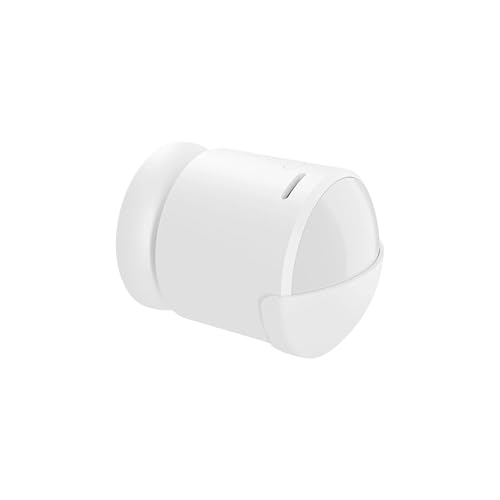
- Measures temperature, humidity, and occupancy
- Zigbee 3.0 connection for Lux TQX systems
- Flexible wall, corner, or tabletop mounting
Best For: Lux TQX thermostat users needing remote room data
High-Bay Coverage Pick

- 360-degree PIR occupancy detection
- Adjustable sensitivity, light level, and delay
- Five-pack for compatible lighting circuits
Best For: Ceiling-mounted lighting zones needing automatic control
Humidity-Controlled Option

- Combines PIR motion and humidity sensing
- Humidity settings from 30% to 85% RH
- Controls compatible lights and fans
Best For: Indoor single-pole fan and lighting control
Best Value Pick
RAYZEEK 360° Ceiling Occupancy Sensor

- 1,600-square-foot 360° coverage
- 15-second to 30-minute timing
- Neutral wire required
Best For: Indoor utility areas needing adjustable automatic lighting
Best for Multi-Zone Coverage
EverElectrix 10-Pack Ceiling Sensors

- Ten sensors for larger installations
- 120–277 VAC compatibility
- Up to 30-foot detection coverage
Best For: Commercial greenhouse facilities with multiple zones
Most Versatile Controls
YCA1001 360° Ceiling Motion Sensor

- Controls lights, fans, and alarms
- 110–240 VAC universal voltage
- Adjustable photocell, timing, and sensitivity
Best For: Indoor support spaces needing lighting and ventilation control
Commercial Wall Control – Leviton App-Configurable Occupancy Sensor
For greenhouse lighting controlled from a standard wall switch, this Leviton sensor offers automatic activation when motion is detected while retaining push-button control. Its adjustable detection field and configurable ambient-light override can help reduce unnecessary operation in spaces with adequate daylight.
Best For: Greenhouse rooms or work areas needing a hardwired, wall-mounted occupancy sensor for automatic light control.
Pros:
- Works with incandescent and fluorescent lighting.
- No neutral wire is required.
- 180-degree detection field with adjustable blinders.
- Ambient-light override can prevent activation when sufficient light is present.
Cons:
- Designed for wall mounting rather than broad ceiling coverage.
- Its listed operating voltage is 120 volts AC, despite the product title referencing 120–277VAC.
- Requires wired installation at the switch location.
The Leviton is a practical choice when greenhouse occupancy control needs to integrate with existing wall-switch wiring. Its manual override and light-level setting make it more flexible than a basic motion-only switch.
Smart Presence Monitoring – meross MS600 Matter Presence Sensor
The meross MS600 combines PIR, millimeter-wave radar, and light sensing, making it one of the more capable occupancy sensors for greenhouses where stationary presence matters. It supports several smart-home platforms, but continuous power is required and Matter use requires a hub.
Best For: Connected greenhouse automation that needs presence detection, motion sensing, and ambient-light data.
Pros:
- Combines PIR, mmWave radar, and a light sensor.
- Detects motion up to 12 meters and presence up to 6 meters.
- Supports HomeKit, Alexa, Google Home, Home Assistant, and Meross.
- Adjustable base pivots 180 degrees and rotates 360 degrees.
Cons:
- Requires continuous corded power.
- Matter compatibility requires a hub.
- Its effective presence range is shorter than its maximum motion range.
With radar-based presence detection and a built-in light sensor, the MS600 can support more nuanced greenhouse automations than a conventional motion detector. Confirm your platform, hub, and power requirements before installation.
Wide-Area Ceiling Coverage – ENERLITES MPC-50V PIR Sensor
For larger greenhouse aisles, service areas, and utility spaces, the ENERLITES MPC-50V provides ceiling-mounted PIR detection with a 360-degree field of view. Its adjustable time delay, sensitivity, and light level settings allow the lighting response to be tailored to the space.
Best For: Commercial greenhouse aisles, hallways, bathrooms, offices, and other areas requiring broad ceiling coverage.
Pros:
- Covers up to 1,200 square feet with a 360-degree field of view.
- Adjustable time delay from 15 seconds to 30 minutes.
- Supports LED, CFL, and incandescent lighting.
- UL/cUL listed and California Title 24 compliant.
Cons:
- Installation is intended for a junction box and ceiling location.
- Maximum listed range is 38 feet, so placement still matters.
- Operating temperature is listed from 32°F to 131°F.
The MPC-50V is a straightforward commercial PIR option when broad overhead coverage is more important than smart-home connectivity. Its adjustable controls are useful for balancing reliable activation with reduced false triggering.
Local Smart Automation – Akamatis Litos v3 Presence Sensor
The Akamatis Litos v3 is a compact mmWave and ambient-light sensor for users building local automations with Home Assistant. For occupancy sensors for greenhouses, its ability to detect stationary objects up to 20 feet and measure available light can support presence-aware rules such as activating lights only when the area is occupied and dim.
Best For: Home Assistant users who want local greenhouse presence and light-based automations.
Pros:
- 24GHz mmWave radar detects motion and stationary objects up to 20 feet.
- Includes an integrated ambient-light sensor.
- Arrives pre-flashed with ESPHome firmware.
- Uses an ESP32-C3 and external antenna for Wi-Fi connectivity.
Cons:
- Requires an existing Home Assistant installation.
- Works exclusively with Home Assistant according to the supplied notes.
- Requires a 2.4GHz Wi-Fi network.
Litos v3 is best suited to technically inclined growers who already use Home Assistant and want flexible, local rules rather than a standalone switch. Its integrated light measurement adds useful context for greenhouse lighting automations.
Smart Room Monitoring – QSZ Remote Sensor
The QSZ Remote Sensor is a practical option for occupancy sensors for greenhouses when you need temperature, humidity, and occupancy data from multiple locations. Its Zigbee 3.0 connection pairs with the Lux TQX Smart Thermostat, while the included mounting options support flexible placement.
Best For: Users who already have a Lux TQX Smart Thermostat and want remote occupancy and climate data.
Pros:
- Measures temperature, humidity, and occupancy.
- Uses Zigbee 3.0 connectivity with the TQX thermostat system.
- Includes corner, wall, and table-mounting options.
- Magnetic swivel hinge simplifies battery replacement and sensor positioning.
Cons:
- Designed to pair with the Lux TQX Smart Thermostat rather than operate as a standalone controller.
- Requires two CR2 batteries.
Choose this sensor if ecosystem compatibility and combined environmental readings matter more than standalone greenhouse automation. Its occupancy data can help a compatible thermostat prioritize comfort in occupied rooms.
High-Bay Coverage Pick – ECOELER Ceiling Sensor
The ECOELER ceiling sensor is a straightforward choice among occupancy sensors for greenhouses where automatic light switching is the priority. Its passive infrared detection covers 360 degrees, with adjustable sensitivity, light-level sensing, and time delay for different spaces.
Best For: High-bay or ceiling-mounted lighting areas that need automatic on/off control based on detected movement.
Pros:
- 360-degree PIR detection with a stated range of up to 24 feet.
- Adjustable sensitivity from 20% to 100%.
- Adjustable time delay from 15 seconds to 30 minutes.
- Compatible with LED, incandescent, fluorescent, CFL, and low-voltage lighting types.
Cons:
- Requires a neutral wire and corded electrical installation.
- Operating temperature is listed as 32°F to 131°F.
- It is intended to control lights, not to measure greenhouse temperature or humidity.
This five-pack makes sense for outfitting several ceiling fixtures with motion-based lighting control. Verify wiring, fixture compatibility, and the listed temperature range before installation in a greenhouse environment.
Humidity-Controlled Option – Square D X Series Sensor
The Square D X Series combines PIR occupancy sensing with humidity control, making it a useful consideration among occupancy sensors for greenhouses that also need automated light or fan operation. It supports programmable humidity thresholds and separate manual controls for the connected fan and light.
Best For: Single-pole installations requiring occupancy or vacancy lighting control alongside automatic fan control.
Pros:
- Combines motion detection with programmable humidity sensing from 30% to 85% relative humidity.
- PIR motion range reaches up to 600 square feet.
- Supports fans up to 3 amps and up to 400W LED or 500W incandescent lighting.
- Offers occupancy and vacancy modes with manual push-button control.
Cons:
- Designed for 120-volt, single-pole/one-way wiring.
- Operating temperature is listed as 32°F to 104°F.
- IP20-rated and therefore not specified as weatherproof.
This model is best when humidity-based fan control is as important as occupancy-triggered lighting. Its indoor electrical design and temperature limits should be checked carefully before use in a greenhouse.
Best Value Pick – RAYZEEK 360° Ceiling Occupancy Sensor
For shoppers comparing occupancy sensors for greenhouses, the RAYZEEK offers 360-degree PIR detection, adjustable timing, and an optional ambient-light mode. It covers up to 1,600 square feet, though it is designed for indoor use and requires a working neutral wire.
Best For: Indoor greenhouse-adjacent utility areas, storage rooms, garages, and other spaces needing automatic lighting control.
Pros:
- 360-degree detection with coverage up to 1,600 square feet.
- Adjustable time delay from 15 seconds to 30 minutes.
- Works with incandescent, halogen, fluorescent, CFL, and LED lighting, plus ceiling and exhaust fans.
- Offers adjustable sensitivity and light-level thresholds.
Cons:
- Requires a working neutral wire.
- Rated for indoor use only.
- Supports loads up to 5 amps, so larger installations may need additional planning.
The RAYZEEK is a flexible single-sensor option when you need broad ceiling coverage and configurable lighting behavior. Confirm the wiring and load requirements before installation.
Best for Multi-Zone Coverage – EverElectrix 10-Pack Ceiling Sensors
For larger greenhouse facilities or adjoining work areas, this 10-pack provides multiple hard-wired ceiling occupancy sensors with 360-degree coverage. Its 120–277 VAC compatibility and commercial-grade design suit high-mounted, industrial environments.
Best For: Commercial or industrial installations that need sensors across multiple rooms, bays, aisles, or work zones.
Pros:
- Includes 10 sensors for broad multi-area deployment.
- 360-degree detection with sensitivity coverage up to 30 feet.
- Supports 120–277 VAC systems.
- Adjustable time delay from 15 seconds to 30 minutes, with occupancy and vacancy modes.
Cons:
- Hard-wired installation may require qualified electrical work.
- Designed for commercial and industrial environments rather than small residential spaces.
- The 10-pack may be more than needed for a single-zone installation.
This bundle is the practical choice when consistent occupancy detection is needed across many areas. Its broad voltage range and adjustable controls add installation flexibility, while the pack size helps standardize a larger project.
Most Versatile Controls – YCA1001 360° Ceiling Motion Sensor
The YCA1001 is a versatile choice among occupancy sensors for greenhouses when a single ceiling-mounted unit must control lighting, an exhaust fan, or an alarm system. It provides 360-degree detection, a listed 40-foot detection range, and adjustable photocell, timing, and sensitivity controls.
Best For: Indoor rooms, utility spaces, bathrooms, or greenhouse support areas where lighting and ventilation may be automated together.
Pros:
- 360-degree PIR detection with a 40-foot range listed in the product description.
- Compatible with 110–240 VAC systems.
- Can control lights, exhaust fans, and alarm systems.
- Adjustable photocell, time delay, and motion sensitivity dials.
Cons:
- IP22-rated for indoor use, so it is not intended for exposed outdoor conditions.
- Optimal installation height is about 9 feet, with a stated 5–12-foot range.
- Best results require about 6 feet of clearance between the sensor and light fixture.
Choose the YCA1001 when control flexibility matters more than multi-pack coverage. Its universal voltage support and fan-control capability make it especially useful in enclosed greenhouse support spaces, provided the installation conditions match its indoor rating.
How We Picked the Best Occupancy Sensors for Greenhouses
We compared these Occupancy Sensors for Greenhouses by focusing on detection technology, coverage, electrical compatibility, installation style, connectivity, and practical greenhouse use. The list includes PIR sensors for dependable motion detection, mmWave models for more persistent presence sensing, and devices that add temperature or humidity data. We also considered whether a product is intended for junction-box installation, ceiling mounting, fixture mounting, or flexible placement.
Because greenhouse environments vary widely, no single sensor is ideal for every application. Check the manufacturer’s environmental ratings before installing any indoor-rated product in a humid or condensation-prone structure.
Quick Comparison
| Best For | Recommended Type | What to Look For |
|---|---|---|
| Smart-home automation | Matter or Wi-Fi presence sensor | App support, platform compatibility, and reliable network coverage |
| Basic lighting control | PIR occupancy switch | Detection range, timeout settings, and load rating |
| Commercial greenhouse zones | Hardwired ceiling or high-bay sensor | Voltage range, code approvals, and fixture compatibility |
| Climate monitoring | Temperature, humidity, and occupancy sensor | Accurate readings, remote access, and automation integrations |
| Large installations | Multi-pack ceiling sensors | Per-unit cost, coverage overlap, and wiring requirements |
Key Buying Factors for Occupancy Sensors for Greenhouses
Detection Technology and Coverage
PIR sensors detect changes in infrared energy and work well when people move through a defined area. mmWave sensors can detect smaller movements and may maintain presence detection more consistently, but they often require more configuration. Compare the stated detection angle and range with the height, benches, shelving, and partitions in your greenhouse.
Power, Wiring, and Load Compatibility
Confirm whether the sensor uses line voltage, low voltage, batteries, USB power, or a plug-in adapter. Hardwired commercial models may support 120–277VAC systems, while residential switches can have narrower requirements. Also verify neutral-wire needs, minimum loads, maximum amperage, relay compatibility, and whether LED drivers or fans are supported.
Humidity, Temperature, and Environmental Conditions
Greenhouses can expose electronics to moisture, heat, dust, and rapid temperature changes. An occupancy sensor should be installed in a protected location unless it is specifically rated for the environment. If climate data is important, choose a model with temperature and humidity sensing rather than relying on occupancy data alone.
Connectivity and Automation
Wi-Fi, Matter, and Home Assistant-compatible sensors can trigger lights, fans, alerts, and irrigation-related routines. However, smart models depend on network stability and software support. For critical lighting or ventilation, a standalone hardwired sensor may be more dependable than a cloud-dependent device.
Who Should Buy Which Occupancy Sensors for Greenhouses?
Choose a smart Wi-Fi, Matter, or Home Assistant-compatible sensor if you want schedules, remote monitoring, or automation scenes. Select a commercial ceiling or high-bay model for permanent installations with line-voltage lighting and professional wiring. A temperature-and-humidity sensor is the better choice when occupancy is only one part of your environmental monitoring plan.
For small growing spaces, prioritize easy placement and adjustable sensitivity. For larger greenhouses, use multiple ceiling-mounted sensors with overlapping coverage, and plan zones around benches, walkways, entrances, and work areas. Before buying, confirm voltage, mounting method, detection range, environmental suitability, and compatibility with the lights, fans, or controller you intend to operate.