A portable EV charger can give you a charging option away from a dedicated wall unit—but the right one depends on the outlets you can use and the charging speed your car supports.
These 10 picks span basic 120V charging, dual-voltage flexibility, and higher-output 240V options. Use the guide below to narrow the field before checking each model’s details.
Best 10 Portable Ev Chargers Picks for 2026
Fast 240V Pick

- Up to 9.6 kW at 240V
- NEMA 14-50 plug; 16-foot cable
- ETL certified and IP65 rated
Best For: J1772 drivers with a NEMA 14-50 outlet
Standard-Outlet Pick

- 120V NEMA 5-15 plug
- 16-foot J1772 cable
- ETL certified and IP65 rated
Best For: Overnight charging from a 120V outlet
Adjustable-Charging Pick

- Four current settings and delay timer
- NEMA 6-20 plus 5-15 adapter
- TFT charging-status display
Best For: J1772 drivers wanting current and scheduling controls
Long-Cable Pick

- 25-foot charging cable
- NEMA 6-20 plug and 5-15 adapter
- LED status display and carrying bag
Best For: Compatible J1772 vehicles parked farther from an outlet
Best Dual-Outlet Option
bokman 32A Level 1 & 2 Charger

- 32A maximum Level 2 output
- NEMA 14-50 plug; 5-15 adapter included
- 20-foot cable and 1–12-hour timer
Best For: Home Level 2 charging with a standard-outlet fallback
Best for App Controls

- Up to 40A on a 50A circuit
- Wi-Fi scheduling and charging history
- 25-foot cable; NEMA 14-50 plug
Best For: Drivers seeking app controls and longer cable reach
Best for NEMA 6-20 Outlets
bokman 16A Level 1 & 2 Charger

- 16A maximum Level 2 output
- NEMA 6-20 plug; 5-15 adapter included
- 20-foot cable and adjustable timer
Best For: NEMA 6-20 setups needing a Level 1 fallback
Adjustable 32A Pick

- Up to 32A on a NEMA 14-50 outlet
- 25-foot cable and carrying case
- Adjustable current and delay setting
Best For: J1772 drivers seeking flexible 240V charging
Higher-Output Pick
EVDANCE 40A Level 2 EV Charger

- Up to 40A and 9.6kW at 240V
- 10A–40A selectable current
- 2.4-inch display and delayed start
Best For: J1772 drivers with a circuit suited to 40A charging
Dual-Voltage Pick
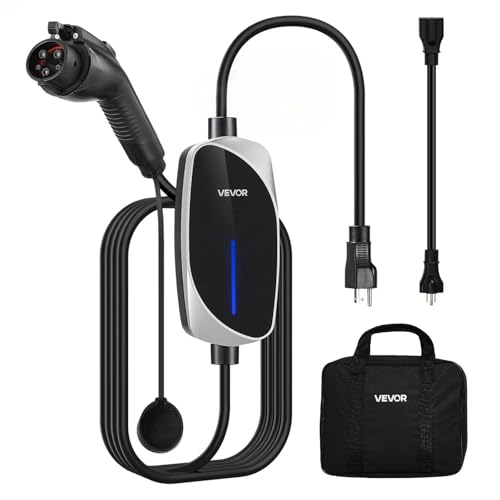
- 120V/240V charging options
- NEMA 6-20 plug and 5-15 adapter
- 16A rating and 25-foot cable
Best For: J1772 drivers needing two outlet options
Fast 240V Pick – Lectron 40A Level 2 Charger
Among portable ev chargers, this Lectron is the higher-output option for drivers with a NEMA 14-50 outlet. It delivers up to 40A at 240V (9.6 kW) through a J1772 connector, with a 16-foot cable for garage or driveway use.
Best For: J1772 drivers who have a suitable 240V NEMA 14-50 outlet and want faster home charging without hardwiring.
Pros:
- Up to 9.6 kW charging output at 240V and 40A.
- Plugs into a NEMA 14-50 outlet; no hardwiring required.
- ETL certified to UL 2594, ENERGY STAR certified, and IP65 rated.
Cons:
- Requires a compatible 240V NEMA 14-50 outlet.
- Its 16-foot cable offers less reach than a 25-foot option.
- Tesla vehicles need an adapter.
Choose this one for charging speed rather than outlet flexibility: it is built around a single 240V plug type, so check your outlet and parking distance before buying.
Standard-Outlet Pick – Lectron 15A Level 1 Charger
If access to an ordinary 120V outlet matters more than charging speed, this Lectron is one of the simpler portable ev chargers to consider. Its NEMA 5-15 plug and J1772 connector make it suited to routine overnight charging where a compatible outlet is available.
Best For: J1772 drivers who need a 120V charging option at home, work, or a destination without a 240V outlet.
Pros:
- Uses a standard NEMA 5-15 outlet.
- 16-foot cable provides some flexibility in where you park.
- ETL certified to UL 2594, ENERGY STAR certified, and IP65 rated.
Cons:
- Level 1 charging is slower than the 240V options in this roundup.
- Does not offer a 240V plug for Level 2 charging.
The practical appeal is easy access to 120V power. Expect charging time to depend on your vehicle and how long you can leave it plugged in.
Adjustable-Charging Pick – Raylix Level 1 & 2 Charger
This Raylix stands out among portable ev chargers for its charging controls: four selectable current settings, a 1–12-hour delay timer, and a TFT display showing charging information. It supports J1772 vehicles using a NEMA 6-20 connection for 240V charging or the supplied NEMA 5-15 adapter for 120V charging.
Best For: J1772 drivers who want adjustable current and delayed charging across compatible 120V and 240V outlets.
Pros:
- Offers 8A, 10A, 12A, and 16A current settings plus a delay timer.
- Supports 240V/16A charging from NEMA 6-20 and 120V charging with the NEMA 5-15 adapter.
- TFT display shows voltage, current, power, and charging temperature.
Cons:
- On a NEMA 5-15 outlet, charging is automatically limited to 12A.
- Its 16A maximum is lower than the 40A Lectron Level 2 model’s rating.
Its controls are useful if you need to tailor charging to your outlet or schedule. Check that you have the appropriate outlet for the charging level you plan to use.
Long-Cable Pick – EVDANCE Level 1 & 2 Charger
For parking spots farther from an outlet, this EVDANCE is one of the portable ev chargers here with a 25-foot cable. It comes with a NEMA 6-20 plug for 240V/16A charging and an adapter for 120V/12A charging from a NEMA 5-15 outlet.
Best For: Drivers of compatible J1772 vehicles who need a longer cable and access to both supported outlet types.
Pros:
- 25-foot cable offers extra reach in a garage or driveway.
- Supports Level 1 and Level 2 charging with the included plugs.
- Includes a carrying bag and an LED status and error display.
Cons:
- Does not directly plug into NEMA 14-50 or several other common 240V outlet types.
- The supplied notes list exceptions to vehicle compatibility; check your model before ordering.
- Tesla vehicles require a separate J1772 adapter.
The longer cable is the main reason to choose it. Verify both your vehicle and outlet against the seller’s compatibility guidance, particularly if you plan to use 240V charging.
Best Dual-Outlet Option – bokman 32A Level 1 & 2 Charger
Among portable ev chargers, this bokman model is a practical choice if you have a NEMA 14-50 outlet at home but also want an included NEMA 5-15 adapter for occasional Level 1 charging. Its 20-foot cable and adjustable current make it easier to fit different parking and outlet setups.
Best For: Drivers who want 32A Level 2 charging at home and a standard-outlet fallback for travel.
Pros:
- Adjustable Level 2 current from 6A to 32A, plus a 1–12-hour delay timer.
- Includes a NEMA 5-15 adapter; tactile buttons and an LED screen provide controls without an app.
- ETL certified, with an IP65-rated enclosure and a 20-foot cable.
Cons:
- Level 2 charging requires a compatible NEMA 14-50 outlet.
- Tesla vehicles require a separate J1772 adapter.
Choose this one if its two supplied plug options match where you expect to charge. The 32A setting offers more Level 2 headroom than the 16A bokman model, while the included adapter avoids an extra purchase for standard-outlet use.
Best for App Controls – AIMILER 40A Level 2 Charger
If you want app features from portable ev chargers, the AIMILER offers Wi-Fi charging controls alongside plug-and-charge operation. It uses a NEMA 14-50 plug, provides adjustable output up to 40A on an appropriate circuit, and has a 25-foot cable for extra parking reach.
Best For: Drivers with a suitable 240V outlet who want charging history, scheduling, and status in an app.
Pros:
- Adjustable 16A–40A output, with a 40A setting specified for a 50A circuit.
- Wi-Fi app supports charging periods, cost and history tracking, and status checks.
- 25-foot cable, on-device display, and ETL certification.
Cons:
- A standard-outlet EV adapter is not included; Level 1 charging with one is much slower.
- Initial Wi-Fi setup may require a 2.4 GHz-only network.
- NACS-equipped vehicles, including Teslas, require a separate J1772 adapter.
This is the feature-rich pick if you will use its app and have a circuit sized for your selected current. Check the plug and vehicle connector before buying, particularly if you also expect to charge from a standard outlet.
Best for NEMA 6-20 Outlets – bokman 16A Level 1 & 2 Charger
This bokman is one of the portable ev chargers to consider when your available Level 2 outlet is NEMA 6-20 rather than NEMA 14-50. It includes a NEMA 5-15 adapter for standard-outlet charging and pairs a 20-foot cable with simple on-device controls.
Best For: Drivers with a NEMA 6-20 outlet who also want an included Level 1 adapter for occasional charging elsewhere.
Pros:
- Adjustable Level 2 current from 6A to 16A and a 1–12-hour delay timer.
- Included NEMA 5-15 adapter adds standard-outlet flexibility.
- ETL certified, with an IP65-rated enclosure, LED screen, and tactile buttons.
Cons:
- Maximum 16A output is lower than the other chargers in this roundup.
- Level 2 use requires a NEMA 6-20 outlet; Tesla vehicles need a separate J1772 adapter.
The outlet type is the deciding factor here. If NEMA 6-20 matches your setup, this model provides dual-level charging without an app; if you need higher Level 2 current, consider a charger and circuit suited to that requirement.
Adjustable 32A Pick – EVDANCE Level 2 EV Charger
Among portable ev chargers for a 240V NEMA 14-50 outlet, this EVDANCE model offers up to 32A (7.68kW) and a 25-foot cable. Its adjustable current and delay setting give you options for different circuits and charging times.
Best For: J1772 drivers who want a portable Level 2 charger with selectable current and a charging display.
Pros:
- Selectable current settings let you match the charger to an appropriate circuit.
- LED screen shows charging information, including current and voltage.
- Includes a carrying case and wall-mounting bracket.
Cons:
- Requires a compatible 240V NEMA 14-50 outlet for use.
- Tesla vehicles need a J1772 adapter, which is not included.
This is a practical choice if you value current control over a fixed-output charger. Despite its weather-resistant rating, the supplied guidance advises against placing it in direct sunlight or heavy rain.
If you are comparing portable ev chargers for higher Level 2 output, this EVDANCE model reaches up to 40A (9.6kW) through a 240V NEMA 14-50 connection. Its 25-foot cable, adjustable current, and delayed start make it useful for both routine and scheduled charging.
Best For: J1772 drivers with a suitable NEMA 14-50 setup who want up to 40A and detailed on-device charging information.
Pros:
- Six selectable current settings from 10A to 40A.
- One- to 12-hour delay setting supports scheduled charging.
- 2.4-inch TFT screen displays charging data and status.
- Includes a carry bag and holders for the cable and control box.
Cons:
- Its 40A maximum requires a suitably rated circuit.
- Tesla charging requires a J1772 adapter that is not included.
Choose this over the 32A EVDANCE model if your electrical setup can support the higher output and you want its larger display. Otherwise, the extra capacity may offer little benefit.
For shoppers who need portable ev chargers that can use more than one outlet type, this 16A VEVOR model supports a NEMA 6-20 connection and includes a NEMA 5-15 adapter. Its 25-foot cable provides reach at home or when charging away from your usual spot.
Best For: J1772 drivers who prioritize 120V/240V outlet flexibility over higher charging current.
Pros:
- Supports Level 1 and Level 2 charging with the supplied plug and adapter.
- 25-foot cable and carrying bag make storage and transport easier.
- LED indicators show charging status and alert you to issues.
- IP66-rated control box offers water and dust protection.
Cons:
- Limited to 16A, below the maximum output of the two EVDANCE chargers.
- The notes do not list adjustable current or a charging timer.
This is the flexible-outlet option of the three. Check which receptacles you expect to use and choose it for compatibility and portability rather than maximum Level 2 speed.
How We Picked These Portable Ev Chargers
We focused on practical differences in the listed specifications: 120V versus 240V operation, plug type, stated amperage, cable length, and features such as adjustable current or app controls. We also considered whether a charger is better suited to occasional travel, routine home charging, or both. Listings do not replace independent testing: confirm certification claims and the exact package contents with the seller before buying.
Quick Comparison: Match the Charger to Your Outlet
Start with the receptacle you actually have. The Lectron Level 1 uses a standard 120V NEMA 5-15 connection for slower charging. Dual-voltage 16A options from Lectron’s competitors—including EVDANCE, VEVOR, and bokman—offer more flexibility when their supplied plugs or adapters match your outlets. For a NEMA 14-50 outlet, the listed 32A and 40A models from bokman, EVDANCE, AIMILER, and Lectron target faster Level 2 charging. A 25-foot cable may help with awkward parking positions; a 16- or 20-foot cable may be sufficient when the outlet is nearby.
Key Buying Factors for Portable Ev Chargers
Outlet and Circuit Capacity
A plug that fits is not proof that a circuit can safely supply the charger’s full rated current. EV charging is a continuous electrical load: as a general rule, set charging current to no more than 80% of the circuit rating, subject to local code and your electrician’s advice. For example, 40A charging generally calls for a suitable 50A circuit. Never use a household extension cord to compensate for an inconvenient outlet.
Vehicle Connector and Charging Limit
These selections advertise J1772 connectors. Check your vehicle’s inlet and whether it needs a compatible adapter, particularly if it uses a NACS port. Your car’s onboard AC charger also limits the charging rate, even when the portable unit is rated for more power.
Portability, Reach, and Controls
Check the length of the charging cable, not just the total length of cables shown in a listing. Adjustable amperage can be useful when switching between suitable circuits; dual-voltage support helps only if the included plugs and adapters match the outlets you expect to use. App features are convenient, but basic charging should fit your needs without relying on them. Look for clear safety certification information for the complete charger and appropriate weather-use guidance if you expect to charge outdoors.
Who Should Buy Which Portable Ev Chargers?
Choose a Level 1 model if you primarily need overnight top-ups from a suitable standard outlet and can accept slower charging. Choose a 16A dual-voltage model if flexibility across compatible 120V and 240V outlets matters more than maximum speed. If you have a properly installed NEMA 14-50 circuit and need regular home charging, compare the 32A and 40A models against your vehicle’s AC limit, cable-reach needs, and budget. For travel, verify your destination’s outlet and permission to use it before packing any charger.