Choosing the right power quality analyzer can make troubleshooting faster, safer, and far more accurate. For electricians, the best tools do more than show voltage and current—they help reveal power issues before they become costly failures.
This roundup covers 10 practical options for different jobs, from basic circuit checks to advanced three-phase logging and energy monitoring.
Best 10 Power Quality Analyzers for Electricians Picks for 2026
Three-Phase Recording Power Analyzer

- Monitors voltage, current, frequency, power, and power factor.
- Logs up to 200,000 data groups with adjustable intervals.
- USB transfer and PC software support deeper analysis.
Best For: Industrial maintenance and three-phase troubleshooting
Handheld Three-Phase Clamp Meter
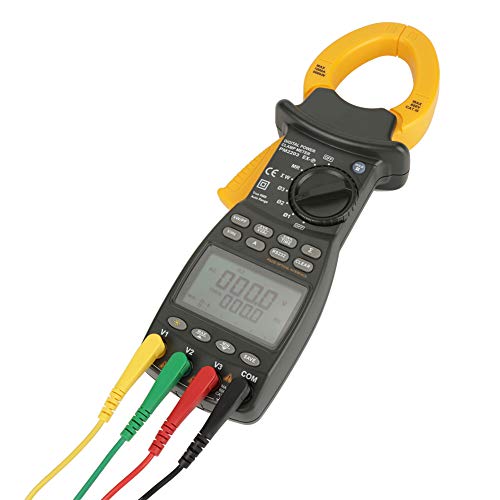
- Measures 8 parameters including power factor and energy.
- Handheld clamp design is suited to field testing.
- Large LCD and easy menu access support quick checks.
Best For: Field technicians needing portable three-phase measurements
Outlet and Load Test Circuit Analyzer

- Detects wiring faults in standard, AFCI, and GFCI outlets.
- Shows voltage drop plus AFCI/GFCI trip time and current.
- Large LCD and load testing support quick inspections.
Best For: Receptacle testing and outlet safety checks
Professional Three-Phase Energy Logger

- Logs voltage, current, power, power factor, and energy.
- Fluke Connect offers local, mobile, desktop, and Wi-Fi viewing.
- Rated 600 V CAT IV / 1000 V CAT III for high-safety work.
Best For: Professional three-phase logging and service work
Essential Electrical Test Kit
Klein Tools 69149P 3-Piece Test Kit
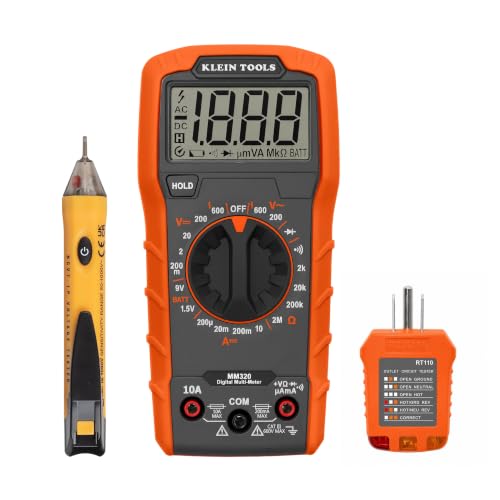
- Includes multimeter, NCVT, and receptacle tester
- Measures up to 600V AC/DC and 10A DC
- Good for continuity, voltage, and wiring checks
Best For: Electricians needing a compact basic test kit
Advanced Power Monitoring

- Measures power, energy, harmonics, THD, and PF
- True RMS for noisy or non-sinusoidal waveforms
- 1000A AC/DC clamp with inrush capture
Best For: Detailed power quality diagnostics on live circuits
Budget Power Analyzer

- Shows real-time amps, volts, and watts
- Tracks Ah, Wh, peak amps, and minimum volts
- Best for low-voltage DC monitoring up to 60V
Best For: Low-voltage DC load and battery monitoring
Single-Phase Logging Pick

- Real-time single-phase monitoring
- Up to 200,000 data groups stored
- USB transfer for analysis
Best For: Unattended monitoring on single-phase 120V/240V circuits
Dual-Outlet Value Pick
Briidea Electricity Usage Monitor
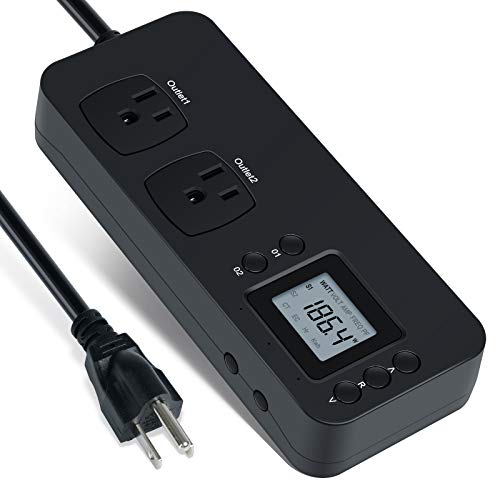
- Monitors two devices independently
- Tracks watts, volts, amps, hertz, and kWh
- Includes memory and overload warning
Best For: Quick plug-in monitoring of two appliances at once
Feature-Rich Plug-In Pick
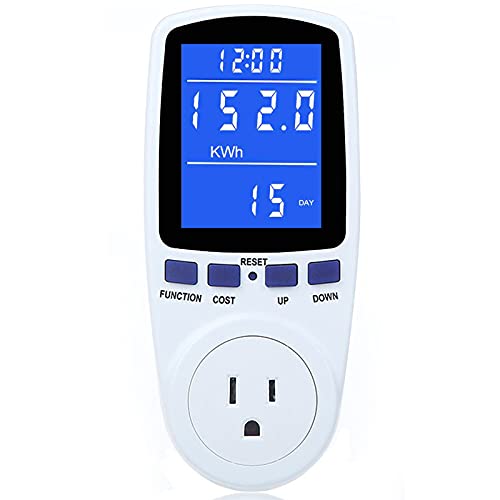
- Seven monitoring modes including cost and power factor
- Large backlit LCD with adjustable timing
- Overload protection and data memory
Best For: Detailed plug-in appliance monitoring with easy-to-read display
Three-Phase Recording Power Analyzer – ETCR8430 USB Power Recorder
For electricians who need power quality analyzers for electricians that can log long-term three-phase data, the ETCR8430 is built for broad monitoring and practical troubleshooting. It tracks voltage, current, frequency, active power, apparent power, and power factor, making it useful for maintenance checks and electrical diagnostics.
Best For: Industrial maintenance, facility inspection, and three-phase power troubleshooting.
Pros:
- Measures voltage from 0.01V to 600V and current from 1mA to 400A.
- Records up to 200,000 groups of data with adjustable intervals from 1 second to 99 minutes.
- Built-in rechargeable battery supports up to 48 hours of continuous operation.
- USB interface and PC software simplify data transfer and analysis.
Cons:
- Focused on recording and analysis rather than quick handheld spot checks.
- Best suited to three-phase systems, so it may be more tool than needed for simple outlet testing.
This is a strong pick when you need a recorder that can capture a lot of electrical data over time and move it into software for review. It fits electricians who work on industrial or facility systems and want a more complete view of power behavior.
Handheld Three-Phase Clamp Meter – Jeanoko MS2203 Multimeter
If you want power quality analyzers for electricians in a portable form, the Jeanoko MS2203 is built for on-site testing and maintenance. It measures and displays eight key parameters, including voltage, current, active power, power factor, apparent power, reactive power, active energy, and frequency.
Best For: Field technicians who need a handheld three-phase meter with broad power measurements.
Pros:
- Measures 8 parameters for detailed power analysis.
- Handheld clamp design suits on-site testing and maintenance.
- Large LCD and simple menu controls improve usability.
- Stores up to 28 sets of measurement parameters.
Cons:
- Memory capacity is limited compared with logging-focused analyzers.
- Designed more for direct measurement than long-duration recording.
The MS2203 makes sense when portability matters and you want a meter that can show multiple electrical values without bringing a larger recorder to the job. It is a practical choice for electricians who need fast, hands-on three-phase diagnostics.
Outlet and Load Test Circuit Analyzer – Klein RT390 Receptacle Tester
The Klein RT390 is a practical tester for electricians who need fast outlet and circuit checks rather than a full three-phase power logger. It identifies wiring faults, tests AFCI and GFCI devices, and shows voltage drop and trip time on a large color LCD.
Best For: Quick receptacle testing, wiring fault detection, and AFCI/GFCI inspection.
Pros:
- Large color LCD makes results easy to read.
- Detects common wiring faults, including open neutral and open ground.
- Tests AFCI and GFCI devices with trip time and trip current.
- Supports 12A, 15A, and 20A load testing.
Cons:
- Limited to North American 120V AC 3-wire outlets.
- Not intended for three-phase power quality analysis.
This is the right tool when the job is receptacle verification and basic load testing. For electricians focused on outlet safety and fault detection, it adds useful inspection features in a compact package.
Professional Three-Phase Energy Logger – Fluke 1732/B Power Meter
For electricians who want power quality analyzers for electricians with serious logging capability, the Fluke 1732/B is designed to measure and record three-phase AC power and energy. It automatically captures voltage, current, power, power factor, energy, and related values, while Fluke Connect support adds local, mobile, desktop, and Wi-Fi-based viewing options.
Best For: Professional three-phase power logging and high-safety service work.
Pros:
- Automatically captures and logs key power and energy measurements.
- Fluke Connect compatibility supports multiple ways to view data.
- Can be powered directly from the measured circuit.
- High safety rating: 600 V CAT IV / 1000 V CAT III.
Cons:
- Geared toward professional logging rather than simple point-and-test use.
- May be more tool than needed for basic outlet or single-circuit checks.
The 1732/B stands out for electricians who need a trusted logger for demanding three-phase jobs and service-entrance-adjacent work. Its logging features and safety rating make it a strong fit for serious electrical analysis.
Essential Electrical Test Kit – Klein Tools 69149P 3-Piece Test Kit
For electricians who need a practical starter set, this Klein Tools kit covers basic checks that matter on the job. It combines a multimeter, a non-contact voltage tester, and a receptacle tester, making it a useful option for fast troubleshooting and routine verification rather than full power quality analyzers for electricians.
Best For: Electricians who want a compact all-in-one kit for voltage checks, continuity testing, and outlet verification.
Pros:
- Multimeter measures up to 600V AC/DC, 10A DC current, and resistance to 2MOhms.
- NCVT1P provides non-contact voltage detection with bright LED and audible alerts.
- Receptacle tester identifies correct wiring and common wiring faults.
Cons:
- Not designed for advanced power quality measurements like harmonics or power factor.
- Focuses on basic electrical testing rather than detailed circuit analysis.
This is a sensible field kit if your priority is quick, reliable verification work. It is not a deep power analysis tool, but it does cover several everyday electrician checks in one compact package.
Advanced Power Monitoring – Triplett PQC300 Clamp Meter
If you are comparing power quality analyzers for electricians, the Triplett PQC300 stands out as the most analysis-focused tool in this group. It measures active, apparent, and reactive power, plus energy, harmonics, THD, and power factor, while the True RMS clamp design helps capture readings accurately on noisy or non-sinusoidal waveforms.
Best For: Electricians and technicians who need detailed power quality measurement without opening the circuit.
Pros:
- Measures power quality metrics including harmonics, THD, and power factor.
- True RMS support improves accuracy on non-sinusoidal or noisy waveforms.
- 1000A TRMS AC/DC clamp measurement is non-intrusive and practical for live circuits.
- 1.26″ clamp jaw and inrush function add flexibility for field work.
Cons:
- Bulkier and heavier than a basic meter at 7 pounds.
- More specialized than a simple troubleshooting tester if you only need voltage checks.
For deeper electrical diagnostics, this clamp meter offers the broadest feature set and the most relevant measurements for power-quality work. It is built for users who need more than basic voltage and continuity testing.
Budget Power Analyzer – 150A Watt Meter LCD
This watt meter is a compact option for checking current, voltage, and power in low-voltage setups. It is aimed at monitoring loads and battery systems, so it can be a practical support tool for electricians working with small DC circuits, though it is not a full-featured power quality analyzer for electricians.
Best For: Monitoring low-voltage DC loads, battery systems, and real-time electrical readings.
Pros:
- Displays real-time amperes, volts, and watts on an easy-to-read LCD.
- Provides eight readings, including Ah, Wh, peak amps, minimum volts, and peak watts.
- High-precision measurement covers 0-150A and 0-60V with fine resolution.
Cons:
- Limited to low-voltage applications up to 60V.
- Better suited to DC monitoring than full power quality analysis.
- Not intended for clamp-style field testing on higher-voltage circuits.
As a specialized watt meter, this unit is useful when you need clear, continuous readings on small electrical systems. It is less versatile than a clamp meter, but its detailed display can help with load and battery checks.
Single-Phase Logging Pick – ETCR8400 Power Recorder
If you need power quality analyzers for electricians that can track single-phase circuits over time, the ETCR8400 is built for practical field logging. It measures voltage, current, frequency, and power in real time, making it a useful choice for diagnosing 120V/240V lines and documenting load behavior during maintenance checks.
Best For: Electricians who need unattended single-phase monitoring and long-duration data logging on 120V/240V systems.
Pros:
- Monitors voltage, current, frequency, and power in real time.
- Uses one voltage channel and one clamp current channel for non-intrusive testing.
- Stores up to 200,000 data groups for long logging sessions.
- USB transfer makes it easier to move recorded data to a computer.
Cons:
- Designed for single-phase systems only.
- Requires a clamp sensor setup for current measurement.
- More focused on logging and analysis than quick plug-in checks.
Overall, the ETCR8400 is a strong fit when the job calls for continuous recording rather than a fast one-minute reading. Its memory capacity and battery life make it especially practical for inspections, troubleshooting, and maintenance tasks where captured data matters.
Dual-Outlet Value Pick – Briidea Electricity Usage Monitor
For electricians and homeowners looking at power quality analyzers for electricians in a simple plug-in format, the Briidea electricity usage monitor focuses on easy appliance-level tracking. Its dual-outlet layout lets you monitor two devices independently, while the display covers watts, volts, amps, hertz, kilowatt-hours, time, and power factor for straightforward energy checks.
Best For: Monitoring two household devices at once and checking basic power-use data from a plug-in analyzer.
Pros:
- Two outlets let you monitor two devices independently.
- Tracks power, voltage, current, hertz, kWh, time, and power factor.
- Includes power-off memory for retained usage data.
- Overload warning helps alert you when rated power is exceeded.
Cons:
- Best suited to plug-in appliances rather than panel or circuit logging.
- Less specialized than dedicated field recorders.
- Power limit warnings mean it is not meant for heavier loads beyond its rating.
This is a practical pick if you want simple, independent monitoring for two devices without complicated setup. It’s geared toward everyday usage analysis, so it makes more sense for appliance comparisons and energy-saving checks than for advanced troubleshooting.
Feature-Rich Plug-In Pick – Upgraded Watt Power Meter
If you want power quality analyzers for electricians in a compact socket tester, this upgraded watt meter packs a lot of display detail into a plug-in design. It shows watts, kWh, volts, amps, hertz, power factor, min/max power, and cost, with a backlit LCD that is easier to read in different lighting conditions.
Best For: Users who want a compact plug-in analyzer with detailed readings and a clear backlit display.
Pros:
- Displays seven modes of electrical data, including power, energy, voltage, current, and power factor.
- Large backlit screen improves readability day or night.
- Adjustable backlight timing adds flexibility for extended viewing.
- Overload protection warns when the connected load is too high.
Cons:
- Plug-in format limits it to outlet-connected appliances.
- Overload setting may need adjustment before first use.
- Not intended for direct circuit logging like a recorder with clamp input.
Among plug-in monitors, this one stands out for giving you more viewing options and clearer day-to-night usability. It is a solid choice if your main goal is to review appliance energy use, keep track of cost, and retain previous readings after unplugging.
How We Picked the Best Power Quality Analyzers for Electricians
We focused on Power Quality Analyzers for Electricians that balance measurement accuracy, useful diagnostics, portability, and everyday jobsite durability. The best choices also offer clear displays, straightforward controls, and the ability to capture the data that matters most during troubleshooting.
We prioritized tools that fit real electrical workflows, including single-phase and three-phase testing, load monitoring, energy tracking, and fault detection.
Quick Comparison
Not every analyzer serves the same purpose. Some models are better for fast checks at outlets and circuits, while others are built for longer logging sessions on panels, motors, and commercial systems. Clamp meter-style analyzers are usually the most versatile for fieldwork, while plug-in watt meters are better for basic usage checks.
Key Buying Factors for Power Quality Analyzers for Electricians
Measurement Scope
Start with the type of system you service most often. Single-phase tools are useful for homes and light commercial work, while three-phase analyzers are a better fit for industrial panels, HVAC, and larger distribution systems.
Logging and Data Capture
If you need to track intermittent issues, look for recording and logging features. These help you catch voltage dips, current spikes, energy use, and load patterns over time instead of relying on one-time readings.
Accuracy and Test Functions
For power quality work, accuracy matters. Look for tools that clearly measure voltage, current, wattage, frequency, and power usage. Extra functions like wiring fault detection, GFCI/AFCI testing, and voltage drop checks can save time in the field.
Display, Portability, and Ease of Use
A bright backlit display, simple navigation, and a compact body can make a big difference on busy jobs. Electricians often need to read results quickly in low-light spaces, so usability is not a minor feature.
Who Should Buy Which Power Quality Analyzers for Electricians?
If you need a versatile everyday tester, a clamp meter or circuit analyzer is often the best starting point. If your work involves troubleshooting commercial or industrial systems, a three-phase recorder or logger is usually worth the investment. For basic appliance, outlet, or home usage checks, a plug-in watt meter may be enough.
In short, the best Power Quality Analyzers for Electricians are the ones that match your typical system, deliver reliable readings, and help you act on the data quickly. Pick the lightest tool that still covers the measurements you truly use.