Choosing the right tester can make photovoltaic troubleshooting faster, safer, and far more accurate on site. For electricians working with solar, a good meter should deliver dependable readings without slowing down the job.
Below, we focus on practical options for real-world PV checks, from compact entry-level meters to higher-capacity units built for more demanding diagnostics.
Best 10 Solar Panel Testers for Electricians Picks for 2026
Professional PV Testing Pick
ZIBOO FT-2000W Solar Panel Tester

- Up to 2000W, 150V, 35A PV testing
- ±0.8% accuracy for Voc/Isc checks
- CAT III 1000V / CAT IV 600V rated
Best For: Field electricians and installers validating PV performance
Wide-Range Value Tester
1800W Solar Panel Tester MPPT Multimeter

- Covers 5W to 1800W and up to 60A
- Solar powered, so no batteries are needed
- LCD and safety protections support field use
Best For: Routine PV checks in residential and commercial installs
Portable Commissioning Choice
SK-705S Solar MPPT Power Tester
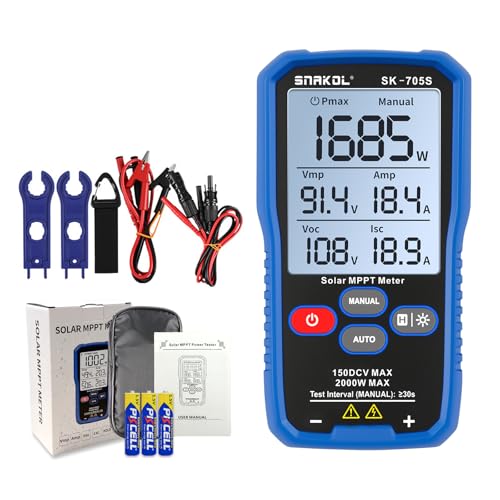
- Measures Pmax, Voc, Isc, Vmp, and Imp
- Auto and manual modes for field workflows
- 3.2-inch backlit LCD with data hold
Best For: Portable commissioning and maintenance testing
Compact Budget Option

- Measures Pmax, Voc, and Isc
- No battery needed for operation
- Compact with MC4 cables and wrench included
Best For: Smaller PV panels and quick troubleshooting
Field-Ready MPPT Tester
XUNTOP 2000W Solar Panel Tester

- 2000W MPPT testing with Pmax, Voc, Isc, Vmp, and amp
- Safety protections for over-voltage, over-current, reverse polarity, and heat
- Rechargeable battery with auto/manual modes and saved readings
Best For: Electricians needing a portable PV tester for quick field diagnostics
High-Range Solar Meter
UNI-T UT673PV Solar MPPT Meter

- Pmax up to 5800W with Voc and Vmp up to 1260V
- Large screen shows all results at once
- Solar-powered design with manual/auto MPPT modes
Best For: Installers and maintenance crews working on larger PV systems
Safety-Rated PV Checker
ZIBOO FT-1000W Solar Panel Tester
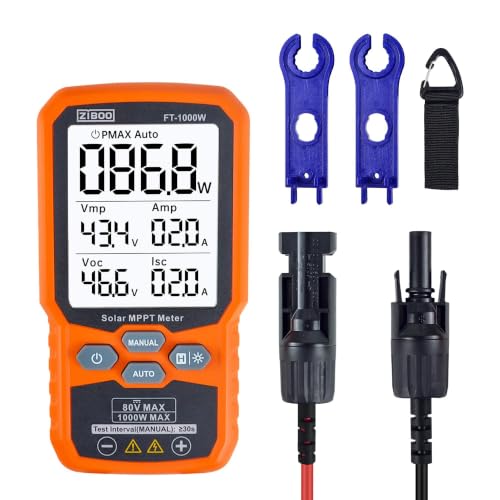
- 1000W PV tester with Voc, Isc, Vmp, and Amp measurements
- Backlit LCD and data hold for low-light job sites
- CAT III 1000V / CAT IV 600V rating with IP54 protection
Best For: Solar pros who prioritize safety ratings and easy-to-read results
MPPT Precision Tester

- Measures Pmax, Voc, and Isc with MPPT tracking.
- Large sunlight-readable LCD for outdoor use.
- MC4 plug-and-play setup with built-in protection.
Best For: Electricians needing a portable solar panel tester for installs and troubleshooting.
High-Precision PV Meter

- Measures Pmax, Vmp, Voc, Isc, and current.
- Backlit display shows multiple readings at once.
- Compact kit includes pouch, leads, and MC4 tool.
Best For: Professionals who need a compact tester for single-panel solar checks.
Field-Ready Watt Meter
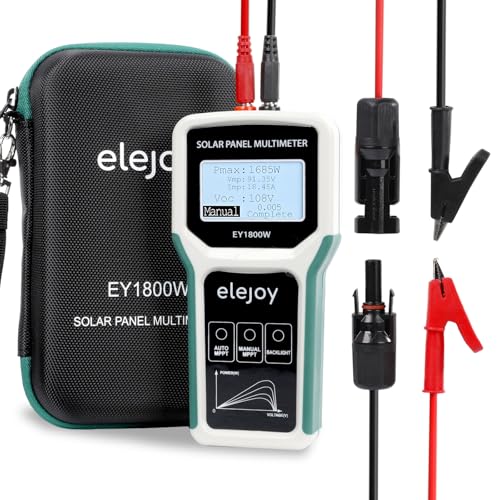
- Measures Pmax, Voc, and Isc in real time.
- No batteries needed; connects directly to the panel.
- Includes MC-4 connectors, clips, and EVA toolkit.
Best For: Technicians who want a simple portable tester for quick PV checks.
Professional PV Testing Pick – ZIBOO FT-2000W Solar Panel Tester
If you need solar panel testers for electricians that can validate panel output in the field, the ZIBOO FT-2000W is built for detailed PV checks. It measures Pmax, Voc, Isc, and MPPT-related values, giving you the core data needed for commissioning, troubleshooting, and maintenance on residential or commercial arrays.
Best For: Electricians, installers, and field techs who need a professional-grade tester for high-output PV checks.
Pros:
- Measures up to 2000W with Voc from 12–150V and Isc up to 35A.
- ±0.8% accuracy supports more reliable performance validation.
- CAT III 1000V / CAT IV 600V rating with double-insulated probes for safer use.
- Backlit LCD, data hold, IP54 resistance, and auto-off suit rooftop and outdoor work.
Cons:
- Higher-capability tester than basic users may need.
- Focused on PV testing rather than general-purpose electrical measurements.
Overall, this model is a strong choice when you want a solar tester that balances capacity, safety, and field-friendly features. It is especially useful when accurate panel verification matters more than a simple pass/fail reading.
Wide-Range Value Tester – 1800W Solar Panel Tester MPPT Multimeter
For electricians looking at solar panel testers for electricians with a broad measuring range, this FROGBRO unit covers everyday PV checks without adding much bulk. It reads panel power, voltage, and current, and the solar-powered design means you can start testing without worrying about batteries.
Best For: Installers who want a lightweight, battery-free tester for routine solar panel checks.
Pros:
- Measures 5W to 1800W, 20V to 120V, and up to 60A.
- Large LCD is designed to stay readable in direct sunlight.
- No batteries required; it runs from the solar panel connection.
- Built-in protections include overvoltage, overheating, overcurrent, and reverse polarity.
Cons:
- Voltage ceiling is lower than some higher-end PV testers.
- Best suited to standard panel testing rather than more specialized analysis.
This is a practical option if portability and simplicity matter most. The included MC4 and alligator clip cables also make it easier to move between different installation setups.
Portable Commissioning Choice – SK-705S Solar MPPT Power Tester
This SK-705S model fits electricians who want solar panel testers for electricians that handle commissioning and inspection work with a straightforward interface. It measures Pmax, Voc, Isc, Vmp, and Imp, and includes both auto and manual modes for controlled testing in the field.
Best For: Techs who need a portable PV tester for installation checks and maintenance visits.
Pros:
- Measures key PV values including Pmax, Voc, Isc, Vmp, and Imp.
- Auto and manual modes provide flexibility for different test workflows.
- 3.2-inch backlit LCD helps readability outdoors.
- Includes test leads, alligator clips, storage pouch, and user manual.
Cons:
- Listed details show a lower practical operating ceiling than the product headline suggests.
- Battery-powered design adds another power source to manage.
As a portable tester, it focuses on quick field measurements and convenient carrying. It makes the most sense when you need a compact tool for verification rather than a heavily specialized bench instrument.
Compact Budget Option – 800W MPPT Solar Panel Tester
If you want solar panel testers for electricians that handle the basics without taking up much room, this 800W FROGBRO meter is a simple field tool. It measures Pmax, Voc, and Isc, and the large LCD helps you read results clearly in bright outdoor conditions.
Best For: Electricians who need a compact tester for smaller PV panels and straightforward troubleshooting.
Pros:
- Measures up to 800W and 60V, which suits smaller-panel testing.
- Displays Pmax, Voc, and Isc on one screen for quick checks.
- No battery required; it operates directly from the solar panel.
- Includes MC4 cables and an MC4 connector wrench for easier setup.
Cons:
- Lower 800W/60V limit makes it less suitable for larger PV systems.
- Not intended for series-connected panels beyond its stated limits.
For smaller jobs, this tester keeps things simple and efficient. Its protections and portable design make it a useful backup or entry-level PV tool for quick diagnostics.
Field-Ready MPPT Tester – XUNTOP 2000W Solar Panel Tester
If you need solar panel testers for electricians that can handle on-site PV checks, the XUNTOP 2000W model is built around practical field verification. It measures Pmax, Voc, Isc, Vmp, and amp, and its MPPT sampling is designed to give dependable readings when you are diagnosing panel performance or confirming output before handoff.
Best For: Electricians and solar technicians who want a compact tester with strong safety protection and onboard data saving for field work.
Pros:
- Measures Pmax up to 2000W, Voc from 3-90V, Isc up to 40A, plus Vmp and amp.
- Built-in protections for over-voltage, over-current, reverse polarity, and over-temperature.
- Auto/manual modes with automatic saving for up to 30 test entries.
- Rechargeable 1250mAh battery supports up to 15 hours of use and charges by Type-C.
Cons:
- Must be used with the photovoltaic panel disconnected from other devices or loads.
- No backlight or brightness adjustment on the 3.2-inch screen.
This is a good fit if your priority is a portable PV tester with clear measurement coverage and built-in protection rather than a more advanced display. The included EVA case, test lead, and accessories make it easy to keep in a service kit.
High-Range Solar Meter – UNI-T UT673PV Solar MPPT Meter
For electricians comparing solar panel testers for electricians in larger PV systems, the UNI-T UT673PV stands out for its wide measurement range and easy simultaneous readout. It tests maximum power, Vmp, Imp, Voc, and Isc, while the large screen and automatic measurement mode make it straightforward to use during maintenance or commissioning work.
Best For: Installers, maintenance techs, and PV users who want a self-powered tester with broad measurement range and multiple language support.
Pros:
- Very wide measurement range, including Pmax up to 5800W and Voc/Vmp up to 1260V.
- Displays all measurement results simultaneously on a large screen.
- No batteries needed because it is powered by the solar panel itself.
- Manual and automatic MPPT test modes with data hold for flexible workflows.
Cons:
- Current and short-circuit current ranges are limited to 0.35A in the supplied specs.
- Uses an MC4 test lead, so compatibility depends on your PV setup.
This is the best pick if you want broad voltage capability and a simple, self-powered testing workflow. The included safety protections and multilingual interface also make it useful for teams working across different sites.
Safety-Rated PV Checker – ZIBOO FT-1000W Solar Panel Tester
If your shortlist of solar panel testers for electricians includes a compact, safety-focused meter, the ZIBOO FT-1000W is aimed at professional PV testing and troubleshooting. It covers Pmax, Voc, Isc, Vmp, and Amp, while the backlit LCD and data hold function make it easier to read values during rooftop or low-light work.
Best For: Solar professionals who want a portable tester with backlighting, data hold, and strong electrical safety ratings.
Pros:
- Tests up to 1000W and measures Voc, Isc, Vmp, and Amp for PV validation.
- Backlit LCD with data hold helps in darker working conditions.
- Rated CAT III 1000V / CAT IV 600V with double-insulated probes.
- IP54 dust/water resistance and auto-off support outdoor use.
Cons:
- Lower maximum power than some higher-capacity solar panel testers.
- Supplied specs emphasize professional use; it may be more than casual users need.
Overall, this model makes sense when safety ratings and readability matter as much as raw measurement range. It is a solid field tool for installers and service technicians who work in varied outdoor conditions.
MPPT Precision Tester – Solar Power Meter PV Tester
If you need solar panel testers for electricians that can quickly verify field performance, this 2000W MPPT unit focuses on the core measurements that matter: Pmax, Voc, and Isc. The large 3.2-inch LCD is easy to read outdoors, and the plug-and-play MC4 setup keeps testing straightforward on rooftops, RV systems, and home installs.
Best For: Electricians and installers who want a portable all-in-one tester for solar panel installation, troubleshooting, and maintenance.
Pros:
- Measures Pmax, Voc (3–90V), and Isc (0–40A) with built-in MPPT tracking.
- MC4 connection makes setup quick, with auto and manual modes available.
- 3.2-inch LCD stays readable in direct sunlight.
- Built-in protection covers over-voltage, over-current, reverse polarity, and overheating.
Cons:
- Specifically designed for solar panel testing rather than general electrical diagnostics.
- Best suited to field use where MC4-compatible connections are available.
This is a practical choice if your priority is accurate, on-site PV readings in a durable package. It balances simplicity with enough measurement coverage for routine solar troubleshooting.
High-Precision PV Meter – LD673PV Solar Tester
For electricians comparing panel output on-site, this LODESTAR unit is built around the measurements used most often in solar panel testers for electricians: Pmax, Vmp, Voc, Isc, and current. It supports single-panel testing only, and the backlit multi-display is designed to show key readings at once for faster diagnosis and maintenance work.
Best For: Installers and electricians who need a compact, professional tester for single-panel PV checks.
Pros:
- Reads Pmax, Vmp, Voc, Isc, and amps with high precision.
- Wide range covers Voc 12–80V and Isc up to 35A.
- Backlit LCD shows all key parameters simultaneously.
- Includes a protective pouch, test leads, and MC4 disconnect tool.
Cons:
- Only for single solar panel measurement, not series or parallel strings.
- 1000W maximum panel rating may be limiting for larger modules.
This model stands out when you want clear, field-friendly data without extra setup. Its compact size and included accessories make it easy to keep in the service kit.
Field-Ready Watt Meter – 1800W MPPT Tester
This 1800W option fits well among solar panel testers for electricians who want a simple way to measure performance in the field. It reports Pmax, Voc, and Isc, and the clear LCD makes readings easy to review when you are comparing actual output against panel specs or checking multiple PV modules.
Best For: Electricians and solar technicians who want a portable tester with basic diagnostics and quick hookup.
Pros:
- Measures Pmax, Voc, and Isc for real-time solar panel testing.
- Rated up to 60A and 120V for broader troubleshooting coverage.
- Includes MC-4 connectors, alligator clips, and an EVA toolkit.
- No batteries required; connects directly to the solar panel.
Cons:
- Does not claim the more advanced display or tracking features of some rivals.
- Best used as a solar-specific tool rather than a general-purpose meter.
It is a straightforward field tool for quick checks, especially when portability and simple hookup matter more than extra features. The included accessories also make it easier to move from panel to panel without extra gear.
How We Picked the Best Solar Panel Testers for Electricians
We prioritized tools that match everyday field use: accurate MPPT-based power measurement, clear readings for Voc, Isc, Vmp, and Pmax, and practical voltage/current ranges for common rooftop and ground-mount systems. We also looked at display readability, protection features, portability, and how well each tester fits the workflow of Solar Panel Testers for Electricians.
Quick Comparison
Higher-capacity models are a better fit for larger residential and light commercial arrays, while lower-watt testers are often sufficient for module-level troubleshooting, commissioning, and quick verification work. If you need one meter for mixed jobs, choose a model with a broader input range and automatic/manual measurement modes.
Key Buying Factors for Solar Panel Testers for Electricians
Power and Voltage Rating
Match the tester’s wattage, maximum voltage, and current limits to the systems you service most often. Undersized ratings can restrict testing or force you to work around the meter’s limits.
Measurement Functions
Look for the readings you actually use in the field: open-circuit voltage, short-circuit current, operating voltage, operating current, and maximum power. For faster diagnostics, automatic measurement is convenient, while manual control can be useful in unusual conditions.
Safety and Protection
Reverse-polarity, overcurrent, and overvoltage protection are especially important when testing unfamiliar arrays or working in bright, high-output conditions. A stable housing and solid leads also matter on job sites.
Display and Usability
A large backlit screen, straightforward buttons, and a readable layout reduce mistakes. If you work outdoors often, visibility in direct sun and simple navigation are worth paying for.
Portability and Durability
Electricians moving between rooftops, service calls, and commissioning jobs should favor compact, lightweight testers that still feel robust in the hand.
Who Should Buy Which Solar Panel Testers for Electricians?
If you handle occasional residential diagnostics, a smaller 800W to 1000W unit may be enough. For most installers and service electricians, a 1800W or 2000W tester offers a better balance of capability and flexibility. If you regularly troubleshoot larger strings or want extra safety headroom, choose one of the higher-rated models with built-in protection and a full-featured display.
In short, the best Solar Panel Testers for Electricians are the ones that fit your system sizes, your testing frequency, and the kind of fieldwork you do every day.