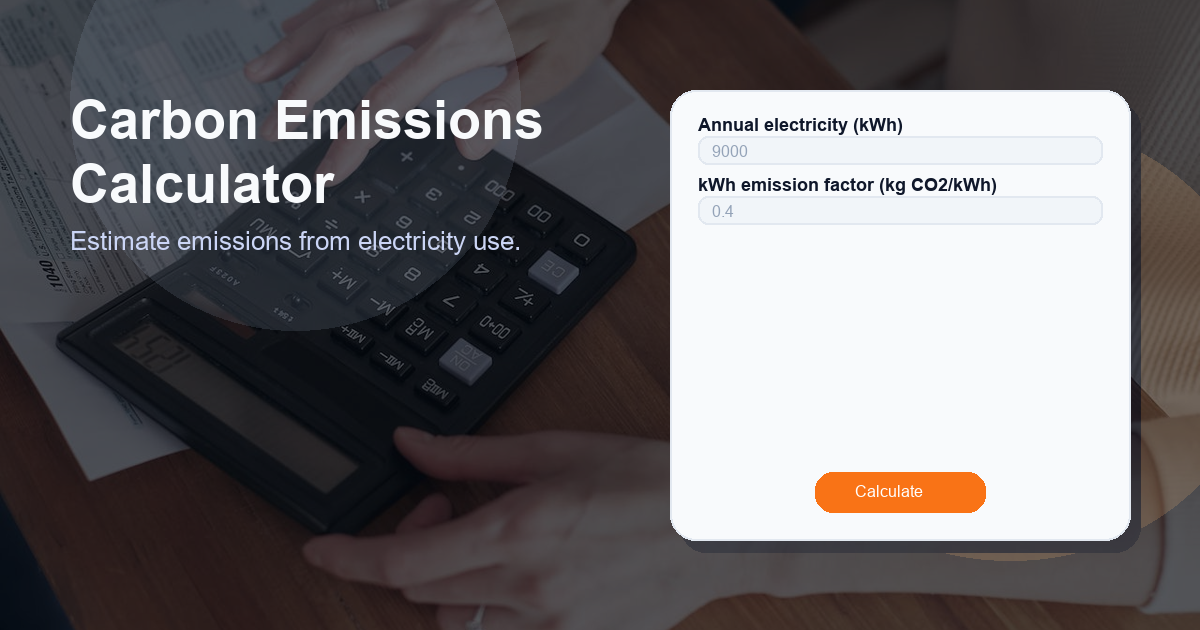
The Carbon Emissions Calculator on this page helps individuals, businesses, and organizations quickly estimate the greenhouse gas impact of their electricity consumption. Designed for clarity and accuracy, this tool uses two simple inputs — Annual electricity (kWh) and kWh emission factor (kg CO2/kWh) — and returns your Annual Emissions in kilograms of CO2 (and converted to metric tonnes for convenience).
What this Carbon Emissions Calculator does
This Carbon Emissions Calculator estimates how much carbon dioxide (CO2) is associated with the electricity you use over a year. It is focused specifically on emissions released from electricity generation and delivered to the point of use. The calculator:
- Accepts your annual electricity usage in kilowatt-hours (kWh).
- Uses a kWh emission factor (kg CO2 per kWh) that represents the carbon intensity of the electricity source or local grid.
- Computes annual CO2 emissions using the formula: annual_kwh × kwh_emission_factor.
- Displays the result as Annual Emissions in kilograms of CO2 and optionally in metric tonnes (tCO2).
The output gives a simple, comparable number you can use for reporting, sustainability planning, or tracking progress after energy efficiency upgrades or switching to renewable energy.
How to use the Carbon Emissions Calculator
Using the Carbon Emissions Calculator is straightforward. Follow these steps:
- Find your annual electricity consumption (kWh): This is usually on your electricity bill as “annual usage” or you can total 12 months of bills to get an accurate number.
- Determine the kWh emission factor (kg CO2/kWh): Use a national or regional grid emission factor, or a supplier-specific factor if available. Typical values range from near 0 kg CO2/kWh for 100% renewable supply up to 1.0 kg CO2/kWh or higher for fossil-heavy grids.
- Enter both values into the calculator: The tool multiplies the numbers and returns Annual Emissions.
- Interpret the result: Convert kilograms to metric tonnes by dividing by 1,000 for easier comparison with corporate or national targets.
Example calculation:
Formula: 4,000 × 0.5 = 2,000 kg CO2
Annual Emissions: 2,000 kg CO2 (which is 2.0 tCO2)
How the Carbon Emissions Calculator formula works
The calculator uses a single, transparent formula:
Annual Emissions (kg CO2) = annual_kwh × kwh_emission_factor (kg CO2/kWh)
Key points about this formula:
- Linear relationship: If you double your electricity consumption, your calculated emissions double. This makes the result easy to understand and forecast.
- Emission factor is critical: The kWh emission factor encapsulates the carbon intensity of the electricity supply. It may be an average grid mix, a marginal generation factor, or a supplier-specific figure. Choosing the right factor has the largest influence on accuracy.
- Units consistency: Ensure the annual electricity is in kWh and the emission factor in kg CO2/kWh. The result will be in kilograms of CO2. Convert to tonnes by dividing by 1,000 for a more standard reporting unit.
Why the formula is appropriate: Electricity-related emissions are directly proportional to consumption when the carbon intensity per unit of electricity is assumed constant over the period considered (typically a year). For many practical planning and reporting tasks this is an effective approximation.
Use cases for the Carbon Emissions Calculator
The calculator is versatile and useful for a range of scenarios. Typical use cases include:
- Household emissions estimation: Homeowners can understand the CO2 impact of their electricity use and compare the effect of switching to a green tariff.
- Small business reporting: Small and medium enterprises (SMEs) can include electricity emissions in simplified carbon inventories or sustainability reports.
- Energy retrofit planning: Estimate emissions savings from efficiency measures (LED lighting, efficient HVAC, insulation) by comparing pre- and post-retrofit kWh.
- Renewable procurement decisions: Compare supplier-specific emission factors to evaluate the benefit of purchasing green power or installing on-site renewables.
- Educational and outreach: Use in presentations or workshops to help audiences grasp the link between electricity use and CO2 emissions.
Other factors to consider when calculating emissions
While the Carbon Emissions Calculator provides a clear first-order estimate, several additional factors can influence the accuracy or applicability of results:
- Scope and boundary: This calculator addresses direct emissions from electricity consumption (Scope 2). It does not include upstream emissions from fuel extraction, transmission losses, or embodied emissions in equipment unless you add those separately.
- Time variation: Grid emission factors change over time and by hour. If you have time-of-use data and marginal emission intensities, you can refine estimates using hourly factors rather than an annual average.
- Transmission and distribution losses: Some datasets include losses; others represent delivered electricity. Know whether your emission factor accounts for those losses.
- Renewable energy certificates and carbon accounting: Purchasing certificates (RECs/GoOs) or using a supplier-specific factor can change reported emissions but may not change physical energy flows. Be transparent about the method in reporting.
- Non-CO2 greenhouse gases: This calculator focuses on CO2. If methane (CH4) and nitrous oxide (N2O) from fuel cycles are material, consider using CO2e factors that include those gases.
- Local vs. national factors: Use the most granular emission factor available (grid region, supplier, or site-specific) for better precision.
By acknowledging these considerations, you can use the calculator as part of a robust emissions assessment and make informed decisions about energy management and decarbonization strategies.
Frequently Asked Questions
1. What input values do I need for the Carbon Emissions Calculator?
You need two inputs: Annual electricity (kWh) — usually from bills — and the kWh emission factor (kg CO2/kWh), which you can find from national statistics, your utility, or recognized emission factor databases.
2. Where can I find the kWh emission factor for my region?
Check your electricity supplier, national government environmental agencies, or international databases (e.g., IEA, EPA, or local grid operator). Many countries publish an annual or regional grid-average emission factor in kg CO2 per kWh.
3. Does this calculator account for renewable energy certificates (RECs) or green tariffs?
The basic calculation uses the emission factor you provide. If you have purchased RECs or a green tariff that reduces your reported intensity, use the supplier-specific factor or adjust the kWh emission factor accordingly and document the approach in your reporting.
4. Can the calculator handle other greenhouse gases?
This tool calculates CO2 only. To account for other greenhouse gases, use a CO2e emission factor (expressed in kg CO2e/kWh) that includes CH4 and N2O impacts, and enter that factor in place of the CO2-only number.
5. How accurate is the result?
The result is as accurate as the inputs. The main source of uncertainty is the kWh emission factor. For more precise work, use site-specific metering, hourly marginal factors, and include transmission losses or upstream emissions as needed.
Start using the Carbon Emissions Calculator to get a clear, actionable estimate of your electricity-related emissions. Use the result — labeled Annual Emissions — to set targets, communicate progress, and prioritize actions that reduce both energy consumption and carbon footprint.