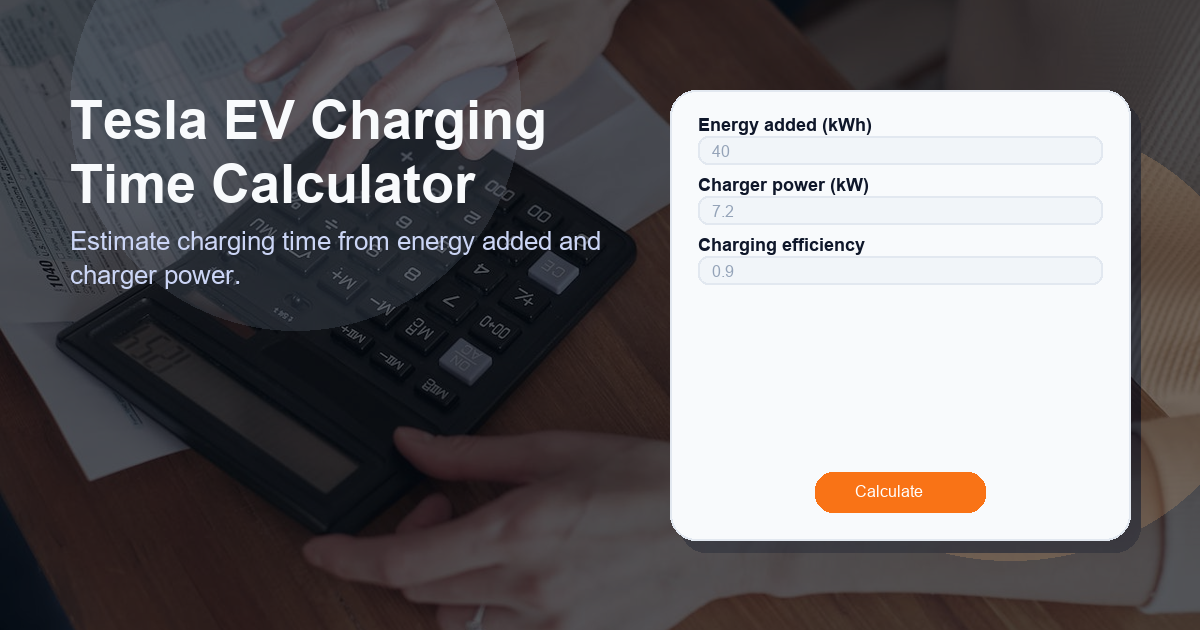
Tesla EV Charging Time Calculator
Description: Estimate charging time from energy added and charger power using the Tesla EV Charging Time Calculator. This tool helps Tesla owners and EV drivers quickly approximate how long a charging session will take based on the amount of energy you want to add, the charger power, and the real-world charging efficiency.
What this Tesla EV Charging Time Calculator calculator does
The Tesla EV Charging Time Calculator provides a straightforward estimate of how long a charging session will take by dividing the energy you want to add (in kilowatt-hours) by the effective charging power (charger power multiplied by charging efficiency). It converts technical inputs into an actionable time estimate labeled as Charging Time, so you can plan trips, charging stops, or home-charging schedules more accurately.
This calculator is ideal for:
- Trip planning: Estimate stop durations at Superchargers or public chargers.
- Home charging planning: Determine whether overnight charging will fully replenish the battery.
- Cost and time trade-offs: Compare how much faster a higher-powered charger is versus charging longer at a lower power.
How to use the Tesla EV Charging Time Calculator calculator
Using the calculator is simple. You need three inputs:
- Energy added (kWh) — the amount of energy you want to transfer into the battery. This can be the full battery capacity or the difference between current and target state of charge (SoC).
- Charger power (kW) — the nominal maximum power provided by the charger or the vehicle’s onboard AC limit. For Superchargers, use the peak DC power; for home chargers, use the charger’s kW rating (e.g., 7.4 kW, 11 kW).
- Charging efficiency — a decimal value representing conversion and losses, typically between 0.85 and 0.95. For a Tesla, 0.9 (90%) is a good default estimate for many real-world situations.
Enter those three values into the calculator and get the result labeled Charging Time. Example usage:
- Energy added = 50 kWh
- Charger power = 11 kW
- Charging efficiency = 0.90
Charging Time ≈ 50 / (11 × 0.9) ≈ 5.05 hours (approximately 5 hours and 3 minutes).
How the Tesla EV Charging Time Calculator formula works
Formula used:
charger_power_kw > 0 ? energy_added_kwh / (charger_power_kw * charging_efficiency) : 0
Broken down in plain language:
- If the charger power is greater than zero, the calculator divides the required energy (kWh) by the effective charging rate (kW multiplied by efficiency).
- If charger power is zero or invalid, the output is 0 to avoid division errors.
Equivalent mathematical form:
Charging Time (hours) = energy_added_kwh / (charger_power_kw × charging_efficiency)
Notes on each term:
- Energy added (kWh): Battery energy to be transferred. If you want to go from 20% to 80% on a 75 kWh battery, energy_added_kwh = 0.60 × 75 = 45 kWh.
- Charger power (kW): Peak or nominal power. For AC home chargers, this is often lower (e.g., 7.4 kW or 11 kW). For Tesla Superchargers, it may be 150 kW, 250 kW, or higher depending on the V3 Supercharger and conditions.
- Charging efficiency: Accounts for heat and conversion losses. Use 0.85–0.95 depending on temperature, battery condition, and charging type.
Use cases for the Tesla EV Charging Time Calculator
This calculator is practical across many real-world scenarios. Common use cases include:
- Road trip planning: Estimate how long to stop at a Tesla Supercharger to add a target amount of range. Use a conservative charging efficiency for fast DC charging (e.g., 0.88–0.92) and factor in battery acceptance rates.
- Home charging schedules: Figure out whether your overnight window is sufficient. Example: If you have a 10-hour overnight period and need 40 kWh, a 7.4 kW charger at 90% efficiency will supply roughly 7.4 × 10 × 0.9 = 66.6 kWh, so 40 kWh is comfortably achievable.
- Workplace charging: Decide whether charging at work for 4 hours will give you enough range. Use the calculator to confirm energy added during your shift time.
- Comparing charger investments: If you’re considering upgrading from a 7 kW to an 11 kW wallbox, the calculator shows the time savings for typical daily energy needs.
Other factors to consider when calculating charging time
The formula gives a solid first-order estimate, but real-world charging is affected by several important factors:
- Battery charging curve: Tesla batteries charge fastest at low to mid state-of-charge and slow significantly above ~70–80% SoC. Adding the last 10–20% can take disproportionately longer.
- Battery acceptance rate: The vehicle may limit power based on battery temperature, SoC, and battery health. On some Teslas, peak charging power may only occur for a limited portion of the session.
- Charger limitations and sharing: Public chargers may share power across stalls or throttle to maintain station temperature or manage grid constraints.
- Ambient temperature: Extreme cold or hot weather reduces efficiency and can slow charging while the battery thermal management system prepares the battery.
- State-of-charge start and end points: Charging from 10% to 60% is faster per kWh than charging from 60% to 95%.
- Losses beyond converter efficiency: Cable resistance, connector condition, and onboard electronics all introduce minor losses.
To get the most accurate estimate, combine the calculator’s output with knowledge of your specific Tesla model’s charging curve, local charger conditions, and expected SoC behavior.
FAQ
How accurate is the Tesla EV Charging Time Calculator?
The calculator provides a reliable baseline estimate based on energy and power. Accuracy depends on the quality of your inputs (especially charging efficiency and whether your charger provides sustained peak power). For precise planning, adjust the efficiency and factor in the Tesla’s charging curve and battery temperature.
What value should I use for charging efficiency?
Typical charging efficiency values range from 0.85 to 0.95. Use 0.90 (90%) as a sensible default. For fast DC charging, slightly lower efficiency (e.g., 0.88) can be realistic; for steady AC home charging in mild temperatures, 0.92–0.95 may be achievable.
Does the calculator work for all Tesla models?
Yes, the formula is model-agnostic because it uses energy and power. However, different Tesla models have different onboard limits and battery acceptance curves, so you should tailor the charger power and efficiency for your specific model for best results.
Can I use this for non-Tesla EVs?
Absolutely. The underlying physics is the same for any electric vehicle. Replace your Tesla-specific assumptions with your EV’s charger limits and typical efficiency to estimate charging time for other brands.
Why might charging take longer than the calculated time?
Common causes for longer charging times include reduced charging power due to battery temperature or state-of-charge, charger power sharing at public stations, conservative charger output, and real-world efficiency lower than estimated. Always allow a buffer when planning critical trips.