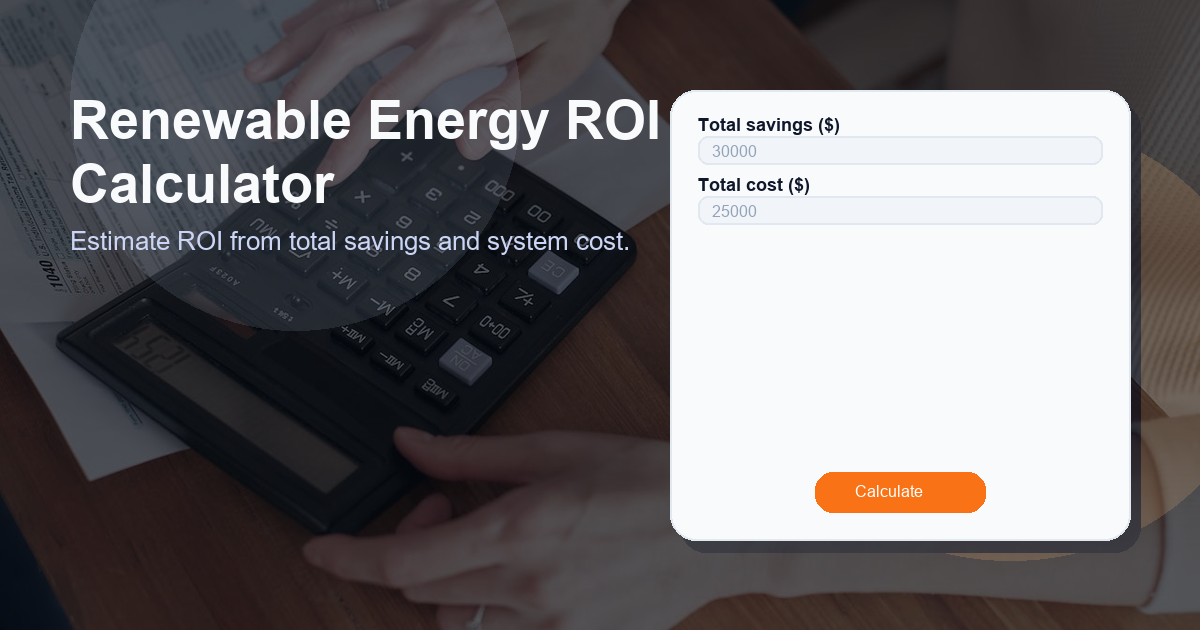
What this Renewable Energy ROI Calculator does
The Renewable Energy ROI Calculator is a simple, practical tool designed to help homeowners, businesses, and investors estimate the return on investment (ROI) from a renewable energy project. By comparing the total savings ($) generated by the system against the total cost ($) to install or acquire it, this calculator provides a quick percentage that indicates whether a project produces positive value over its cost.
This calculator is ideal for preliminary decision-making and feasibility checks. It does not replace detailed financial models, but it does provide a fast answer to the core question: “Is the system likely to pay back its cost and by how much, in relative terms?” The result label used by the tool is ROI, expressed as a percentage.
How to use the Renewable Energy ROI Calculator
Using the Renewable Energy ROI Calculator is straightforward. You only need two inputs:
- Total savings ($) — the cumulative financial savings or revenue generated by the renewable energy system over a defined period (e.g., annual savings, 5-year savings, lifetime savings). This includes lower utility bills, incentives, tax credits (if realized as savings), and any revenue from selling energy back to the grid.
- Total cost ($) — the total installed cost of the system, including equipment, installation, permits, and any other one-time expenses required to get the system operational.
Steps to use the calculator:
- Decide the time frame for your total savings input (e.g., annual, 10-year, lifetime). Consistency matters — compare savings and costs over the same period or use lifetime savings vs. total lifetime cost.
- Enter the total savings ($) amount into the calculator.
- Enter the total cost ($) amount into the calculator.
- Read the ROI percentage the calculator outputs. A positive ROI means savings exceed cost; a negative ROI means cost is higher than savings for the chosen timeframe.
Example: If your total savings over 10 years is $15,000 and the total cost is $12,000, the calculator will show a positive ROI indicating a favorable return.
How the Renewable Energy ROI Calculator formula works
The calculator uses a simple, transparent formula to compute ROI. The formula is:
total_cost > 0 ? (total_savings – total_cost) / total_cost * 100 : 0
Broken down:
- If total_cost is greater than zero, it calculates the difference between total_savings and total_cost, divides that difference by total_cost, and multiplies by 100 to get a percentage.
- If total_cost is zero or not provided, the formula returns 0 to avoid division by zero errors.
Interpreting the result:
- Positive ROI (e.g., 25%): Your savings exceed your cost by 25% of the initial cost for the selected timeframe. In plain terms, for every $1 invested, you get $1.25 back in total value (original cost plus 25% profit in savings).
- Zero ROI (0%): Savings equal cost — you break even.
- Negative ROI (e.g., -10%): Savings are less than cost — the system does not pay back its cost within the selected timeframe.
Example calculation:
- Total savings = $20,000
- Total cost = $16,000
- ROI = (20,000 – 16,000) / 16,000 * 100 = 25%
Use cases for the Renewable Energy ROI Calculator
The calculator serves multiple audiences and purposes. Typical use cases include:
- Homeowners evaluating solar panel installations, battery systems, or heat pumps to compare potential savings versus purchase and installation costs.
- Small business owners determining whether to invest in rooftop solar, geothermal, or other renewable systems to reduce operating costs.
- Facility managers who need a quick ROI estimate for budgeting and capital planning before commissioning detailed engineering studies.
- Investors and developers assessing project-level economics when screening multiple renewable energy opportunities.
- Policy analysts and NGOs modeling the economic attractiveness of rebate programs, incentives, or community solar projects using aggregated savings and cost figures.
Because the tool is fast and requires minimal data, it’s best used for screening and comparison. If the ROI looks promising, proceed to more granular analyses that include cash flow, net present value (NPV), internal rate of return (IRR), and scenario planning.
Other factors to consider when calculating ROI
While the Renewable Energy ROI Calculator provides an essential percentage-based indication, real-world decisions should consider additional factors that influence both costs and savings. These include:
- Timeframe and discounting — Savings are typically realized over many years. Consider using discounted cash flow (DCF) methods to account for the time value of money rather than raw totals.
- Incentives and tax credits — Upfront rebates, feed-in tariffs, and tax credits can substantially reduce net cost or increase net savings. Confirm which incentives apply to your situation and how they are delivered (cash vs. tax benefit).
- Maintenance and operating costs — Include recurring maintenance, insurance, inverter replacements, and any performance de-rating over time when estimating true savings.
- Energy price inflation — If grid electricity prices rise, your system’s savings could increase over time. Use conservative and optimistic price escalation scenarios.
- Financing costs — Loans, leases, or power purchase agreements (PPAs) add financing costs that reduce net ROI. Compare cash purchase vs. financed scenarios.
- System lifespan and degradation — Solar panels and batteries degrade; account for reduced output over the system’s lifetime when predicting savings.
- Site-specific factors — Shading, local weather patterns, grid connection costs, and permitting timelines all affect real savings and costs.
Frequently asked questions about the Renewable Energy ROI Calculator
Q: What does a positive ROI mean for my renewable project?
A: A positive ROI means your total savings exceed the total cost over the timeframe used in the calculation. It indicates the project is likely to recover its cost and generate net financial benefit in that period. However, always check the timeframe and include other financial considerations like financing and maintenance.
Q: Can I use the calculator for both annual and lifetime ROI?
A: Yes. Ensure your total savings and total cost correspond to the same timeframe. For lifetime ROI, use lifetime savings and total lifetime cost. For annual ROI, use annual savings and annualized cost if applicable.
Q: How do incentives and tax credits affect the ROI?
A: Incentives and tax credits typically lower your effective total cost or increase net savings, improving ROI. Accurately accounting for when and how incentives are realized (immediate cash vs. tax reductions over time) improves the reliability of the ROI estimate.
Q: Why does the calculator return 0 if total cost is zero?
A: The formula avoids division by zero. If total cost is zero (which is rare in real projects), the calculator returns 0 to indicate that ROI cannot be computed in the standard percent format. In practice, a zero cost implies a free system—then any savings would be pure benefit, conceptually infinite ROI; such cases require special handling.
Q: Is this calculator a substitute for detailed financial modeling?
A: No. The Renewable Energy ROI Calculator is a fast screening tool. For investment decisions, follow up with detailed cash flow analysis, NPV, IRR calculations, and sensitivity analysis to account for financing, taxes, degradation, and uncertainty.