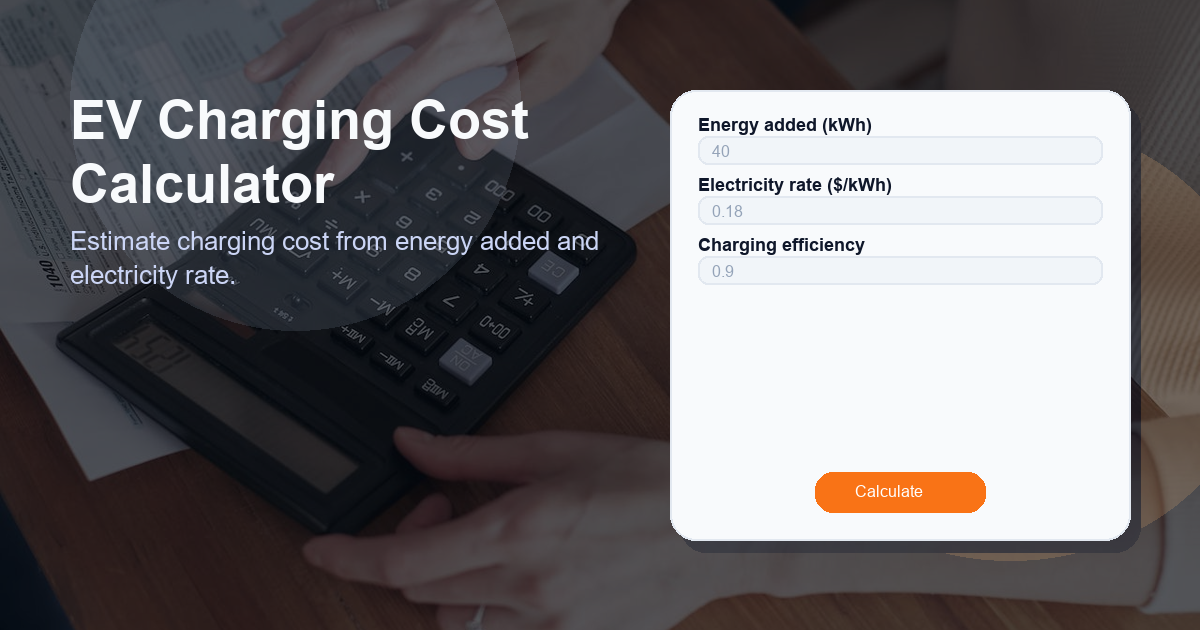
EV Charging Cost Calculator
Description: Estimate charging cost from energy added and electricity rate. Use the EV Charging Cost Calculator to understand how much it costs to add energy to an electric vehicle based on the energy you want the battery to gain, your local electricity rate, and the charging system’s efficiency.
What this EV Charging Cost Calculator calculator does
The EV Charging Cost Calculator helps drivers, fleet managers, and charging station operators estimate the monetary cost to charge an electric vehicle (EV). Instead of guessing how much you’ll pay at the next charge, the calculator uses three clear inputs to give a quick, reliable cost estimate:
- Energy added (kWh) – the amount of energy you want the battery to gain.
- Electricity rate ($/kWh) – the price you pay per kilowatt-hour from your utility or charging provider.
- Charging efficiency – a factor (often less than 1) that accounts for energy lost during charging.
It outputs a single value labeled: Charging Cost. The result represents the expected dollars spent to add the specified energy to the EV battery, factoring in charging losses.
How to use the EV Charging Cost Calculator calculator
Using this tool is straightforward. Follow these simple steps to estimate your charging expense:
- Enter energy added (kWh): This is how many kilowatt-hours you want the car battery to gain. Example: 30 kWh to go from 20% to 70% in a 75 kWh battery.
- Enter electricity rate ($/kWh): Use the rate you pay at home or the public charging rate. Example: $0.15/kWh for home charging, or $0.30/kWh at a public fast charger.
- Enter charging efficiency: Enter as a decimal or percentage. For example, 90% efficiency = 0.90. If you prefer percentages, convert by dividing by 100 (90% → 0.90).
- Calculate: The calculator applies the formula and returns the Charging Cost, displayed in your currency.
Tip: If you only know the battery state-of-charge (SoC) change, estimate energy added by multiplying battery capacity by the percent change (e.g., 75 kWh × 0.50 = 37.5 kWh added).
How the EV Charging Cost Calculator formula works
The calculator uses a simple physics/economics relationship to convert energy added and accounting for losses into dollars spent. The formula is:
Charging Cost = energy_added_kwh / charging_efficiency * electricity_rate
Breakdown of the formula:
- energy_added_kwh: The usable energy you want stored in the battery (kWh).
- charging_efficiency: The fraction of grid energy that actually ends up in the battery. Charging losses (heat, conversion inefficiencies) mean more grid energy is drawn than the battery receives. Typical values range from 0.85 to 0.95 for AC charging and may be lower for rapid DC fast charging depending on conditions.
- electricity_rate: Your cost per kWh charged by your utility or charging station ($/kWh).
How the math flows:
- Adjust for charging losses: grid_energy_required = energy_added_kwh / charging_efficiency
- Convert to dollars: Charging Cost = grid_energy_required × electricity_rate
Example calculation:
- Energy added = 40 kWh
- Charging efficiency = 90% (0.90)
- Electricity rate = $0.13/kWh
- Grid energy required = 40 / 0.90 = 44.444… kWh
- Charging Cost = 44.444 × $0.13 ≈ $5.78
This result tells you that adding 40 kWh to the battery will cost about $5.78 at $0.13/kWh assuming 90% charging efficiency.
Use cases for the EV Charging Cost Calculator
The EV Charging Cost Calculator is useful in many real-world situations. Typical use cases include:
- Daily home charging budgeting: Estimate weekly or monthly EV energy costs for household budgets.
- Trip planning: Compare costs between home charging and public fast charging along a route.
- Fleet management: Forecast electricity spend for a fleet of EVs and compare costs across sites or time-of-use rates.
- Incentive calculations: Evaluate savings from lower residential rates, solar PV integration, or off-peak charging programs.
- Charging station pricing: Operators can set competitive pricing by understanding real energy costs plus markup.
Because the calculator is transparent and simple, it can be embedded in websites, shared in cost comparison articles, or used internally by drivers and fleet admins to make informed decisions.
Other factors to consider when calculating EV charging cost
While the formula above provides a solid baseline estimate, several additional factors can influence actual cost. Keep these in mind:
- Time-of-use rates: Electricity prices often vary by time of day. Charging during off-peak hours can reduce cost significantly.
- Fixed fees and demand charges: Some public chargers or commercial utility rates include per-session fees or demand charges that increase total cost beyond $/kWh.
- Charging curve and thermal losses: DC fast charging can be less efficient at high power and high temperatures; efficiency varies across the charge session.
- Battery aging: Older batteries may accept energy less efficiently or require more balancing energy, changing the effective charging efficiency.
- Metering differences: Public charging operators may bill by session time, energy, or even add a connection fee—read the pricing method.
- Local taxes and surcharges: Some regions add taxes or environmental surcharges to electricity, which affect the per-kWh price.
- Vehicle-to-grid (V2G) and solar offsets: If you have solar or export credit, the net cost for charging can be reduced or sometimes negative during surplus generation.
Including these factors will produce a more accurate, realistic estimate of what you’ll actually pay.
FAQ
Q: What exactly is “charging efficiency” and how do I determine it?
A: Charging efficiency is the ratio of energy stored in the battery to energy drawn from the grid during charging. Typical charging efficiencies range from about 85% to 95% depending on charger type (AC vs DC), ambient temperature, battery state, and cable losses. If you don’t know the exact number, use 0.90 (90%) as a reasonable default.
Q: Can I use kWh readings from my home meter to get a precise cost?
A: Yes. If you measure the meter before and after a charge session (or use a smart meter or EVSE that logs kWh delivered), you can use that delivered kWh as the energy drawn and multiply by the utility rate. This bypasses the need to estimate charging efficiency because it measures grid energy directly.
Q: Does this calculator include charging station fees or taxes?
A: The basic formula uses only energy added, efficiency, and electricity rate. It does not automatically include flat session fees, taxes, demand charges, or subscription fees. Add those values to the calculated Charging Cost to get a complete bill estimate.
Q: How should I account for time-of-use pricing and variable rates?
A: For time-of-use pricing, run the calculator separately for the kWh you plan to charge in each pricing period using the respective $/kWh rates, then sum the results. This helps identify cost savings by shifting charging to cheaper periods.
Q: Is the calculator useful for comparing home charging vs public fast charging?
A: Yes. Enter your home electricity rate and expected efficiency for Level 2 charging, then compare with public fast-charging rates (and potentially lower efficiency for fast charging) to see the real cost difference per charge.
Use the EV Charging Cost Calculator to make smarter charging decisions, compare options, and budget real-world EV energy expenses. Accurate inputs lead to accurate cost estimates—so measure or verify your energy, rates, and efficiency whenever possible.