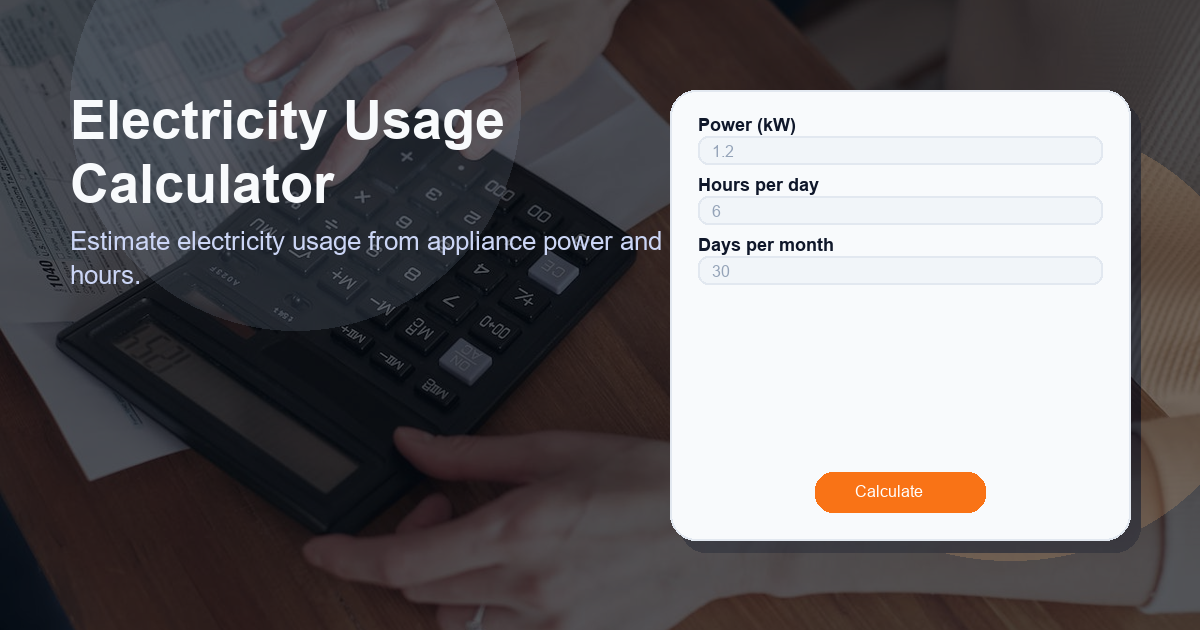
Electricity Usage Calculator
Description: Estimate electricity usage from appliance power and hours. Use this Electricity Usage Calculator to quickly determine the Monthly Usage of a device based on its rated power and operating time.
What this Electricity Usage Calculator calculator does
This Electricity Usage Calculator provides a straightforward way to estimate the energy consumption of an appliance or device over a month. By entering three simple inputs—
- Power (kW) — the appliance’s rated power in kilowatts
- Hours per day — average daily runtime in hours
- Days per month — number of days the device runs in a month
The calculator applies a single formula to return the Monthly Usage in kilowatt-hours (kWh). This value can be used to estimate energy costs, compare appliances, or plan energy-saving measures.
How to use the Electricity Usage Calculator calculator
Follow these easy steps to use the Electricity Usage Calculator correctly:
- Identify the device power — find the rating plate or manual to get the power in kilowatts (kW). If the device lists watts (W), divide by 1000 to convert to kW. Example: 1500 W = 1.5 kW.
- Estimate hours per day — enter the average number of hours the device runs each day. Use realistic averages (e.g., 8 hours for a heater, 24 hours for a refrigerator).
- Choose days per month — enter how many days the device runs in a typical month (commonly 30 or 31, but could be less if seasonal).
- Compute Monthly Usage — the calculator multiplies the three inputs to provide the monthly energy consumption in kWh: Monthly Usage = power (kW) × hours per day × days per month.
- Optional: Multiply the monthly kWh by your electricity rate ($/kWh) to estimate the monthly cost.
Example: A 1.5 kW heater used 5 hours per day for 30 days gives Monthly Usage = 1.5 × 5 × 30 = 225 kWh.
How the Electricity Usage Calculator formula works
The formula used by the Electricity Usage Calculator is intentionally simple and widely used in energy estimates:
Formula: power_kW × hours_per_day × days_per_month
Explanation of each component:
- power_kW: The rated electrical power of the appliance in kilowatts. This is the instantaneous energy use when the device is operating at its rated load.
- hours_per_day: The average operating time per day. This captures how long the device is actively consuming its rated power.
- days_per_month: The number of days per month the device operates. Multiplying by days converts daily consumption to monthly consumption.
The product of these three values results in energy measured in kilowatt-hours (kWh), the standard billing unit for electricity: 1 kW running for 1 hour = 1 kWh.
Use cases for the Electricity Usage Calculator
This Electricity Usage Calculator is useful in many scenarios:
- Estimating monthly bills: Quickly determine how much a particular appliance contributes to your electricity bill.
- Comparing appliances: Compare different models (e.g., an LED vs. incandescent bulb) by calculating their monthly kWh usage to choose the most efficient option.
- Energy audits: Use the calculator during a home or office audit to estimate consumption by category (lighting, HVAC, kitchen appliances).
- Budgeting and planning: Forecast the impact of new appliances or behavior changes (e.g., reducing daily hours) on monthly usage and cost.
- Renewable sizing: Estimate loads when sizing solar PV systems or battery storage to ensure adequate capacity for monthly consumption.
Because the calculator returns Monthly Usage in kWh, you can immediately multiply by the electricity rate (for example, $0.15/kWh) to get an estimated monthly cost.
Other factors to consider when calculating electricity usage
While the Electricity Usage Calculator gives a solid baseline, real-world consumption can differ. Consider these additional factors to refine your estimates:
- Duty cycle and load variation: Many appliances don’t run at full rated power continuously. For example, refrigerators cycle on and off, and variable-speed drives change power draw. Use an average effective power or a duty cycle fraction to adjust the calculation.
- Standby and phantom loads: Devices like TVs, chargers, and routers consume small amounts of power even when “off.” These standby loads add up across many devices.
- Power factor: For some industrial or large appliances, the apparent power differs from real power due to power factor. Household appliances are usually rated in real power (kW), but for specialized equipment, account for power factor if necessary.
- Seasonal changes: Heating and cooling loads vary by season. Your monthly usage for an HVAC system will differ dramatically between summer and winter months.
- Manufacturer vs. real-world use: Nameplate power is often a maximum value. Real-world consumption can be lower. Measuring with a plug-in power meter or smart meter provides the most accurate data.
- Tariff structure and peak charges: Some utilities charge different rates by time-of-use or impose demand charges. Monthly kWh is useful, but check whether peak demand or time-of-day rates affect cost calculations.
- Appliance efficiency and maintenance: Dirty filters, worn components, or aging appliances may consume more energy than spec values indicate.
For the most accurate assessment, combine this calculator with measured data from a plug-in energy monitor or your utility’s detailed usage reports.
FAQ
Q: What units does the Electricity Usage Calculator use?
A: The calculator uses kilowatts (kW) for power and returns Monthly Usage in kilowatt-hours (kWh). If your appliance lists watts (W), convert to kW by dividing by 1000.
Q: How do I convert the Monthly Usage into a dollar cost?
A: Multiply the monthly kWh result by your electricity rate (for example, $0.12/kWh). Example: 225 kWh × $0.12/kWh = $27.00 per month.
Q: Why is my real electricity bill different from the calculator’s estimate?
A: Differences can arise from standby loads, varying duty cycles, inaccurate power ratings, time-of-use rates, or additional charges like fixed fees and taxes. Measuring with a meter yields a more accurate figure.
Q: Can I use this calculator for systems that cycle on and off, like refrigerators?
A: Yes. Instead of using the appliance’s nameplate power directly, estimate the average effective power or multiply by the duty cycle (the fraction of time the appliance is actually running) to get a more realistic result.
Q: Does the calculator account for power factor or reactive power?
A: This calculator focuses on real energy consumption (kWh). Household devices are usually rated in real power. For industrial equipment where power factor matters, use measurements of real power (kW) or consult an electrical engineer.
Tip: To refine estimates, periodically measure devices with a plug-in energy monitor or review interval data from your smart meter. The Electricity Usage Calculator is a quick and effective tool for planning and comparison, but pairing it with measured data will improve accuracy.