Solar Panel Savings Calculator
What this Solar Panel Savings Calculator does
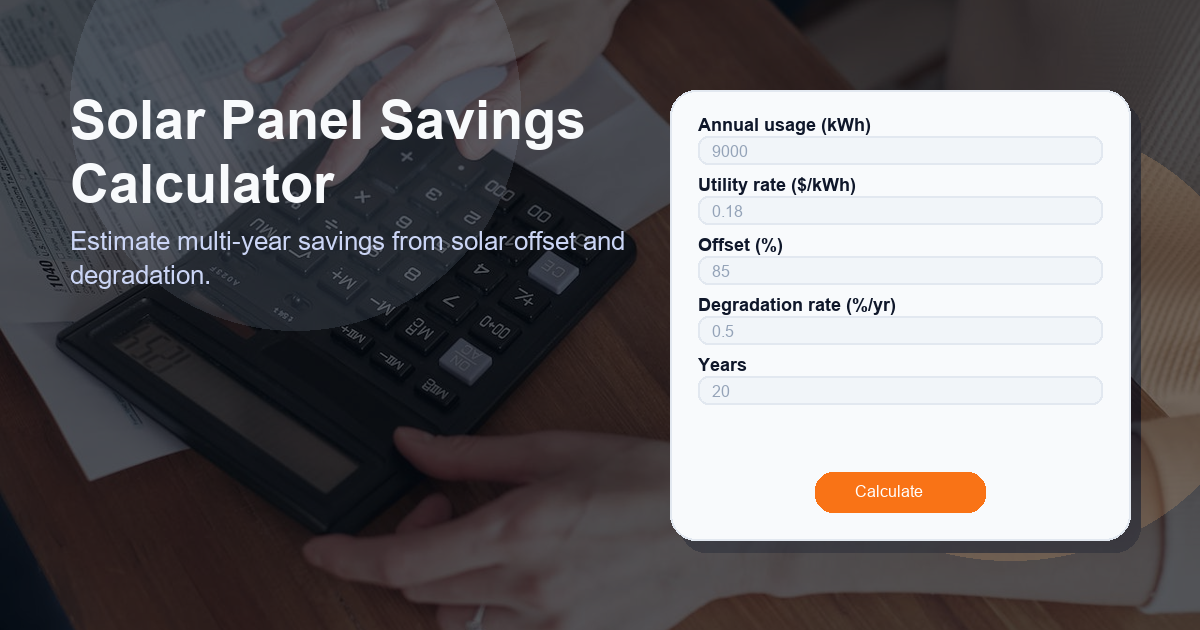
The Solar Panel Savings Calculator helps homeowners, businesses, and solar shoppers quickly estimate multi-year savings from installing a solar PV system. Using a few simple inputs — annual electricity usage, utility rate, system offset, expected degradation, and the number of years — the calculator returns a projected Total Savings in dollars over the chosen period.
This calculator focuses on the value of the energy your system offsets (in kWh) and factors in a steady, linear degradation of system output year over year. It provides a clear, defensible approximation of lifetime savings without requiring a full energy model or detailed production simulation.
How to use the Solar Panel Savings Calculator
Using the Solar Panel Savings Calculator is fast. Enter these five inputs and the tool computes your Total Savings:
- Annual usage (kWh) — Your yearly electricity consumption in kilowatt-hours.
- Utility rate ($/kWh) — The price you pay per kWh (average or current rate).
- Offset (%) — The percent of your annual usage the solar system will cover (for example, 80 means 80%).
- Degradation rate (%/yr) — The annual percent drop in panel output (common values: 0.3%–1%/yr).
- Years — The number of years over which to estimate savings.
After entering values, the calculator outputs Total Savings — the estimated dollar amount saved on electricity over the chosen period.
How the Solar Panel Savings Calculator formula works
The calculator uses a compact formula that multiplies the annual energy offset by the utility cost and scales for multi-year output accounting for linear degradation. The formula is:
annual_kwh * utility_rate * offset_percent / 100 * years * (years > 1 ? (1 - (degradation_rate_percent * (years - 1) / 2) / 100) : 1)
Breaking this down step-by-step:
- annual_kwh * offset_percent / 100 = the number of kWh your solar system offsets in year 1.
- times utility_rate = the dollar value of that offset in the first year.
- times years = naive multi-year value if production stayed constant each year.
- The final multiplier (1 – (degradation_rate_percent * (years – 1) / 2) / 100) adjusts for average output decline across the full period assuming a steady linear degradation each year.
Why that degradation factor? If panels degrade by d% each year, year-by-year production (relative to year 1) looks like:
- Year 1: 100% of initial output
- Year 2: 100% − d%
- Year 3: 100% − 2d%
- …
- Year n: 100% − (n−1)d%
Total production over n years is the sum of these yearly percentages. The formula uses the arithmetic series average to get the mean multiplier across the entire period: average_production ≈ 1 − (d * (n − 1) / 2) / 100. Multiplying the first-year value by years and by this average gives an accurate, simple estimate of multi-year energy delivered.
Special case: when Years = 1, the formula uses the factor 1 (no degradation adjustment) because degradation does not reduce the first year’s output.
Example calculation
Example inputs:
- Annual usage: 10,000 kWh
- Utility rate: $0.15/kWh
- Offset: 80%
- Degradation rate: 0.5%/yr
- Years: 25
Step-by-step:
- Year 1 offset in kWh = 10,000 × 80% = 8,000 kWh
- Value in Year 1 = 8,000 × $0.15 = $1,200
- Naive 25-year value without degradation = $1,200 × 25 = $30,000
- Degradation adjustment = 1 − ((0.5 × (25 − 1) / 2) / 100) = 1 − (0.5 × 12 / 100) = 1 − 0.06 = 0.94
- Adjusted Total Savings = $30,000 × 0.94 = $28,200
This gives a quick, intuitive sense for how small degradation rates compound over long project horizons.
Use cases for the Solar Panel Savings Calculator
The Solar Panel Savings Calculator is useful for:
- Initial feasibility screening — estimate whether rooftop solar will meaningfully reduce your electric bill.
- Comparing system sizes — see how different offset percentages affect cumulative savings.
- Financial planning — help estimate payback time, return-on-investment (ROI) inputs for more detailed financial models.
- Sales and client discussions — solar consultants can provide quick ballpark savings during early conversations.
- Policy or community energy planning — compare outcomes across households or scaled systems with consistent assumptions.
Other factors to consider when calculating savings
The calculator gives a solid baseline, but real-world savings are affected by many additional factors. Consider these when interpreting results:
- Utility rate escalation — electricity prices often rise over time. Including an escalation rate increases projected savings.
- Time-of-use rates and net metering — the value of produced energy can vary by time; exported energy may be credited at different rates.
- Incentives and tax credits — rebates, federal tax credits, and local incentives reduce upfront costs and improve ROI, though they don’t directly change energy savings.
- System downtime & maintenance — inverter failures, shading changes, and soiling reduce real output; factor in maintenance costs and occasional production dips.
- Degradation profile — degradation may not be perfectly linear; newer modules often have warranties (e.g., 0.5%/yr) and different performance curves.
- Battery storage — batteries can increase self-consumption of solar and change the effective value of produced energy.
- Financing costs — loans or leases introduce interest and payment structures that affect net savings.
- System sizing accuracy — offset percentage is an estimate. Over- or under-sizing will change actual offset and economic outcomes.
FAQ
Q: What does “Offset (%)” mean in the Solar Panel Savings Calculator?
A: Offset (%) is the percentage of your annual electricity consumption that the solar system is expected to cover. For example, 80% offset means the panels will produce energy equivalent to 80% of your yearly kWh usage (before accounting for degradation).
Q: How does the calculator handle panel degradation?
A: The calculator uses a simple linear degradation model. It calculates the average production across the chosen years using the arithmetic mean of yearly declines and applies that factor to the multi-year total. This is a practical approximation for steady, small annual degradation rates.
Q: Does this calculator include incentives or tax credits?
A: No. The Solar Panel Savings Calculator focuses on energy-value savings (dollars avoided by not buying utility electricity). Incentives and tax credits reduce upfront costs but are not part of this energy-savings calculation — include them separately for full financial analysis.
Q: Can I use this for a business or commercial system?
A: Yes. The calculator works for residential or commercial systems as long as you supply accurate annual usage, rates, and offset expectations. For large commercial projects, additional factors (demand charges, real-time pricing, and production modeling) may be important.
Q: What if my utility rate changes over time?
A: This calculator uses a constant utility rate for simplicity. To model changing rates, you can run multiple scenarios with different rates or extend the model to include an annual escalation percentage that grows the utility rate each year.
Final note: The Solar Panel Savings Calculator gives a straightforward, defensible estimate of multi-year savings. Use it as a starting point for decisions and pair it with detailed quotes and production estimates from solar professionals for purchase or financing decisions.