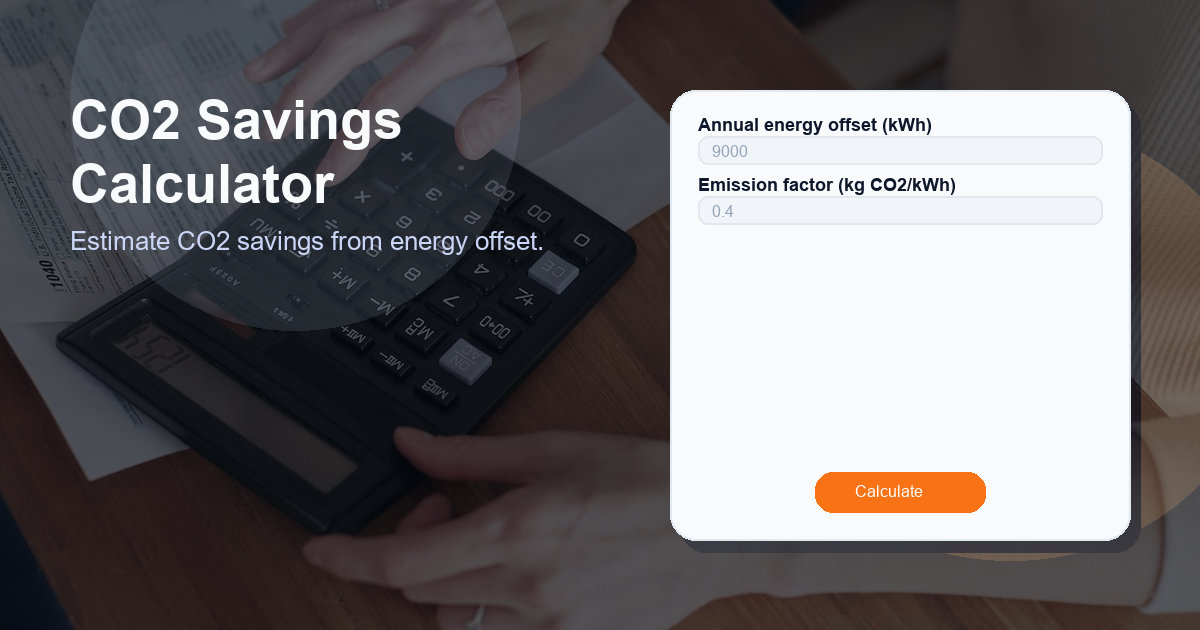
What this CO2 Savings Calculator calculator does
The CO2 Savings Calculator is a simple tool that helps you estimate how much carbon dioxide (CO2) you avoid releasing into the atmosphere by offsetting energy consumption. Whether you’re evaluating the impact of installing solar panels, buying renewable energy certificates, or improving energy efficiency, this calculator converts energy offsets into a clear CO2 savings figure.
Description: Estimate CO2 savings from energy offset.
Calculator inputs:
- Annual energy offset (kWh) — the amount of electricity you expect to offset in kilowatt-hours per year.
- Emission factor (kg CO2/kWh) — the amount of CO2 emitted per kWh for the energy source being replaced (often a grid-average value).
Formula: annual_kwh * kwh_emission_factor
Result label: CO2 Savings
How to use the CO2 Savings Calculator calculator
Using the CO2 Savings Calculator is straightforward. Follow these steps to get an actionable estimate:
- Determine your annual energy offset (kWh). This could be the predicted production of a rooftop solar array, the kWh represented by purchased renewable energy certificates, or the energy you expect to save after upgrades.
- Choose an appropriate emission factor (kg CO2/kWh). Use a national or grid-average number if available, or a technology-specific factor if you are replacing a particular fuel. Emission factors vary by region and energy mix.
- Apply the formula: multiply annual kWh by the emission factor to get CO2 savings in kilograms.
- Convert units if needed. For easier communication, convert kilograms to metric tonnes by dividing by 1,000 (e.g., 2,500 kg = 2.5 tonnes).
Example: If your solar array offsets 5,000 kWh per year and your grid emission factor is 0.475 kg CO2/kWh, then:
CO2 Savings = 5,000 * 0.475 = 2,375 kg CO2 (or 2.375 tonnes CO2).
How the CO2 Savings Calculator formula works
The core computation in this CO2 Savings Calculator is intentionally simple and transparent:
annual_kwh * kwh_emission_factor
Why this works:
- The annual energy offset (kWh) represents the quantity of electricity that is no longer drawn from the baseline energy mix (typically the grid).
- The emission factor (kg CO2/kWh) represents the average CO2 emissions produced for every kilowatt-hour generated within that baseline. Multiplying the two converts energy units into mass of CO2 avoided.
Important notes on the formula:
- This method calculates direct operational CO2 savings tied to the specific kWh offset. It does not automatically include embedded or lifecycle emissions unless the emission factor you use already accounts for those.
- Emission factors can be specified at different scopes: central-grid average, marginal grid emissions (what is actually reduced when you offset), or technology-specific. Choose the one that best matches your use case.
Use cases for the CO2 Savings Calculator
The CO2 Savings Calculator is useful for a wide variety of stakeholders. Common use cases include:
- Homeowners estimating the environmental benefit of rooftop solar or heat pump installations.
- Businesses calculating annual CO2 reductions from energy efficiency projects, on-site generation, or contracted renewable energy.
- Project developers modeling the climate impact of proposed renewable installations for investor reports or grant applications.
- Policy analysts and NGOs performing quick scenario analysis to compare outcomes across energy policy options.
- Reporting and communications where concise, easy-to-understand CO2 savings figures are needed for sustainability reports or stakeholder updates.
For each use case, be sure to customize the emission factor to reflect the local electricity mix or the specific baseline you aim to replace. Using national or region-specific factors improves accuracy and credibility.
Other factors to consider when calculating x
While the CO2 Savings Calculator provides a reliable baseline estimate based on kWh and an emission factor, real-world accounting often involves additional considerations:
- Grid dynamics: In many power systems, marginal emissions differ from average emissions. If your offset displaces coal during peak hours or gas during off-peak hours, the actual CO2 savings may differ from a simple average-based calculation.
- Lifecycle emissions: Manufacturing, transport, installation and decommissioning of equipment (like solar panels or batteries) create emissions. If you want full lifecycle CO2, include those estimates in your calculation or adjust the emission factor accordingly.
- Transmission and distribution losses: Electricity losses in the grid mean that producing 1 kWh at a power plant might result in slightly less delivered kWh. Decide whether your baseline emission factor is generation-based or delivered-energy-based.
- Additionality and accounting rules: For claimed offset projects or carbon credits, ensure the project meets additionality criteria and follows accepted standards (e.g., VCS, Gold Standard).
- Temporal mismatch: If your renewable generation occurs at different times than your consumption, consider whether storage or grid balancing changes the effective savings.
- Co-pollutants and local impacts: While CO2 is a primary focus, replacing fossil generation also affects local pollutants (NOx, SOx, particulates) — relevant for air quality considerations.
FAQ
1. What units does the CO2 Savings Calculator return?
The calculator multiplies kWh by kg CO2/kWh to return results in kg CO2. You can convert to metric tonnes by dividing by 1,000 (kg → t).
2. Which emission factor should I use?
Use the most relevant emission factor you have available: a national or regional grid-average for general estimates, a marginal emission factor for more precise displacement estimates, or a technology-specific factor if replacing a known fuel source. Government energy agencies and utilities often publish reliable factors.
3. Does this calculator include lifecycle emissions?
Not by default. The formula (annual_kwh * kwh_emission_factor) estimates operational CO2 savings tied to electricity generation. To include lifecycle emissions, either choose an emission factor that already includes lifecycle impacts or add lifecycle CO2 to your final tally.
4. Can I use this for small and large projects?
Yes. The calculation is scalable and works for household, commercial, or utility-scale projects. Ensure your chosen emission factor matches the scale and baseline you are replacing.
5. How accurate is the estimate from the CO2 Savings Calculator?
Accuracy depends on the quality of the inputs. The arithmetic is exact, but the result only reflects the accuracy of the annual energy offset and the emission factor. Use localized and up-to-date emission factors and account for additional factors (marginal emissions, lifecycle) for improved accuracy.
For teams and individuals aiming to communicate climate impact, the CO2 Savings Calculator is a practical first step. It transforms energy metrics into a tangible CO2 figure you can use in reports, decisions, and conversations about sustainability.