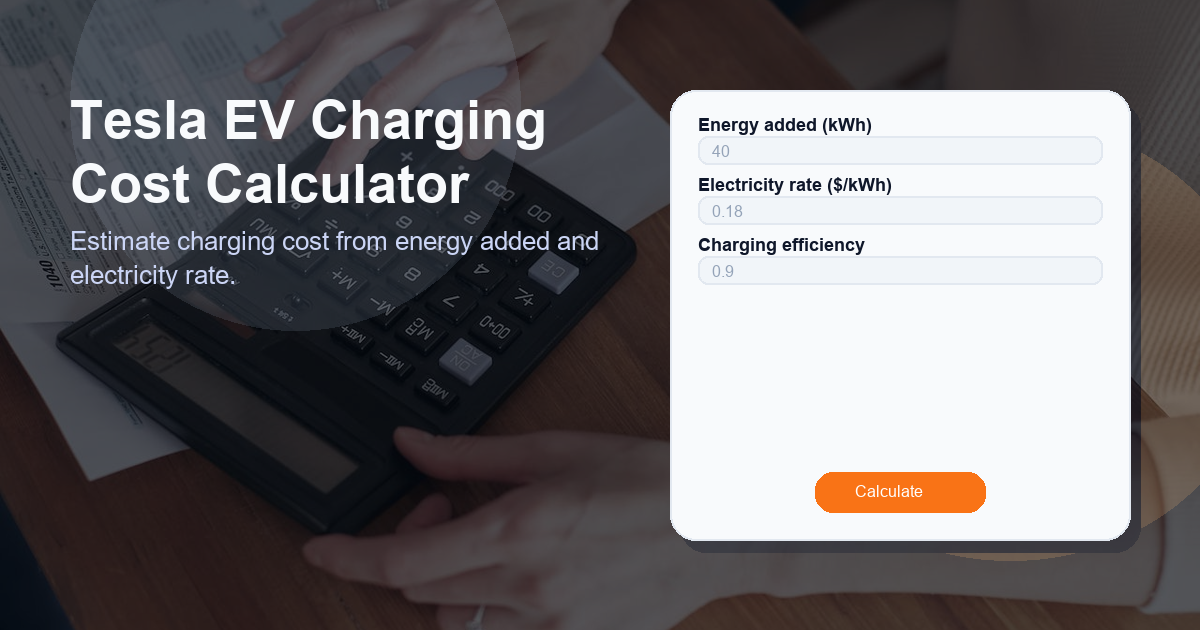
Tesla EV Charging Cost Calculator
Tesla EV Charging Cost Calculator — Estimate your charging cost quickly and accurately. This article explains what the calculator does, how to use it, the underlying formula, practical use cases, and additional factors to consider when calculating charging cost for a Tesla or any electric vehicle.
What this Tesla EV Charging Cost Calculator calculator does
The Tesla EV Charging Cost Calculator estimates the cost to add a specific amount of energy to a Tesla (or other EV) based on the amount of energy added, the electricity rate, and the charging efficiency. It converts the energy you want to put into your car into the energy drawn from the grid and multiplies that by your electricity price so you can see the expected Charging Cost.
- Inputs: Energy added (kWh), Electricity rate ($/kWh), Charging efficiency
- Formula: energy_added_kwh / charging_efficiency * electricity_rate
- Result label: Charging Cost
This is useful for planning home charging, comparing public charging costs, and budgeting for trips or fleet operations.
How to use the Tesla EV Charging Cost Calculator calculator
Using the Tesla EV Charging Cost Calculator is straightforward. Follow these simple steps to get an accurate estimate:
- Enter Energy added (kWh) — The amount of energy you want to add to the battery. This is usually the difference between the current state-of-charge and the target state-of-charge. Example: 50 kWh.
- Enter Electricity rate ($/kWh) — Your utility price or the public charging price. Input as dollars per kilowatt-hour. Example: $0.15/kWh.
- Enter Charging efficiency — The fraction of energy that actually reaches the battery versus what is drawn from the grid. Enter as a decimal (e.g., 0.90 for 90%). If you prefer percentages, convert to decimal first (90% → 0.90). A typical value is between 0.85 and 0.95 depending on charging type and losses.
- Calculate — The calculator applies the formula and returns the Charging Cost, typically shown in dollars with two decimal places.
Example: If you add 50 kWh, your rate is $0.15/kWh, and efficiency is 0.90, then Charging Cost = (50 / 0.90) * 0.15 = (55.56 * 0.15) ≈ $8.33.
How the Tesla EV Charging Cost Calculator formula works
The core of the calculator is a simple formula that accounts for charging losses. It ensures you are charged for the energy drawn from the grid, not just what ends up in the battery.
Formula:
energy_added_kwh / charging_efficiency * electricity_rate
Explanation of each term:
- energy_added_kwh — The net energy increase in the battery (kWh).
- charging_efficiency — A decimal showing what portion of the energy drawn from the grid is stored in the battery. This reflects losses in AC/DC conversion, resistance, heat, and charging overhead.
- electricity_rate — Cost per unit of electricity ($/kWh) billed by your utility or the public charger operator.
Why divide by efficiency? If only 90% of grid energy reaches the battery, you must draw more energy from the grid than what you add to the battery. Dividing by the efficiency increases the energy drawn accordingly, then multiplication by the rate converts that energy into a dollar amount.
Practical notes:
- If charging_efficiency = 1.0, the formula reduces to energy_added_kwh * electricity_rate (no losses).
- Use realistic efficiency values: Level 1 (slow AC) and Level 2 chargers often see ~85–95% efficiency; DC fast charging may be slightly less efficient depending on conditions.
- Round the final Charging Cost to two decimal places for currency output.
Use cases for the Tesla EV Charging Cost Calculator
The Tesla EV Charging Cost Calculator is useful in many scenarios. Here are common applications:
- Home charging budgeting: Estimate monthly charging costs by summing daily or weekly calculations.
- Trip planning: Compare costs for charging at home versus public DC fast chargers on a long trip.
- Charging network comparison: Evaluate whether a paid public charger is worth the time savings versus a cheaper home charge.
- Fleet management: Calculate operational costs for multiple Tesla vehicles to forecast electricity expenses and optimize charging schedules.
- Lease/ownership cost comparison: Factor charging cost into total cost-of-ownership comparisons with gasoline vehicles.
- Tax and reimbursement calculations: Compute monetary values for employer reimbursements or for documentation for business use.
Other factors to consider when calculating charging cost
While the calculator gives a solid baseline, several other factors can affect the real-world Charging Cost:
- Time-of-use (TOU) rates: Electricity rates often vary by time of day. Charging overnight can be much cheaper than daytime rates.
- Demand charges and fixed fees: Some commercial rates include demand charges or minimum fees that change the effective cost per kWh.
- Charging network fees: Public chargers may add session fees, per-minute fees, or subscription discounts that affect the final price.
- Temperature and battery conditioning: Cold weather increases losses and preheating can consume extra energy, reducing efficiency.
- State and local taxes: Some regions add levies to electricity that increase the billed rate.
- Vehicle-to-grid (V2G) or regenerative braking: Energy recovered by regen reduces net energy added over time but isn’t captured by a single charging session calculation.
- Battery degradation: Older batteries may accept and retain charge differently, slightly altering effective energy added.
- Charger power and cable losses: Long charging cables and high-power sessions can produce additional losses not reflected in a generic efficiency value.
To improve accuracy, use local utility rates, track actual meter readings, and measure real-world efficiency over multiple charging sessions. For quick estimates the standard formula is usually sufficient.
FAQ
How do I choose the right charging efficiency value?
Use a realistic value based on charger type: 0.90 (90%) is a good default for Level 2 home charging. For DC fast charging, consider 0.85–0.90. If you have measured data from your meter, use that observed efficiency.
Does the calculator account for public charging fees or subscription costs?
No—this calculator focuses on energy cost based on kWh and efficiency. To include public charging fees, add session fees or per-minute charges to the resulting Charging Cost manually.
Can I use this for non-Tesla EVs?
Yes. The formula applies to any EV. The name Tesla EV Charging Cost Calculator highlights a common use case, but input your vehicle-specific energy needs and efficiency for accurate results.
What if my electricity rate is in cents per kWh?
Convert cents to dollars before using the formula. For example, 15 cents/kWh becomes $0.15/kWh. Keep units consistent to get correct Charging Cost.
How accurate is the estimate?
Accuracy depends on input quality. If you provide precise energy added (from odometer/SOC calculations), real utility rates, and an accurate efficiency estimate, the calculator can be very close to actual cost. Expect minor variance due to transient losses, taxes, or additional fees.