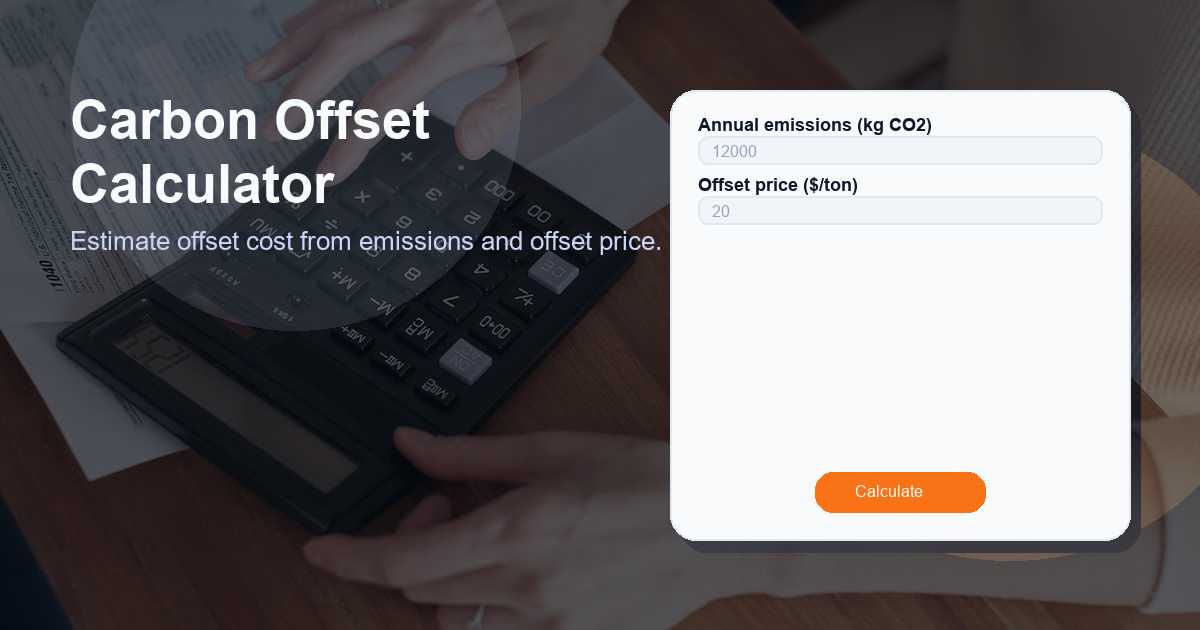
What this Carbon Offset Calculator does
The Carbon Offset Calculator helps you quickly estimate the monetary cost to offset a given amount of carbon dioxide emissions. It converts your input of annual emissions (kg CO2) into tonnes, multiplies by the offset price ($/ton), and returns the expected Offset Cost in dollars. This simple tool is ideal for individuals, households, businesses, or event planners who want a fast, transparent estimate of how much it would cost to compensate for a year’s worth of emissions.
Key benefits:
- Fast estimates: get a clear dollar figure based on current or chosen offset prices.
- Transparent formula: the calculation is straightforward and easy to audit.
- Actionable: use the result to budget for carbon neutrality, purchasing offsets, or prioritizing emissions reductions.
How to use the Carbon Offset Calculator
Using the Carbon Offset Calculator is simple. You only need two inputs:
- Annual emissions (kg CO2) — the total amount of CO2 emitted over one year, measured in kilograms.
- Offset price ($/ton) — the cost to buy one metric tonne of carbon offset at the price you choose (market price or vendor quote).
Follow these steps:
- Measure or estimate your annual emissions in kilograms of CO2. Common sources include electricity use, heating, vehicle fuel, flights, and waste.
- Decide on an offset price per tonne. Use current market quotes, vendor prices, or a budgetary figure.
- Enter the values into the calculator and read the Offset Cost result in dollars.
Example:
- Annual emissions: 4,500 kg CO2
- Offset price: $15/ton
- Enter these into the calculator to obtain the Offset Cost.
How the Carbon Offset Calculator formula works
The calculation used by this Carbon Offset Calculator is intentionally straightforward and based on common unit conversions. The formula is:
annual_emissions_kg / 1000 * offset_price_per_tonExplanation:
- Convert kilograms to tonnes: 1 tonne = 1000 kg. So divide the annual emissions in kg by 1000 to get tonnes of CO2.
- Multiply by offset price: multiply the resulting tonnes by the offset price ($ per tonne).
- Result label — Offset Cost: the final value is the amount in dollars required to purchase offsets that equal your annual emissions.
Worked example:
- Annual emissions = 4,500 kg CO2 → 4,500 / 1,000 = 4.5 tonnes CO2
- Offset price = $15/ton → 4.5 * 15 = $67.50
- Offset Cost = $67.50
The formula is intentionally simple to encourage transparency. It assumes you are offsetting only CO2 and that 1 tonne of certified offsets corresponds to 1 tonne of CO2-equivalent avoided or removed.
Use cases for the Carbon Offset Calculator
The Carbon Offset Calculator is versatile. Typical use cases include:
- Individual carbon neutrality: people estimating the cost to offset household energy use and commutes.
- Travel and flights: quickly budgeting for offsetting emissions from air travel or business trips.
- Small business sustainability planning: projecting costs to offset office energy, company vehicles, or product shipments.
- Event planning: estimating the offset budget for conferences, weddings, or festivals.
- Product lifecycle audits: incorporating offsetting costs into product pricing or sustainability reports.
Because the calculator is transparent and simple, it’s also useful for educational purposes — helping teams understand how emission quantities translate into monetary commitments for offsets.
Other factors to consider when calculating offset cost
While the Carbon Offset Calculator gives a clear monetary estimate, real-world offsetting decisions should consider additional factors beyond the raw calculation:
- Offset quality: prices vary by project type (renewable energy, reforestation, methane capture). Cheaper offsets may not deliver the same co-benefits or verification standards as higher-priced projects.
- Verification and standards: look for third-party verification (e.g., Verified Carbon Standard, Gold Standard) to ensure offsets are real, additional, and permanent.
- Additionality and permanence: ensure the project would not have happened without offset funding (additionality) and that carbon reductions are permanent or managed long-term.
- Leakage: some projects may shift emissions elsewhere; effective projects minimize leakage.
- Scope and coverage: this calculator covers CO2 only — for full greenhouse gas accounting, convert other gases to CO2e before applying the formula.
- Regional price differences and currency: offset prices can vary by country and currency, so adjust for exchange rates and local cost structures.
- Transaction and administrative fees: platforms or brokers may add fees on top of offset prices; budget accordingly.
- Baseline accuracy: the quality of your emissions estimate directly impacts the reliability of the Offset Cost. Use accurate activity data where possible.
- Reduction vs. offset: prioritize emissions reductions first — offsets should complement, not replace, direct decarbonization actions.
By combining the simple output of this calculator with careful selection of high-quality offsets and a commitment to reduce emissions, you can create a credible and cost-effective carbon management strategy.
FAQ
What counts as an acceptable offset price to use in the Carbon Offset Calculator?
Acceptable offset prices vary widely. Use market averages or quotes from reputable vendors. Prices can range from under $5/ton for some large-scale projects to $50+/ton for high-quality, co-benefit-rich projects. Choose a price that matches the verification level you want (e.g., Gold Standard projects often cost more).
Can the Carbon Offset Calculator handle greenhouse gases other than CO2?
This calculator uses kg CO2 as input. To account for other greenhouse gases (CH4, N2O, etc.), convert them to CO2-equivalent (CO2e) using global warming potential (GWP) multipliers and input the CO2e value in kilograms before running the calculation.
How accurate is the Offset Cost estimate?
Accuracy depends on the quality of your emissions estimate and the offset price used. The mathematical conversion is exact, but emissions inventories and market prices introduce variability. Treat the output as a budgetary or planning estimate, not a certified accounting result.
Should I buy offsets or invest in emissions reductions first?
Best practice is to prioritize direct emissions reductions (efficiency, electrification, low-carbon fuels) and then use offsets for residual emissions that are hard to eliminate. Offsets are complementary, not a substitute for decarbonization.
Where can I buy high-quality offsets recommended by the calculator?
Purchase from reputable registries or vendors that use recognized standards (e.g., Verra, Gold Standard). Check project transparency, co-benefits, verification reports, and seller reputation. Many platforms allow bulk purchases for businesses or subscription offsetting for individuals.
Use the Carbon Offset Calculator as a clear, repeatable starting point for budgeting and planning. Combine it with high-quality offsets and a long-term emissions reduction strategy for the best environmental and financial outcomes.