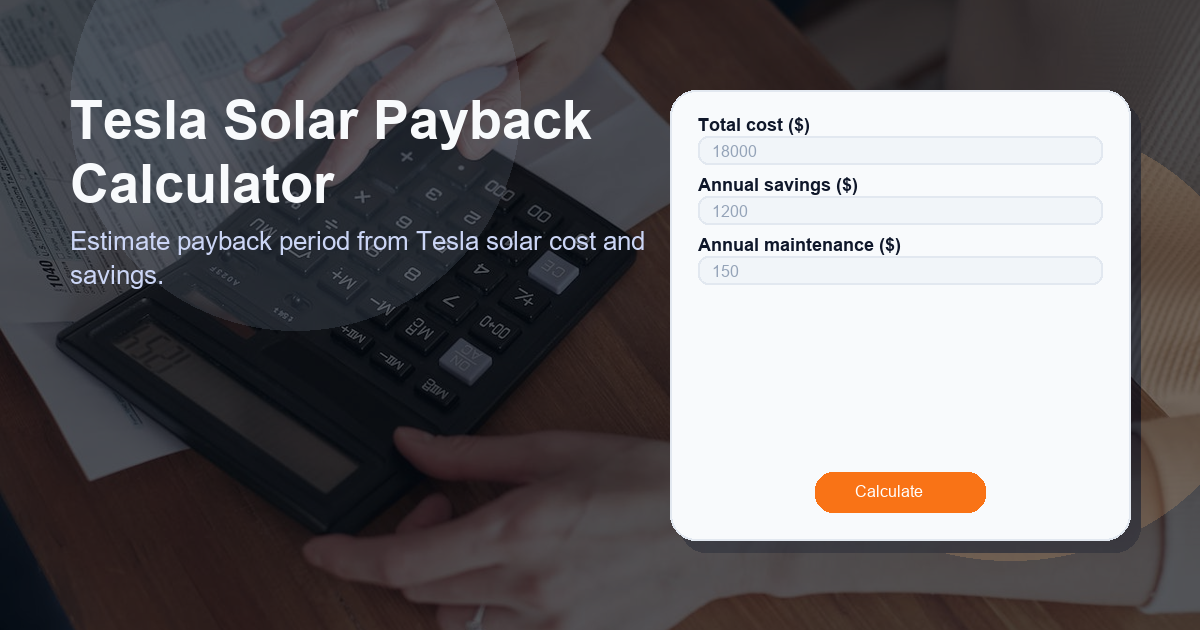
Tesla Solar Payback Calculator
Description: Estimate payback period from Tesla solar cost and savings. Use the Tesla Solar Payback Calculator to quickly evaluate how long it will take for your Tesla solar system to pay for itself based on your installation cost, expected annual savings, and ongoing annual maintenance.
What this Tesla Solar Payback Calculator calculator does
The Tesla Solar Payback Calculator provides an easy, immediate estimate of the Payback Period for a Tesla solar installation. It uses three simple inputs:
- Total cost ($) — the upfront cost of the Tesla solar system, including panels, inverter, installation, permits, and any local fees.
- Annual savings ($) — the amount you expect to save on electricity bills each year because of solar generation and net metering, before maintenance costs.
- Annual maintenance ($) — recurring yearly costs to maintain the system (cleaning, minor repairs, monitoring fees, insurance increases, etc.).
Based on these inputs, the calculator outputs the Payback Period (in years) using a straightforward, conservative approach. It is designed for quick decision-making, comparisons between financing options, or initial feasibility checks.
How to use the Tesla Solar Payback Calculator calculator
Using the Tesla Solar Payback Calculator is simple and intuitive. Follow these steps:
- Enter Total cost ($): Input the total upfront price of the Tesla solar system. Include any rebates or tax credits if you prefer to calculate net cost; otherwise enter the gross installation price.
- Enter Annual savings ($): Estimate how much you will save on your electricity bills each year. Use conservative numbers or your historical electricity usage and local solar insolation to estimate this.
- Enter Annual maintenance ($): Add expected recurring expenses for system upkeep. Even if you expect minimal costs, include a small allowance for cleaning, monitoring, and repairs.
- Read the Payback Period: The calculator will display the Payback Period in years. If the yearly net savings (annual savings minus annual maintenance) is zero or negative, the result will show 0 (no payback under current assumptions).
Example: If your Total cost is $18,000, Annual savings are $1,800, and Annual maintenance is $150, then Net annual savings = $1,800 – $150 = $1,650. Payback Period = $18,000 / $1,650 ≈ 10.9 years.
How the Tesla Solar Payback Calculator formula works
The calculator uses a simple, transparent formula so you can easily understand and adjust assumptions:
Formula: (annual_savings – annual_maintenance) > 0 ? total_cost / (annual_savings – annual_maintenance) : 0
Explanation of the formula components:
- annual_savings: The gross financial benefit from the solar system each year — primarily lower electricity bills and any credit from net metering.
- annual_maintenance: The recurring costs to keep the system operating and safe.
- total_cost: The full initial investment in the system.
The formula calculates the number of years required for the cumulative net savings to equal the initial investment. If net annual savings are positive, the Payback Period equals total_cost divided by net annual savings. If net annual savings are not positive (zero or negative), the calculator returns 0 to indicate that, under the entered assumptions, the system will not pay back.
Use cases for the Tesla Solar Payback Calculator
This calculator is useful for several common scenarios:
- Homeowners comparing options: Quickly compare different Tesla system sizes or price quotes to see which delivers the fastest payback.
- Budget planning: Evaluate how long it will take to recover an investment in Tesla solar, useful for mortgage planning, refinancing, or leasing decisions.
- Policy and incentive analysis: Test how rebates, tax credits, or increases in electricity rates affect payback by adjusting the inputs.
- Commercial or rental property owners: Estimate how solar improves cash flow and when the system starts generating net positive returns.
- Initial feasibility checks: Quickly screen whether a deeper, more detailed financial analysis is warranted before contacting installers.
Other factors to consider when calculating payback
While the Tesla Solar Payback Calculator provides a fast payback estimate, real-world outcomes depend on many additional variables. Consider these important factors:
- Electricity rate escalation: Utility rates typically rise over time. Increasing electricity prices will shorten the payback period, so using a constant annual savings figure is conservative.
- Incentives and tax credits: Federal solar tax credits, state rebates, and local incentives can significantly reduce total_cost. Decide whether to subtract these from total_cost when using the calculator.
- Financing costs: If you finance the system with a loan, interest payments increase the effective cost and lengthen payback. Consider including loan payments in annual maintenance or adjust total_cost accordingly.
- Performance degradation: Solar panels gradually lose efficiency (commonly ~0.5–1% per year). Long-term modeling that includes degradation will affect lifetime savings but has a smaller effect on initial payback years.
- System warranties and lifespan: Tesla systems come with warranties but components may need replacement over decades. Include replacement costs or reduced output in longer-term plans.
- Net metering rules and time-of-use rates: Local utility policies can significantly impact effective savings—some compensation methods for exported electricity reduce annual savings compared to full retail credit.
- Maintenance variability: Some systems require very little maintenance, while others (e.g., in dusty or snowy climates) may need more frequent service.
Use the calculator for a quick, baseline estimate, then refine inputs with local data and financial terms for a robust decision.
FAQ
What exactly does the Payback Period from the Tesla Solar Payback Calculator mean?
The Payback Period is the number of years it will take for your cumulative net savings (annual savings minus annual maintenance) to equal the initial Total cost ($) of the Tesla solar installation. It measures how long before you “break even.”
Can I include tax credits or incentives in the calculator?
Yes. You can subtract federal tax credits, state rebates, or other incentives from the Total cost ($) before using the calculator to reflect your net investment. Doing this will reduce the Payback Period.
What if my annual maintenance is higher than my annual savings?
If annual_maintenance is greater than or equal to annual_savings, the calculator returns 0, indicating the system will not pay back under the provided assumptions. You should revisit inputs or adjust for incentives, rate increases, or financing to evaluate feasibility.
Does this calculator account for rising electricity prices?
No, the basic formula uses constant annual savings. Rising electricity prices generally shorten payback because annual savings will increase over time. For a more detailed projection, model year-by-year savings or use a discounted cash flow analysis.
Is this tool suitable for business or multi-site installations?
Yes, as a quick screening tool. For commercial or multi-site projects, use site-specific production estimates, separate maintenance costs, and detailed financial modeling to account for taxes, depreciation, and financing structures.