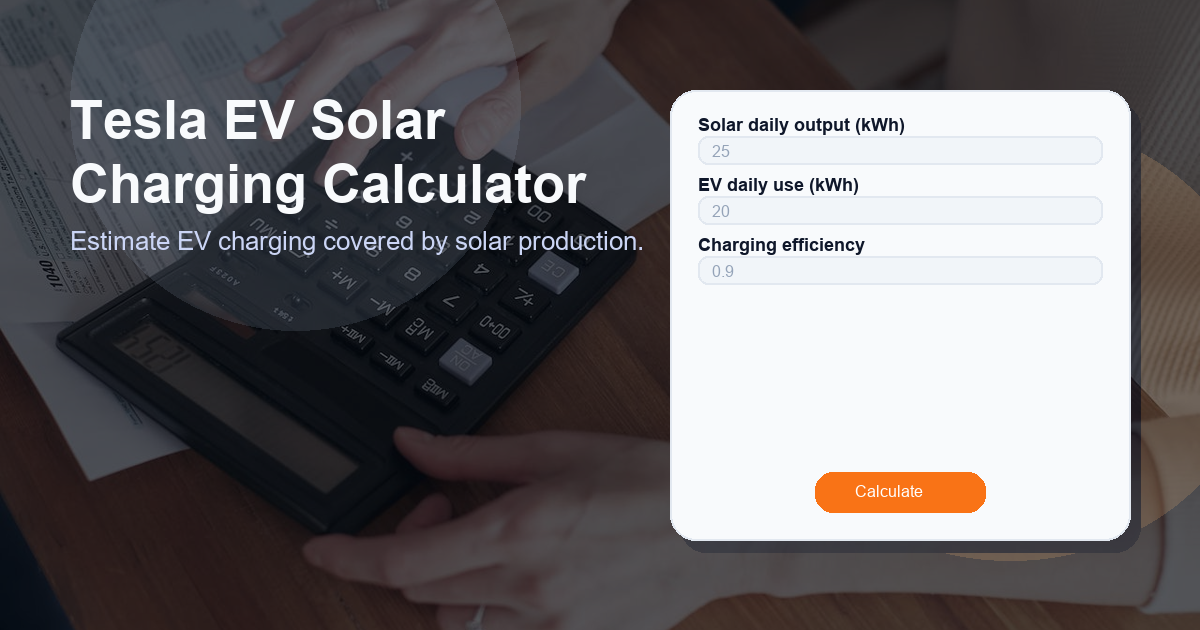
Tesla EV Solar Charging Calculator
What this Tesla EV Solar Charging Calculator calculator does
The Tesla EV Solar Charging Calculator helps you quickly estimate what percentage of your electric vehicle’s daily energy needs can be supplied by your solar array. This tool compares your solar daily output (kWh) against your EV daily use (kWh), and adjusts for charging efficiency to produce a single, easy-to-understand result labeled EV Charging Covered.
In practical terms, this calculator answers the simple question: How much of my car’s daily charging can come directly from my rooftop solar? It is intended for homeowners and fleet managers who want a fast estimate without diving into advanced modeling. Use it as a planning aid to evaluate the impact of adding more solar capacity, changing EV usage patterns, or improving charging efficiency.
How to use the Tesla EV Solar Charging Calculator calculator
Using the calculator is straightforward. You only need three inputs:
- Solar daily output (kWh) — the average energy your solar system produces in a day.
- EV daily use (kWh) — the average energy your electric vehicle consumes per day (or fleet average).
- Charging efficiency — the fraction (0–1) of solar energy that actually reaches the battery after conversion and losses. Typical values: 0.85–0.95 for Level 2 charging, slightly lower if you account for inverter and battery losses.
Enter those values and the calculator returns a percentage labeled EV Charging Covered — how much of your EV charging demand can be met by daily solar production. If your EV daily use is zero or not provided, the calculator returns 0% to avoid division errors.
Example:
- Solar daily output: 30 kWh
- EV daily use: 15 kWh
- Charging efficiency: 0.90
Calculation: (30 kWh * 0.90) / 15 kWh * 100 = (27 / 15) * 100 = 180%. This means your solar can more than cover the EV’s daily needs — you could potentially charge the car fully and still export excess energy or use it elsewhere in the home.
How the Tesla EV Solar Charging Calculator formula works
The calculator uses a simple, transparent formula that prioritizes clarity and ease of use:
ev_daily_kwh > 0 ? (solar_daily_kwh * charging_efficiency) / ev_daily_kwh * 100 : 0Broken down:
- solar_daily_kwh: the baseline solar energy available per day.
- charging_efficiency: multiplies the solar energy by the proportion that actually charges the EV battery (accounts for inverter losses, charger inefficiency, battery acceptance, etc.).
- ev_daily_kwh: the energy needed by the EV each day; dividing the usable solar production by this need yields the fraction covered.
The ternary expression ensures safety: if the EV daily use is zero or not specified, the result is zero to avoid dividing by zero. The final value is multiplied by 100 to present the result as a percentage, which is labeled as EV Charging Covered.
Why percentage? A percentage is intuitive for most users — showing whether the system covers 25%, 100%, or 250% of daily EV demand makes the result actionable: under 100% suggests you still draw from the grid; over 100% indicates potential export or surplus energy for other loads.
Use cases for the Tesla EV Solar Charging Calculator
The calculator is useful in many situations. Common use cases include:
- Homeowner planning: Evaluate whether your existing solar system will supply all or part of an EV you’re considering buying.
- Solar sizing decisions: Determine how much additional solar capacity you might need to reach full EV charging coverage.
- Time-of-use and self-consumption analysis: Estimate how much of your charging can occur directly from daytime solar production vs. drawing from the grid at night.
- Fleet managers: Quickly compare different vehicle types or daily mileage scenarios to optimize solar investments for commercial EV fleets.
- Cost-benefit assessments: Combine the percentage from the calculator with energy pricing to estimate avoided grid electricity costs and payback times.
Because the calculator is simple and fast, it’s ideal for early-stage decision-making and for communicating expected outcomes to stakeholders or family members without getting bogged down in complex simulations.
Other factors to consider when calculating EV charging coverage
While the Tesla EV Solar Charging Calculator gives a quick, reliable estimate, real-world outcomes depend on several additional factors that you should consider:
- Time-of-day production vs. charging schedule: Solar produces during daylight. If you charge at night, you may still draw from the grid unless you have a storage battery or a time-shift strategy.
- Battery storage: Adding home battery storage can increase the effective portion of solar used for EV charging by storing daytime solar for evening charging.
- Seasonal variability: Solar daily output varies by season and location. Use average values or run the calculator for summer and winter averages separately for a range.
- Shading and system degradation: Real solar output can be reduced by shading, soiling, or panel degradation over time.
- Charger type and losses: DC fast charging has different efficiencies compared to Level 2 AC charging; include realistic charging efficiency values for your setup.
- Vehicle energy use variations: EV kWh per mile depends on speed, climate control use, and payload. Use a representative daily average.
Incorporating these variables can refine your estimate. For quick planning, however, the core inputs (solar output, EV use, charging efficiency) provide a meaningful first-order result that helps guide next steps.
FAQ
How accurate is the Tesla EV Solar Charging Calculator?
The calculator provides a simplified estimate based on average daily values. It’s accurate for quick comparisons and planning, but it does not model hourly production, battery storage, or seasonal fluctuations. For precise design work, pair it with hourly solar production data and detailed energy modeling.
What value should I use for charging efficiency?
Charging efficiency depends on your charger and system. Use values between 0.85 and 0.95 for typical home Level 2 charging when accounting for inverter and battery acceptance losses. Lower values may be appropriate for older equipment or DC fast charging scenarios.
Can this tool tell me how big a solar system I need to cover my EV?
Yes—by rearranging the formula, you can estimate required solar output: required solar_daily_kwh = (ev_daily_kwh / charging_efficiency) * desired_coverage_fraction. The calculator helps you see the percentage coverage for a given solar size; invert it to size a system for a target percentage.
Does the calculator account for energy used by the house?
No—this tool focuses on EV charging coverage only. If you want a holistic picture of self-consumption and home energy use, combine EV estimates with home load profiles and consider battery storage to optimize midday solar usage.
What if my solar production exceeds EV needs?
If the result is over 100%, your solar system produces more energy than needed for daily EV charging. That surplus can be used for household loads, stored in a battery, or exported to the grid depending on your system and local policies.