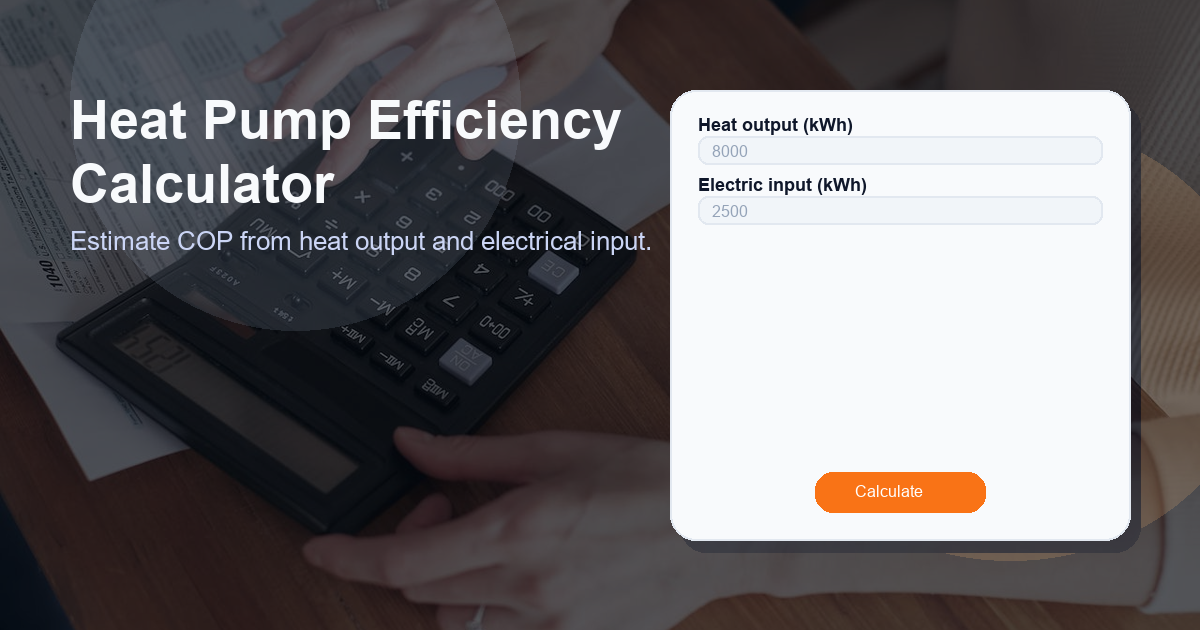
Heat Pump Efficiency Calculator
What this Heat Pump Efficiency Calculator calculator does
The Heat Pump Efficiency Calculator is a simple tool designed to help homeowners, engineers, and energy auditors quickly estimate the performance of a heat pump system. Using two easy-to-measure inputs — Heat output (kWh) and Electric input (kWh) — the calculator returns the system’s COP (Coefficient of Performance). This value indicates how efficiently the heat pump converts electrical energy into useful heat.
Key details:
- Calculator title: Heat Pump Efficiency Calculator
- Description: Estimate COP from heat output and electrical input.
- Inputs: Heat output (kWh), Electric input (kWh)
- Formula: electric_input_kwh > 0 ? heat_output_kwh / electric_input_kwh : 0
- Result label: COP
A COP greater than 1 means the heat pump produces more heat energy than the electrical energy it consumes, which is typical for properly operating heat pumps. This calculator gives a quick, objective number you can use to compare systems or monitor performance over time.
How to use the Heat Pump Efficiency Calculator calculator
Using the Heat Pump Efficiency Calculator is straightforward. Follow these steps to get an accurate COP estimate:
- Measure or record the heat output. This is the total heat delivered by the heat pump over the measurement period, expressed in kWh. Sources: utility-grade heat meters, manufacturer data, or calculated from temperature rise and flow rate for hydronic systems.
- Measure the electrical input. This is the electrical energy consumed by the heat pump (compressor, fans, controls) during the same period, expressed in kWh. Use an energy meter or smart meter readings.
- Enter the two values into the calculator. Both values must be in the same energy units (kWh) and cover the same time period.
- Run the calculation. The calculator applies this logic: if electric_input_kwh > 0, then COP = heat_output_kwh / electric_input_kwh; otherwise COP = 0.
- Interpret the COP. Higher COP indicates greater efficiency. Use it to compare systems, verify manufacturer claims, or estimate running costs.
Example: if a heat pump delivers 6 kWh of heat while consuming 2 kWh of electricity over the same period, COP = 6 / 2 = 3.0.
How the Heat Pump Efficiency Calculator formula works
The formula behind the Heat Pump Efficiency Calculator is intentionally simple and grounded in energy balance. COP is defined as:
- COP = Useful heat output / Electrical energy input
The calculator uses the conditional expression:
electric_input_kwh > 0 ? heat_output_kwh / electric_input_kwh : 0
Why the condition? If electrical input is zero or not measured, division would be undefined or misleading. The calculator safely returns 0 in that case. In practice, a properly operating heat pump will always consume some electrical input, and the formula will produce a meaningful COP.
Important technical notes:
- Unit consistency: Both inputs must be energy values (kWh). If you have power readings (kW), integrate them over time to get kWh for the same period.
- Steady-state vs. transient: Short-term spikes (defrost, startup) can skew COP. For reliable numbers, use averaged data over representative operating intervals.
- Dimensionless result: COP has no units — it is a ratio. A COP of 3 means the heat pump produces three times more heat energy than the electrical energy it consumes.
Use cases for the Heat Pump Efficiency Calculator
The Heat Pump Efficiency Calculator has many practical applications across residential, commercial, and industrial contexts:
- Homeowners: Validate the expected savings after installing a heat pump; compare different models or operating settings.
- Installers and contractors: Commissioning checks and on-site verification of system performance against specification.
- Energy auditors: Document system efficiency during audits and calculate potential upgrades or retrofit benefits.
- Facility managers: Monitor seasonal trends in COP to identify maintenance needs or performance degradation.
- Researchers and policy analysts: Aggregate COP measurements across installations to estimate large-scale energy impacts and greenhouse gas reductions.
Example practical scenarios:
- Cost estimation: Knowing COP helps you estimate how much heat you get per dollar of electricity. Multiply the COP by the cost per kWh or rearrange the formula to estimate electrical consumption for a heat demand.
- Comparison shopping: Use measured COPs to compare in-field performance, not just manufacturer-rated values.
- Performance thresholds: Set alarm thresholds (e.g., COP < 2.0) to trigger maintenance inspections.
Other factors to consider when calculating COP
While the Heat Pump Efficiency Calculator gives a clear numerical COP, real-world performance is influenced by many additional factors. Consider these when interpreting results:
- Source and sink temperatures: COP depends strongly on the temperature difference between the heat source (air, ground, water) and the target heating temperature. Colder source temperatures reduce COP.
- Part-load operation: Systems often run at partial load; inverter-driven compressors can maintain higher COPs than fixed-speed units under varying load.
- Auxiliary heat: Electric resistance or backup heat elements drastically reduce effective COP when they run.
- Defrost cycles: Air-source heat pumps periodically defrost; during defrost operations the apparent COP drops temporarily.
- Installation quality: Incorrect refrigerant charge, poor airflow, and improper controls can lower COP.
- Measurement accuracy: Meter errors, mismatched measurement periods, and rounding can distort the calculated COP. Always align start/end times and use accurate meters.
- Seasonal metrics: Instantaneous COP differs from seasonal COP (SCOP or HSPF), which aggregates performance across an entire season and is more useful for annual energy cost estimates.
Tips to improve measured COP:
- Improve insulation and reduce system temperature setpoints.
- Ensure proper refrigerant charge and clean heat exchangers.
- Use variable-speed compressors and pumps where possible.
- Minimize use of auxiliary resistance heat by optimizing controls.
FAQ
1. What does COP mean and why is it important?
COP (Coefficient of Performance) is the ratio of useful heat output to electrical input. It indicates how efficiently a heat pump converts electricity into heat. A higher COP means lower operating costs and reduced environmental impact.
2. Can the Heat Pump Efficiency Calculator be used for cooling performance?
The calculator is designed for heating COP (heat output vs. electrical input). For cooling, a similar ratio exists called EER or SEER, or you can compute a cooling COP using cooling output (kWh) divided by electrical input (kWh).
3. Why does my heat pump sometimes show a COP lower than 1?
A COP lower than 1 is unusual for heat pump heating mode, but it can occur if auxiliary electric resistance heaters are active, if measurements include periods with no heat output, or if measurement errors exist. Verify inputs and check for auxiliary heat usage.
4. How long should I measure to get a reliable COP?
Measure over representative operating periods — at least several hours to days, and ideally a full heating cycle or season for seasonal COP. Avoid short intervals during startup, defrost, or extreme transients.
5. Can this calculator estimate cost savings?
Yes. Combine COP with local electricity prices to estimate cost per kWh of heat. Example: if electricity costs $0.20/kWh and COP = 3.0, the effective heat cost = $0.20 / 3.0 ≈ $0.067 per kWh of heat.