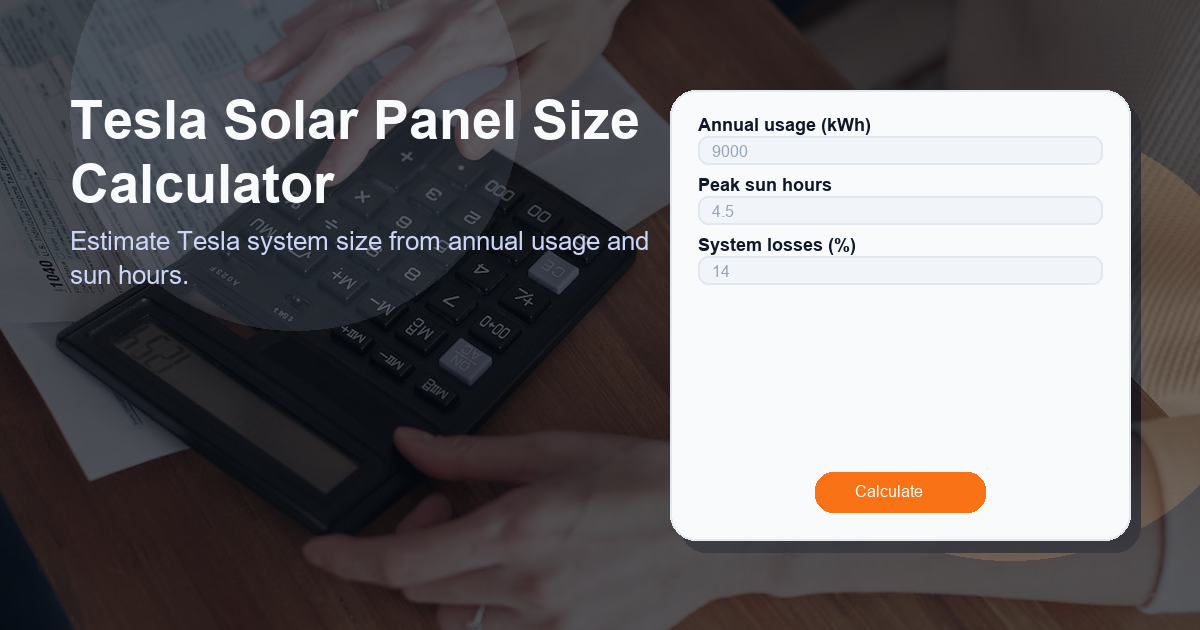
Tesla Solar Panel Size Calculator
Description: Estimate Tesla system size from annual usage and sun hours using the Tesla Solar Panel Size Calculator. This tool helps you translate your yearly electricity consumption into an estimated photovoltaic (PV) array size (System Size) in kilowatts (kW) based on local peak sun hours and expected system losses.
What this Tesla Solar Panel Size Calculator calculator does
The Tesla Solar Panel Size Calculator converts your annual electrical usage (kWh) into an estimated solar system size required to offset that usage. It uses two primary site-specific inputs — Peak sun hours and System losses (%) — to produce a practical estimate of the DC nameplate capacity you would need. The output is shown as the System Size, a value typically expressed in kilowatts (kW).
In short, this calculator provides a quick, data-driven estimate to:
- Gauge how large a Tesla-compatible PV system you might need
- Compare potential system sizes across different locations (different sun hours)
- Start budget and roof-space planning before getting formal quotes
How to use the Tesla Solar Panel Size Calculator calculator
Using the calculator is simple. You will provide three inputs and receive a single output labeled System Size. Follow these steps:
- Annual usage (kWh): Enter your total electricity consumption for a year. You can find this on your utility bills. Example values: 6,000 kWh, 10,500 kWh.
- Peak sun hours: Enter the average daily peak sun hours for your location. This is the equivalent number of hours per day when solar irradiance equals 1,000 W/m². Typical values range from 3 to 6 hours depending on climate and latitude.
- System losses (%): A percentage that represents all inefficiencies — inverter losses, shading, wiring, soiling, temperature losses, and other deratings. Typical assumptions are 10%–25% depending on equipment and site conditions.
- Click “Calculate” (or apply the formula below) to get the System Size, the PV capacity estimated in kilowatts (kW).
Example calculation (manual):
- Annual usage = 8,760 kWh (equivalent to 1 kW continuous)
- Peak sun hours = 4.5
- System losses = 15%
Using the formula below, the estimated System Size would be computed and returned in kW. This gives you a quick, realistic sizing estimate for a Tesla solar installation such as Tesla solar panels or Tesla Solar Roof.
How the Tesla Solar Panel Size Calculator formula works
The calculator uses a straightforward engineering approach: divide the annual energy requirement by the annual energy production per kW of PV array. The production per kW depends on daily peak sun hours, days per year, and an adjustment for system losses.
Formula (exact):
sun_hours > 0 ? annual_kwh / (sun_hours * 365 * (1 - system_losses_percent / 100)) : 0
Breakdown of the formula:
- annual_kwh — the total energy you need per year (kWh).
- sun_hours — average daily peak sun hours (hours/day). Multiplying by 365 converts daily production to annual production potential per kW.
- system_losses_percent — percentage losses expressed as % (e.g., 15 means 15%). The term (1 – system_losses_percent / 100) represents the fraction of nameplate capacity that actually produces usable energy annually.
- Division yields the System Size in kW required to meet annual energy needs assuming the average sun hours and losses are accurate.
Why is the conditional check (sun_hours > 0 ?) included? It prevents division by zero and avoids invalid results for locations where no sun-hours data is available. If sun_hours is 0 or missing, the formula returns 0 as a safe default.
Use cases for the Tesla Solar Panel Size Calculator
This calculator is useful for several practical scenarios:
- Initial home solar planning: Quickly estimate the Tesla system size needed to cover household electricity usage before reaching out to installers.
- Compare locations: Evaluate how different average sun hours (for example, comparing Seattle vs Phoenix) change the required PV capacity.
- Pre-quote budget planning: Roughly estimate equipment and installation costs by multiplying the System Size (kW) by typical cost-per-watt for Tesla-compatible systems.
- Assess battery storage needs: Estimate how much PV capacity would pair with a Tesla Powerwall for targeted self-sufficiency or off-grid use.
- Commercial or fleet planning: Scale the calculation to forecast rooftop or carport arrays to meet business electricity consumption.
Because the calculator returns the PV capacity required (System Size), you can immediately translate that to:
- Estimated number of panels (based on panel wattage, e.g., 370 W panels)
- Approximate roof area required
- Estimated upfront cost and payback timeline
Other factors to consider when calculating system size
While the Tesla Solar Panel Size Calculator provides a fast and reliable estimate, real-world system design should account for additional factors beyond the basic inputs:
- Panel orientation and tilt: South-facing and optimally tilted panels produce more than east/west or flat-mounted arrays.
- Shading: Trees, chimneys, and nearby buildings can reduce output significantly. Tesla’s microinverters or optimizers can mitigate some shading losses, but shading still impacts sizing.
- Temperature effects: Higher temperatures reduce panel efficiency; location climate should influence expected performance.
- Degradation over time: Panels slowly lose output (typically 0.5%–1% per year). Long-term planning might size slightly larger to compensate.
- Inverter performance and clipping: Inverter sizing and behavior can affect annual production; some systems intentionally “oversize” panels relative to inverter capacity to maximize energy yield.
- Local regulations and grid interconnection: Utility rules and permitting may influence maximum allowable system size or how net metering is handled.
- Roof condition and usable area: Structural considerations and usable roof area can limit the practical number of panels you can install.
- Future load changes: Plan for potential increases in usage (EV charging, home additions) — you may want to size a bit larger now to avoid future additions.
For an accurate, installable design and a Tesla-certified quote, you should consult a professional installer who will account for these site-specific details and provide optimized equipment selection and placement.
FAQ
How accurate is the Tesla Solar Panel Size Calculator?
The calculator gives a solid preliminary estimate based on average inputs. Its accuracy depends on correct values for annual usage, peak sun hours, and realistic system losses. It does not replace a site assessment or a full engineering design, which can capture shading, roof geometry, and local weather variations.
What is a typical value for system losses (%)?
Commonly used assumptions for system losses range from 10% to 20%. A conservative default is around 15%, which includes inverter inefficiencies, soiling, wiring, and other derating factors. High-quality installations with optimizers can achieve lower losses.
Are peak sun hours the same as hours of daylight?
No. Peak sun hours refers to the equivalent number of hours per day when solar irradiance equals 1,000 W/m². It’s a way to average sunlight intensity — for example, a location might receive 4 peak sun hours even if it has 12 hours of daylight.
What does the result “System Size” represent?
The result labeled System Size is the estimated PV nameplate capacity (in kW) required to meet the annual energy consumption you entered, given your sun hours and system loss estimate. This is the DC capacity of the solar array, which you can use to estimate number of panels and expected costs.
Can I use this calculator for Tesla Solar Roof as well as panels?
Yes. The underlying energy-sizing logic is the same for Tesla Solar Roof and conventional Tesla solar panels. The main differences are cost per watt and available roof coverage. Use the resulting System Size to estimate required roof area and discuss Tesla-specific product options with a certified installer.
Next steps: Use the calculator to generate a System Size estimate, then consult with a Tesla installer or qualified solar designer to validate assumptions, check site constraints, and receive a detailed proposal tailored to your property.