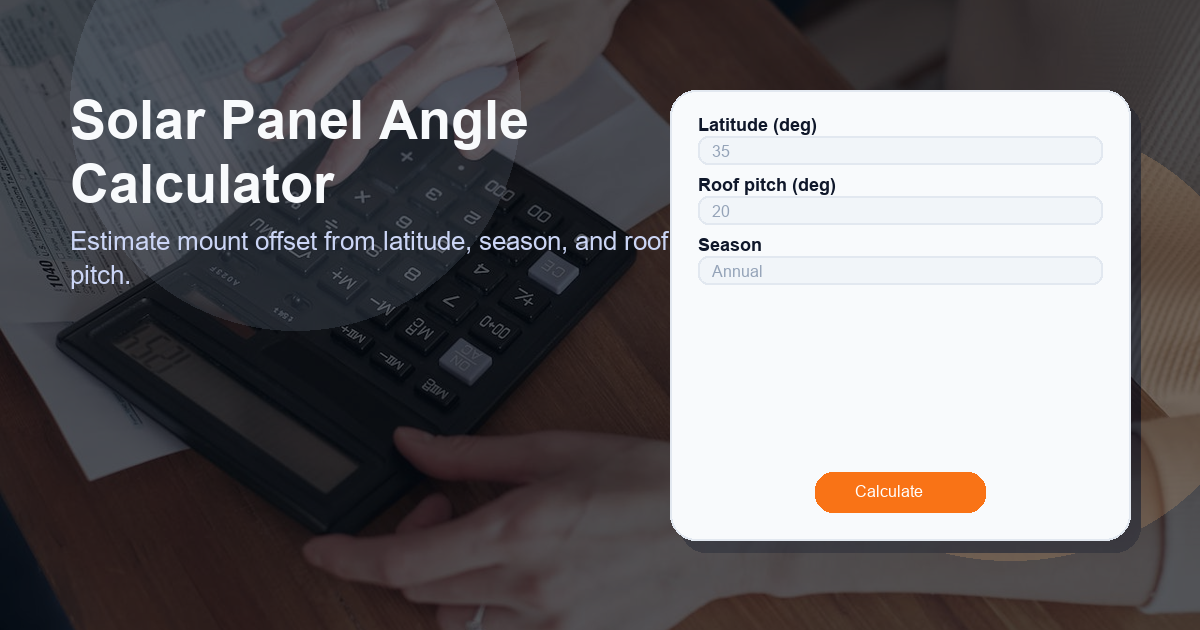
Solar Panel Angle Calculator
Description: Estimate mount offset from latitude, season, and roof pitch.
What this Solar Panel Angle Calculator calculator does
The Solar Panel Angle Calculator is a simple decision tool that estimates the recommended mounting offset (tilt adjustment) for rooftop solar panels. Using three inputs — Latitude (deg), Roof pitch (deg), and Season — it returns a single value labeled Mount Offset, calculated as:
latitude_deg + season_adjust – roof_pitch_deg
This result gives a quick, first-order estimate of how much extra tilt (positive or negative) to add to the existing roof pitch so the panels achieve a more optimal incidence angle for the chosen season. The calculator is designed for rapid planning and comparison rather than as a final engineering specification.
How to use the Solar Panel Angle Calculator calculator
Using the Solar Panel Angle Calculator is straightforward. Follow these steps:
- Enter Latitude (deg) — the geographic latitude of the installation site in degrees (positive for northern hemisphere, negative for southern).
- Enter Roof pitch (deg) — the angle of the roof surface measured from horizontal, typically between 0° (flat) and 60°+ for steep roofs.
- Select Season — choose a season or energy goal. The calculator applies a season adjustment value (season_adjust) to bias the tilt toward maximizing winter, summer, or year-round performance.
- Read Mount Offset — the output labeled Mount Offset is computed using the formula:
latitude_deg + season_adjust - roof_pitch_deg. A positive value means adding tilt relative to the roof; a negative value indicates the roof is already steeper than the seasonally ideal tilt.
Inputs used by the calculator:
- Latitude (deg)
- Roof pitch (deg)
- Season
Result label:
- Mount Offset (degrees)
How the Solar Panel Angle Calculator formula works
The formula behind this calculator is deliberately simple:
mount_offset = latitude_deg + season_adjust – roof_pitch_deg
Explanation of terms:
- latitude_deg — Solar incidence is strongly tied to latitude. A commonly used rule-of-thumb is to tilt panels close to the latitude angle to optimize year-round production.
- season_adjust — Seasonal adjustment in degrees biases the tilt for a particular time of year. Typical heuristics include:
- Winter: +10° to +15° (tilt steeper to capture lower sun angles and maximize winter production)
- Summer: -10° to -15° (reduce tilt to capture high summer sun)
- Year-round / Equinox: 0° (balance across seasons)
- roof_pitch_deg — The current roof angle. If the roof is already at the seasonally ideal angle, the mount offset will be around zero.
Why this works: latitude gives a baseline target tilt. The season_adjust modifies that baseline depending on whether you want to favor winter or summer production. Subtracting the roof pitch converts the baseline into an offset relative to the existing surface so you know how much to raise or lower the panel tilt using the mount.
Worked examples
- Example A: Latitude = 40°, Roof pitch = 20°, Season = Winter (season_adjust = +12°)
Mount Offset = 40 + 12 – 20 = +32°. A positive 32° offset indicates you would mount panels substantially steeper than the roof (tilt them upward ~32° above roof pitch). - Example B: Latitude = 34°, Roof pitch = 30°, Season = Summer (season_adjust = -12°)
Mount Offset = 34 – 12 – 30 = -8°. A negative offset shows the roof is already steeper than the seasonally ideal tilt — you might flatten the panel slightly if feasible. - Example C: Latitude = 52°, Roof pitch = 45°, Season = Year-round (season_adjust = 0°)
Mount Offset = 52 + 0 – 45 = +7°. Small positive offset suggests a modest increase in tilt relative to the roof for better year-round performance.
Use cases for the Solar Panel Angle Calculator
The Solar Panel Angle Calculator is useful for a variety of planning scenarios, including:
- Preliminary system design — Quickly estimate tilt adjustments when comparing different roof sections or mounting options.
- Feasibility studies — Determine whether existing roof pitch is close to ideal or whether specialized racking is necessary.
- Seasonal optimization — Decide whether to bias tilt for winter-heavy loads (heating-driven demand) or summer-heavy loads (air conditioning).
- Site comparisons — Compare multiple sites by latitude and roof pitch to identify which installations will need more significant mounts.
- Cost/benefit screening — Use mount offset as a proxy for racking complexity and therefore cost; higher offsets often require taller racks and stronger attachments.
Other factors to consider when calculating mount offset
While the Solar Panel Angle Calculator provides a quick angle estimate, real-world installations require more nuance. Consider these additional factors before finalizing a tilt or ordering mounts:
- Azimuth / Orientation: Tilt is only one axis. Panels facing away from true south (in the northern hemisphere) typically need tilt adjustments combined with azimuth trade-offs. Orientation can be more influential than small tilt changes.
- Shading: Roof obstructions (chimneys, vents, nearby trees) can change the optimal tilt. Lower tilt can reduce shading across adjacent modules.
- Wind and structural load: High mount offsets increase wind exposure and uplift forces. Ensure racking and roof attachments meet local building codes and wind-load requirements.
- Snow shedding and maintenance: In snow-prone areas, steeper tilts help snow slide off; in other locations ground clearance and gutters may impose limits.
- Roof constraints: Roof geometry, mounting zones, and flashings may limit achievable offsets. Some roofs cannot accept tall pedestals or heavy ballast systems.
- Electrical and panel limits: Higher tilt may change cell temperatures and production patterns. Consider inverter sizing and stringing for seasonal shifts in production.
- Permitting and aesthetics: Local ordinances, HOA rules, and visual impact may limit tilt height.
Because of these factors, treat the output labeled Mount Offset as a planning metric. Always validate with engineering, structural review, and site-specific energy modeling before final installation.
FAQ
Q: What exactly does “Mount Offset” mean?
A: Mount Offset is the angular difference (in degrees) that you should add to or subtract from the roof pitch to reach the seasonally adjusted target tilt. Positive values mean the panels should be mounted steeper than the roof; negative values mean the roof is already steeper than the recommended tilt.
Q: How should I choose the season adjustment value?
A: Typical values are +10° to +15° for winter-focused setups, -10° to -15° for summer-focused setups, and 0° for year-round optimization. Choose based on your energy consumption pattern (heating vs cooling) and local sun path characteristics.
Q: Is this calculator accurate for ground-mounted systems?
A: The formula itself is latitude-based and can be used for ground mounts, but ground systems often allow much wider tilt ranges and different constraints. For ground-mounted arrays, use site-specific wind, snow, and clearance considerations in addition to the mount offset.
Q: Can I use this calculator at very high latitudes?
A: Yes, but be cautious. At very high latitudes (>60°), seasonal sun paths become extreme and a single-season adjustment may not capture the annual variability. Use detailed solar modeling for high-latitude installations.
Q: Does this replace a full solar design?
A: No. The Solar Panel Angle Calculator is a quick, rule-of-thumb tool for early-stage planning. It does not replace detailed site surveys, structural engineering, or energy yield simulations required for final design and permitting.