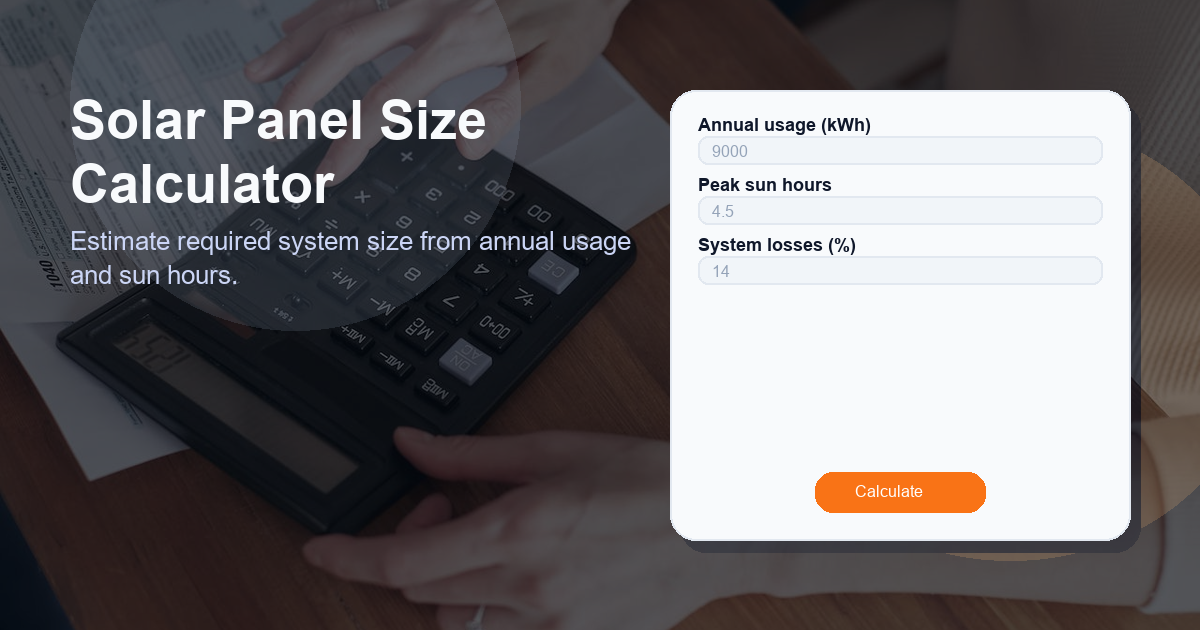
Solar Panel Size Calculator
What this Solar Panel Size Calculator calculator does
The Solar Panel Size Calculator estimates the required solar system capacity (in kilowatts, kW) based on your annual electricity usage, the average peak sun hours at your location, and anticipated system losses (in percent). This tool provides a practical, quick starting point for homeowners, installers, and businesses evaluating how large a photovoltaic (PV) system is needed to meet yearly energy consumption.
The output is labeled System Size and represents the nominal DC capacity of solar panels required to generate the annual kWh you consume, given the input factors. It is an estimate; final system design should involve site-specific evaluation and professional engineering.
How to use the Solar Panel Size Calculator calculator
Using the Solar Panel Size Calculator is straightforward. Enter three inputs and read the estimate:
- Annual usage (kWh) — total electricity you consume in a year. Check your electric bill for the past 12 months or add monthly usage to get this number.
- Peak sun hours — the average number of equivalent full-sun hours per day at your location. This is not hours of daylight but an average of solar irradiance expressed as hours at peak intensity (e.g., 4–6 hours/day common in many regions).
- System losses (%) — a percent estimate for real-world losses such as inverter inefficiency, wiring losses, dirt accumulation, shading, temperature effects, and degradation. Typical values: 10–20%.
After entering these values, the calculator returns System Size in kilowatts (kW). Use this number to:
- Compare against available roof area and panel output ratings.
- Estimate number of panels (divide system size in kW by panel wattage, e.g., a 0.35 kW panel = 350 W).
- Plan budgets and payback projections.
How the Solar Panel Size Calculator formula works
The calculator uses a simple energy balance formula that translates annual energy demand into required daily generation capacity based on average sun exposure and expected losses.
Formula (pseudocode):
sun_hours > 0 ? annual_kwh / (sun_hours * 365 * (1 - system_losses_percent / 100)) : 0
Broken down into a mathematical expression:
System Size (kW) = Annual kWh / (Peak Sun Hours × 365 × (1 − System Losses/100))
Explanation of each term:
- Annual kWh — total energy required each year (kWh).
- Peak Sun Hours — average full-sun equivalent hours per day.
- 365 — converts daily generation to annual basis.
- (1 − System Losses/100) — reduces theoretical production to account for inefficiencies and real-world losses.
Important condition: if Peak Sun Hours is zero or not meaningful, the formula returns zero to avoid division by zero. In practice, a nonzero sun hours value must be used for any useful estimate.
Use cases for the Solar Panel Size Calculator
The Solar Panel Size Calculator is useful in many planning and evaluation scenarios:
- Homeowners estimating how many solar panels they need to offset monthly or yearly electricity bills.
- Commercial property managers doing a first-pass feasibility check for rooftop or carport installations.
- Installers and sales reps providing quick quotes and comparing system sizes across different customer usage profiles.
- Energy consultants and DIY planners modeling different loss scenarios or sun hour assumptions to test sensitivity.
- Educational purposes to demonstrate the relationship between energy consumption, solar resource, and system sizing.
Example scenario:
- Annual usage: 9,000 kWh
- Peak sun hours: 5 hours/day
- System losses: 15%
Apply the formula:
Denominator = 5 × 365 × (1 − 0.15) = 5 × 365 × 0.85 = 1,551.25
System Size ≈ 9,000 / 1,551.25 ≈ 5.80 kW.
So an estimated 5.8 kW of PV capacity is needed to meet ~9,000 kWh/year under those assumptions.
Other factors to consider when calculating solar panel size
The calculator gives a solid high-level estimate, but several additional factors influence final system sizing, performance, and cost. Consider these before making decisions:
- Panel orientation and tilt: South-facing (in the northern hemisphere) with optimal tilt will capture more energy than poorly oriented panels.
- Shading: Partial shading from trees, chimneys, or neighboring buildings can significantly reduce output; microinverters or optimizers can mitigate some effects.
- Temperature effects: High operating temperatures reduce panel efficiency; location-specific temperature coefficients matter.
- Inverter sizing: Inverter selection and AC sizing can affect system efficiency and output limits.
- Future load growth: If you plan to add an EV charger, heat pump, or expand household loads, size the system to accommodate growth or plan for later expansion.
- Battery storage and off-grid needs: For storage, you must size both PV capacity and battery bank based on peak load, discharge depth, and autonomy days.
- Local regulations and incentives: Interconnection rules, net metering policies, and incentives can affect the optimal system size and economics.
- Panel degradation and warranties: Panels lose a small percent of output per year; factor this into long-term planning.
For an accurate, installable design you will want a site visit, shade analysis, roof assessment, and an electrical review from a qualified solar installer or engineer.
Frequently Asked Questions
Q: What is a good value to use for system losses?
A: Typical system losses range from 10% to 20%. Use 10–15% for a well-designed, clean, and optimally installed system. Increase toward 20% if you expect shading, long wiring runs, or older equipment.
Q: How do I find my average peak sun hours?
A: Peak sun hours vary by location and season. Use solar maps, tools like the National Renewable Energy Laboratory (NREL) PVWatts, or local meteorological data. Many online resources provide average daily peak sun hours by city or region.
Q: Does the calculator consider seasonal variations?
A: The calculator uses average daily peak sun hours, which smooths seasonal variation into a single annualized figure. For seasonal mismatch planning (e.g., winter-heavy loads), consider additional design steps or energy storage.
Q: How many panels will the calculator’s System Size represent?
A: To estimate panel count, divide the calculated System Size (kW) by the panel’s rated power in kW. Example: a 5.8 kW system ÷ 0.35 kW (350 W panels) ≈ 16.6 → typically round up to 17 panels.
Q: Can this calculator be used for off-grid systems?
A: This tool estimates PV capacity based on annual energy demand but does not size batteries, charge controllers, or design for autonomy days. For off-grid systems you must add battery capacity and consider daily generation variability, depth-of-discharge, and redundancy.
Use the Solar Panel Size Calculator to get a quick, SEO-friendly estimate of the system size you’ll need, then consult with a professional installer to produce a detailed, site-specific design.