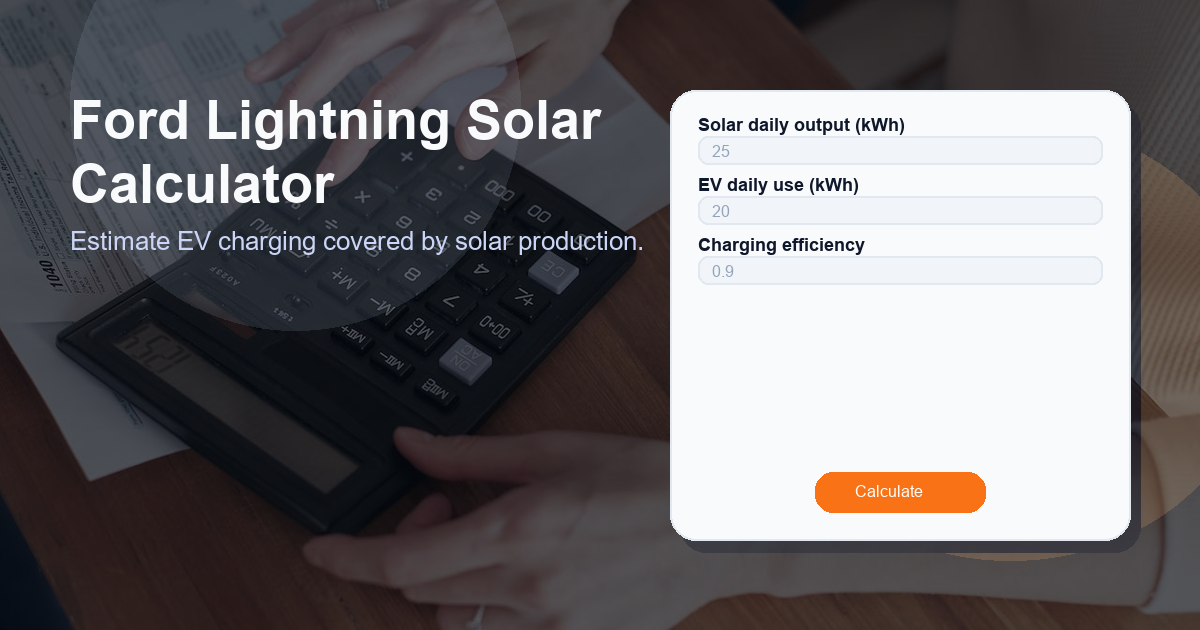
Ford Lightning Solar Calculator is a simple, practical tool for Ford Lightning owners and prospective buyers who want to understand how much of their truck’s daily charging needs can be supplied directly by their rooftop or ground-mounted solar system. This article explains what the calculator does, how to use it, how the underlying formula works, and the other real-world factors that affect solar-to-EV charging coverage.
What this Ford Lightning Solar Calculator calculator does
The Ford Lightning Solar Calculator converts three user inputs — solar daily output, EV daily use, and charging efficiency — into an easy-to-understand percentage called EV Charging Covered. That percentage shows how much of your Ford Lightning’s typical daily energy requirement could be supplied by your solar production on an average day.
- Purpose: Estimate the portion of daily EV charging supplied by solar energy.
- Audience: Ford Lightning owners, EV drivers, solar adopters, and energy planners.
- Outcome: A single percentage labeled EV Charging Covered that you can use for planning, budgeting, and optimizing charging schedules.
How to use the Ford Lightning Solar Calculator calculator
Using the calculator requires three straightforward inputs. Enter each value in kilowatt-hours (kWh) or as a decimal fraction where appropriate:
- Solar daily output (kWh) — The average usable electricity your solar system produces per day after inverter and balance-of-system losses.
- EV daily use (kWh) — The average energy your Ford Lightning consumes per day. You can calculate this from miles driven and the vehicle’s average kWh/mi, or use observed charging data.
- Charging efficiency — The fraction of grid/solar energy that actually reaches the battery during charging. Typical values range from 0.85 to 0.95 (85%–95%).
Steps:
- Estimate your solar system’s daily output (kWh). Use past production data, PVWatts, or your inverter monitoring platform.
- Estimate your EV’s daily kWh use. If you drive 40 miles/day and your Lightning uses 0.5 kWh/mile, your daily use is 20 kWh.
- Choose a realistic charging efficiency (e.g., 0.9 for 90%).
- Enter the three values into the calculator. The result shows EV Charging Covered as a percentage.
Example:
- Solar daily output = 25 kWh
- EV daily use = 30 kWh
- Charging efficiency = 0.9
Using the formula below produces: EV Charging Covered = (25 * 0.9) / 30 * 100 ≈ 75%
How the Ford Lightning Solar Calculator formula works
The calculator uses a concise mathematical relationship to compute how much of your EV’s daily consumption can be satisfied by solar production after accounting for charging losses.
Formula:
ev_daily_kwh > 0 ? (solar_daily_kwh * charging_efficiency) / ev_daily_kwh * 100 : 0
Explanation of the formula components:
- solar_daily_kwh: Total solar energy available per day (kWh).
- charging_efficiency: Fraction between 0 and 1 representing energy lost in conversion, resistance, and thermal effects during charging. Multiply by solar_daily_kwh to find usable energy delivered to the vehicle battery.
- ev_daily_kwh: The energy the EV requires per day (kWh). If this value is zero or missing, the formula returns 0 to avoid division errors.
Interpretation:
- If the formula result is 100%, your solar system produces enough energy (after losses) to cover the EV’s daily needs entirely.
- If it’s less than 100%, solar covers only a portion of that daily usage; you’ll draw the remainder from the grid or other sources.
- If the value exceeds 100%, your daily solar production can fully charge the vehicle and still leave surplus energy for home use, storage, or exporting to the grid.
Rounding and presentation: It’s common to round the final percentage to the nearest whole number for quick planning, or keep one decimal place for more precision.
Use cases for the Ford Lightning Solar Calculator
This calculator is useful in multiple planning and decision-making scenarios:
- Pre-purchase planning: Evaluate whether a planned solar system will meaningfully reduce EV charging costs for a prospective Ford Lightning buyer.
- System sizing: Estimate additional solar capacity required to reach a target EV Charging Covered percentage (e.g., 80% or 100%).
- Charge scheduling: Decide whether daytime charging will use mostly solar production vs. night-time grid charging.
- Storage integration: Determine if adding a battery storage system makes sense to shift excess solar production to evening charging periods.
- Rate optimization: Compare solar coverage against time-of-use (TOU) electricity rates to minimize cost.
Practical scenarios:
- A commuter with a 20–30 mile daily round trip may find their existing solar array covers most or all charging during summer months.
- A tradesperson using their Ford Lightning for heavy daily hauling may need additional solar capacity or overnight grid charging to fully meet energy needs.
- Owners with net metering may accept lower on-site coverage because exported energy offsets grid usage financially.
Other factors to consider when calculating EV charging coverage
While the formula provides a useful baseline, the real world introduces complexities. Consider these additional factors when interpreting your Ford Lightning Solar Calculator results:
- Seasonal variation: Solar output can vary widely by season. Average daily kWh in summer may be 2–3× higher than in winter depending on location.
- Weather and cloud cover: Day-to-day variability means single-day estimates can be misleading. Use monthly averages for planning.
- System losses and shading: Soiling, shading, and inverter inefficiencies reduce usable output. Use real production numbers when possible.
- Charge timing and interoperability: Charging during peak solar production is ideal. Managed charging, vehicle-to-home (V2H), or scheduled charging can improve on-site utilization.
- Battery degradation and temperature: Cold weather and battery state-of-charge affect charging efficiency and effective range.
- Net metering and tariffs: Local utility policies (net metering, export compensation, TOU rates) influence whether exporting surplus or directly charging is most economical.
- Household loads: If you run major appliances during the day, less solar energy may be available for EV charging unless you prioritize EV charging.
- Charger and cable losses: On-board charger efficiency and DC fast charging characteristics differ; the calculator assumes a generic efficiency factor.
Tip: For an actionable plan, combine the calculator’s percentage with your solar monitoring data, vehicle telematics, and local electricity pricing.
Frequently Asked Questions (FAQ)
Q: What is a realistic charging efficiency to use in the Ford Lightning Solar Calculator?
A: A typical charging efficiency for Level 2 AC charging ranges from 85% to 95%. For most homeowner scenarios, using 90% (0.9) is a reasonable baseline. DC fast charging may have different efficiencies; adjust accordingly.
Q: How do I estimate my Ford Lightning’s daily kWh use?
A: Multiply your average daily miles by the vehicle’s average energy consumption in kWh per mile. For example, if you drive 30 miles/day and the Lightning uses roughly 0.6 kWh/mile, daily use ≈ 18 kWh. Check trip logs or vehicle telemetry for more accurate values.
Q: Can the calculator tell me how large my solar array should be to fully charge my Ford Lightning?
A: Indirectly. Use the calculator to set a target EV Charging Covered percentage (e.g., 100%) and solve for solar_daily_kwh = ev_daily_kwh / charging_efficiency. Then convert kWh/day to system size using local solar insolation values (kWh/kW/day).
Q: Does exporting excess solar energy to the grid count as covering EV charging?
A: Technically, exported energy helps offset your overall household energy bill, but it’s not the same as directly charging the EV with on-site solar in real time. The calculator measures on-site usable solar energy for charging; local net metering rules determine the monetary equivalence.
Q: How should I account for seasonal changes in the calculator?
A: Use monthly average solar production values to calculate seasonal EV Charging Covered percentages. Plan for lower winter production and higher summer production, and consider storage or supplemental grid charging for winter months.
Conclusion: The Ford Lightning Solar Calculator provides a fast, clear estimate of how much your solar production can contribute to your EV charging needs. Use it as a planning tool alongside real production data, vehicle usage logs, and local electricity policies to make informed decisions about solar sizing, charging strategy, and cost savings.