Tesla Solar Panel Output Calculator
Tesla Solar Panel Output Calculator is a simple, practical tool to help homeowners, installers, and energy planners estimate how much energy a Tesla solar system will produce each day. This page explains how the calculator works, how to use it, and important factors that affect real-world performance. Use the calculator below to get a quick, reliable estimate of your daily output in kWh/day.
Tesla Solar Panel Output Calculator
What this Tesla Solar Panel Output Calculator calculator does
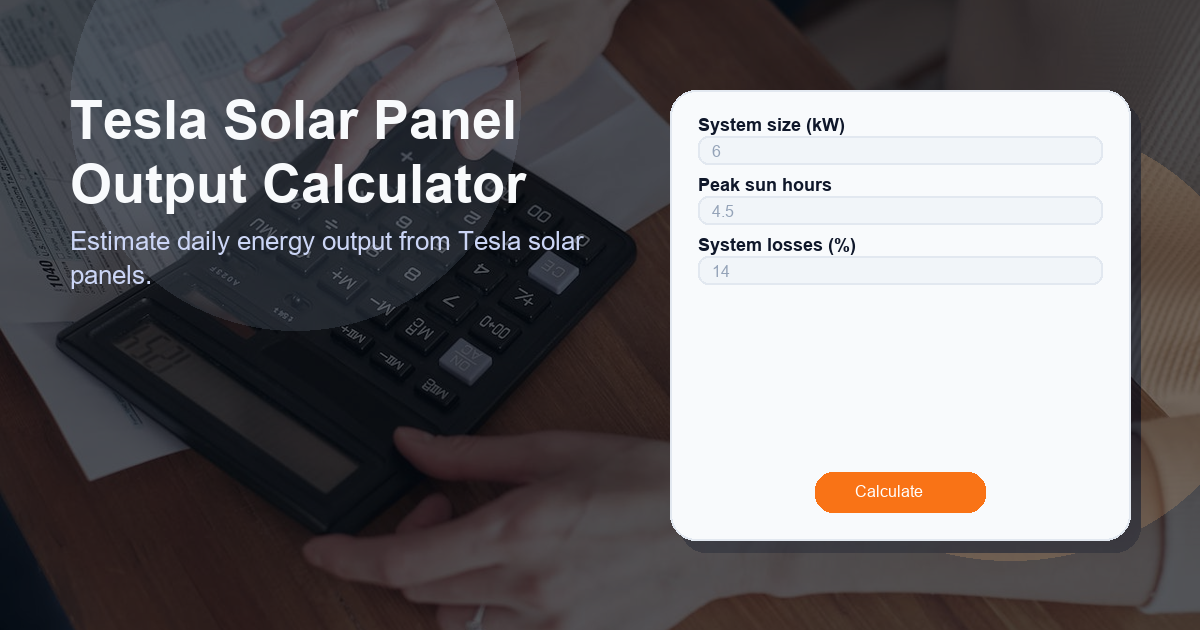
This Tesla Solar Panel Output Calculator estimates the expected daily energy production from a Tesla solar installation. It uses three straightforward inputs:
- System size (kW) — the rated DC capacity of the solar array or Tesla solar roof.
- Peak sun hours — the average number of equivalent full-sun hours per day at your location.
- System losses (%) — an allowance for inverter inefficiency, wiring losses, soiling, shading, and other real-world factors.
Using the formula provided, the calculator returns a quick estimate of Daily Output in kWh/day, which you can use for planning consumption, battery sizing, or comparing system sizes.
How to use the Tesla Solar Panel Output Calculator calculator
Follow these simple steps to get an accurate estimate:
- Enter the system size (kW): Input the combined rated capacity of all Tesla panels or the system nameplate in kilowatts (kW). Typical residential systems range from 3 kW to 10 kW.
- Enter peak sun hours: Use your location’s average peak sun hours. This is usually between 3 and 7 hours/day in most parts of the U.S. (e.g., 5 hours/day is a common average).
- Enter system losses (%): Enter a percentage to account for losses. A common default is around 10–15% (enter 14% in the calculator to match typical real-world losses).
- Click Calculate: The calculator applies the formula and displays the Daily Output (kWh/day) and a short calculation breakdown.
Example: a 6 kW system, 5 peak sun hours, and 14% losses yields:
6 kW × 5 h × (1 − 14% / 100) = 25.8 kWh/day
How the Tesla Solar Panel Output Calculator formula works
The calculator uses a clear, industry-standard formula:
Daily Output = system_size_kw × sun_hours × (1 − system_losses_percent / 100)
Explanation of each term:
- system_size_kw: This is the rated size of the solar array (kW). It represents the maximum power produced under standard test conditions.
- sun_hours: Peak sun hours converts the variable daily solar resource into an equivalent number of full-strength sun hours. For example, 5 peak sun hours means the day provides the same energy as five hours of full solar irradiance.
- system_losses_percent: Real systems never deliver the nameplate capacity continuously. Losses include inverter inefficiency, temperature effects, shading, dust, and wire losses. Subtracting losses gives a realistic usable output.
The result is expressed in kilowatt-hours per day (kWh/day), which is the standard energy unit for billing and battery sizing.
Use cases for the Tesla Solar Panel Output Calculator
The Tesla Solar Panel Output Calculator supports a variety of practical applications:
- Homeowners estimating expected daily production to compare with household usage and assess how much of their electricity can be offset by solar.
- Battery sizing — estimate how large a Tesla Powerwall or battery bank needs to be to store a day’s worth of solar production.
- EV charging planning — determine how many kWh/day your system may supply to an electric vehicle.
- Installer quotes — produce quick production estimates for proposals or feasibility studies.
- Financial modeling — combine daily output estimates with local electricity rates to calculate savings and payback periods.
Other factors to consider when calculating daily output
While the calculator gives a strong baseline, several additional factors influence real-world production. Consider these when interpreting results:
- Orientation and tilt: South-facing (in the Northern Hemisphere) and optimal tilt angles increase production.
- Shading: Trees, buildings, and rooftop obstructions can disproportionately reduce output.
- Temperature: Solar panels operate less efficiently at high temperatures; location and climate matter.
- Degradation: Panels slowly lose efficiency over years. Factor long-term degradation (0.5–1%/year) for lifetime estimates.
- Inverter and equipment performance: Modern inverters are efficient, but older or undersized equipment increases losses.
- Soiling and maintenance: Dust, snow, and bird droppings reduce output; periodic cleaning restores performance.
- Local climate variability: Seasonal differences and cloudy days mean daily averages will fluctuate significantly.
Use the calculator’s system losses input to approximate many of these effects, but for high-fidelity planning, combine this tool with shading analysis, PV simulation software (like PVWatts or PVSyst), or a site assessment by a qualified installer.
FAQ — Tesla Solar Panel Output Calculator
Q: How accurate is the Tesla Solar Panel Output Calculator?
A: The calculator provides a practical estimate. Accuracy depends on the quality of your inputs (especially peak sun hours and losses). For a site-specific, highly accurate projection, use detailed modeling (shading analysis, orientation, local weather) or professional assessment.
Q: What are peak sun hours and where do I find them?
A: Peak sun hours is an average measure of daily solar resource expressed as equivalent hours of 1,000 W/m² irradiance. You can find typical values from solar maps, PVWatts, the National Renewable Energy Laboratory (NREL), or local solar installers. Typical ranges: 3–7 hours/day depending on location.
Q: What should I enter for system losses?
A: System losses cover inverter inefficiency, wiring, shading, soiling, and mismatch. A conservative default is 10–15%. Use lower values only if you have high-performance components and excellent site conditions.
Q: Can I use this calculator to size a battery for my Tesla Powerwall?
A: Yes. The calculator gives daily solar energy produced (kWh/day). Compare that to your daily consumption to estimate required battery capacity. Remember to factor battery round-trip efficiency and reserve margins when sizing storage.
Q: Does the calculator handle seasonal or hourly variation?
A: No — it estimates average daily output based on peak sun hours (a daily average). For hourly or seasonal modeling, use detailed solar simulation tools that incorporate weather files and tilt/orientation specifics.
Need help interpreting results or want a site-specific estimate? Contact a certified installer or energy advisor and provide your calculator results as a starting point. The Tesla Solar Panel Output Calculator is a fast, SEO-friendly tool to begin planning and comparing solar options.