Solar Panel Tilt Calculator
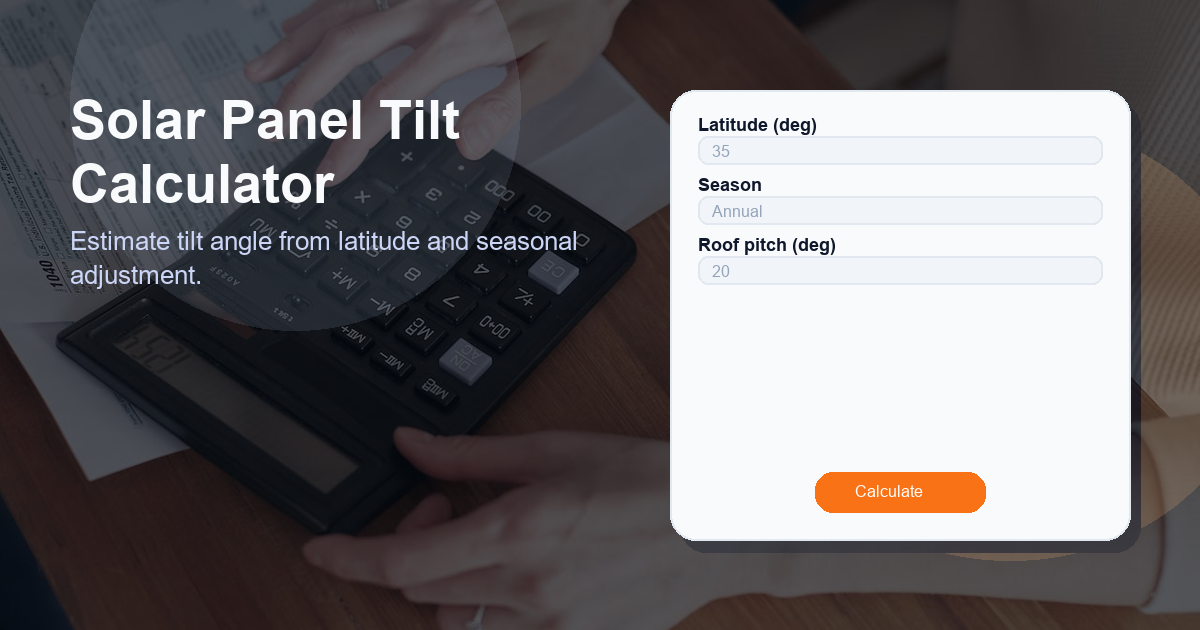
Solar Panel Tilt Calculator — Estimate tilt angle from latitude and seasonal adjustment. This calculator helps homeowners, installers, and DIYers quickly estimate the optimal panel tilt for a specific location, season, and roof configuration.
What this Solar Panel Tilt Calculator calculator does
The Solar Panel Tilt Calculator provides a simple, intuitive estimate of the solar panel tilt angle you should use. It combines three key inputs:
- Latitude (deg) — your site latitude in degrees.
- Season — a seasonal adjustment to bias tilt for higher sun angles (summer) or lower sun angles (winter).
- Roof pitch (deg) — the angle of your roof, which reduces or increases the required tilt relative to a roof-mounted installation.
The calculator returns a single output labeled Tilt Angle, calculated by the formula provided below. Its purpose is to give a quick, actionable tilt recommendation for mounting panels on a roof or an adjustable ground mount.
How to use the Solar Panel Tilt Calculator calculator
Using the Solar Panel Tilt Calculator is straightforward. Follow these steps to get a practical tilt estimate:
- Enter your latitude in degrees (for example, 40 for 40°N). If you are in the southern hemisphere, use a positive value but note season adjustments may invert logically.
- Select the season — choose from options such as Winter, Spring/Fall, or Summer. The calculator applies a recommended seasonal adjustment value.
- Enter your roof pitch in degrees (e.g., 10°). This value reduces the required tilt for roof-mounted panels because the roof already provides elevation.
- Compute the tilt. The result is shown as Tilt Angle in degrees.
Example:
- Latitude = 40°
- Season = Winter (season_adjust = +15°)
- Roof pitch = 10°
Apply the formula: latitude_deg + season_adjust – roof_pitch_deg
Calculation: 40 + 15 − 10 = Tilt Angle: 45°
How the Solar Panel Tilt Calculator formula works
The calculator uses a simple linear formula designed for quick field estimates:
Tilt Angle = latitude_deg + season_adjust – roof_pitch_deg
Breakdown of each term:
- latitude_deg: Latitude is the base starting point for many tilt recommendations. For a year-round fixed installation, a common rule-of-thumb is to tilt panels near the local latitude to maximize annual energy capture.
- season_adjust: A seasonal bias applied to the latitude to favor higher sun angles in summer or lower sun angles in winter. Typical recommended adjustments:
- Winter: +10° to +20° (commonly +15°) to capture lower sun elevation and improve winter production.
- Spring/Fall: 0° (no adjustment) for balanced production.
- Summer: −10° to −20° (commonly −15°) to better align with higher sun positions.
- roof_pitch_deg: The existing roof slope effectively provides part of the tilt. Subtracting the roof pitch reduces the required mounting tilt above the roof surface. For example, a 30° roof pitch already gives substantial tilt, so less additional tilt is needed.
This formula is a practical heuristic rather than a rigorous solar geometry model. It prioritizes speed and ease of use while remaining grounded in established industry heuristics.
Use cases for the Solar Panel Tilt Calculator
The Solar Panel Tilt Calculator is useful in many scenarios:
- Rooftop solar planning: Quickly estimate panel tilt for proposals, initial design sketches, or client discussions.
- Seasonal adjustment planning: Decide how much to change tilt for manually adjustable mounts if you plan seasonal adjustments.
- Ground-mounted systems: Determine a fixed tilt for ground arrays when you want a simple heuristic instead of complex solar modeling.
- Off-grid and remote sites: Rapidly estimate a tilt when advanced tools or on-site measurements are unavailable.
- Solar education and training: A simple tool for teaching the relationship between latitude, seasonality, and tilt.
Other factors to consider when calculating tilt
While the Solar Panel Tilt Calculator gives a fast estimate, real-world installations require considering several additional factors:
- Azimuth (panel orientation): Panels facing true south (northern hemisphere) or true north (southern hemisphere) perform best. Tilt interacts with orientation; if orientation is compromised, tilt adjustments alone won’t recover lost energy.
- Shading: Even partial shade can dramatically reduce energy output. Verify shading patterns through the year before finalizing tilt.
- Snow and wind loads: In snowy climates, a steeper tilt helps snow shed. In high-wind areas, structural and safety considerations can limit maximum tilt.
- Panel technology and performance: Some panels have better low-light performance; tilt choice can be optimized to seasonal production goals (e.g., winter vs summer).
- Structural and aesthetic constraints: Roof racks, flashing, and local building codes may limit tilt or mounting options.
- Energy goals: Are you optimizing for annual production, winter heating months, or peak summer demand? The target determines the best seasonal adjustment.
- Tracking systems: If you use a tracker, optimal fixed-tilt rules change because trackers follow the sun and reduce the need for seasonal tilt adjustments.
For final system design, combine this calculator with solar modeling software (PVsyst, PV*Sol, SAM) or consult a qualified solar installer to account for local conditions, shading analysis, and structural assessments.
Frequently Asked Questions
What is the best tilt angle for solar panels?
There is no single “best” tilt angle for every situation. A common rule-of-thumb is to start with the local latitude for a year-round fixed installation. Use seasonal adjustment (+15° for winter, 0° for spring/fall, −15° for summer) to bias production toward specific months. The Solar Panel Tilt Calculator applies this heuristic for a fast estimate.
How do I choose season_adjust values?
Season_adjust values are heuristics to bias tilt for distinct seasons. Typical values are +10° to +20° for winter, 0° for spring/fall, and −10° to −20° for summer. Use +15°/0°/−15° as a practical default; adjust based on local latitude, climate, and energy priorities.
Does roof pitch reduce the need for additional tilt?
Yes. The formula subtracts roof pitch because the roof already provides some tilt. If your roof pitch equals the calculated latitude+season adjustment, you may need no extra mounting tilt above roof level.
Can I use this calculator for ground-mounted systems?
Yes. The calculator works for ground mounts by entering a roof pitch of 0°. For more precise ground-mounted optimization, consider seasonal adjustment preferences, potential trackers, and local snow/wind conditions.
Is this calculator suitable for final design or permitting?
No. The Solar Panel Tilt Calculator is a planning and estimation tool. For final design, structural analysis, permit submissions, and precise energy yield modeling, use detailed engineering tools or consult a professional installer.