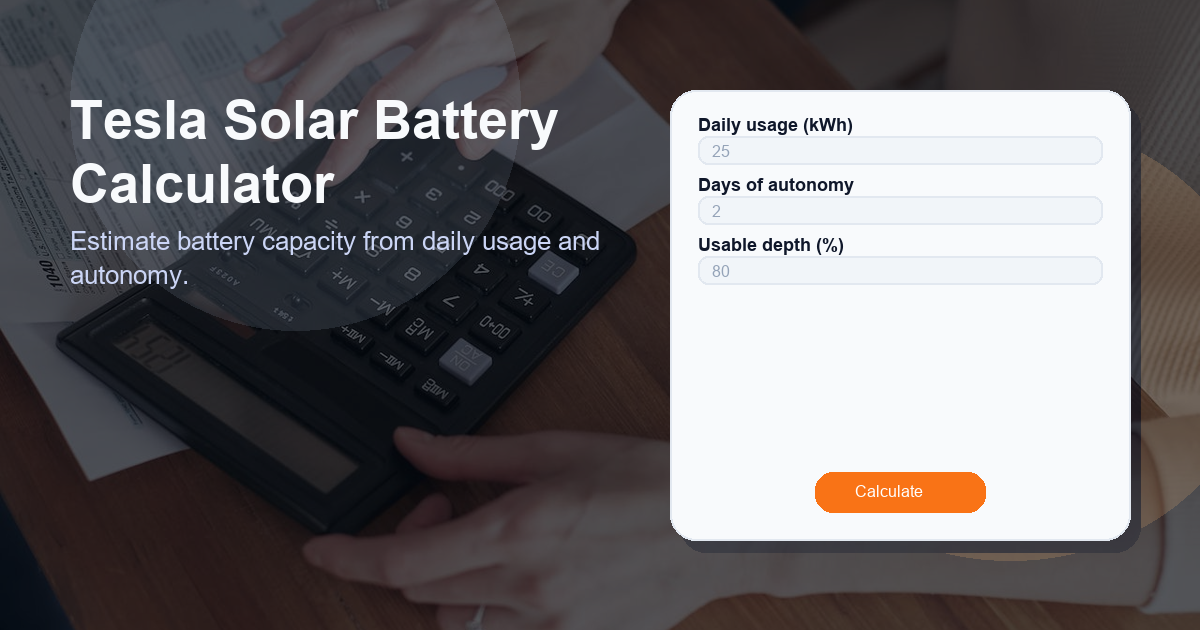
Tesla Solar Battery Calculator
Tesla Solar Battery Calculator — Estimate the battery capacity you need from your daily energy usage and desired days of autonomy. This calculator helps homeowners, installers, and DIY solar designers quickly determine an approximate battery bank size expressed in kilowatt-hours (kWh). Use the simple inputs below to plan for reliable energy backup or off-grid operation.
What this Tesla Solar Battery Calculator calculator does
The Tesla Solar Battery Calculator estimates the total battery capacity required (in kWh) to supply your electrical needs for a specified number of days without recharging. It factors in your daily usage (kWh), the days of autonomy you want to ensure, and the usable depth (%) of your battery system.
This tool is useful for:
- Preliminary system sizing for home backup or partial off-grid solar systems.
- Comparing typical Tesla battery solutions (e.g., Powerwall sizes) to your needs.
- Planning for resilience — how many days can your household run on stored energy?
Outputs: The calculator returns a single value labeled Battery Capacity (kWh), representing the nominal capacity you should target such that, with the given usable depth, your usable stored energy will cover the requested days of autonomy.
How to use the Tesla Solar Battery Calculator calculator
Using the Tesla Solar Battery Calculator is straightforward. Provide the three inputs below and read the estimated Battery Capacity result.
- Daily usage (kWh) — Enter the average electricity used per day. You can get this from your utility bill (monthly kWh ÷ days in month) or from energy monitoring devices.
- Days of autonomy — Enter how many days you want the battery to supply energy without charging (for example during cloudy stretches or outages).
- Usable depth (%) — Enter the percentage of total battery capacity you plan to use. For example, a Tesla Powerwall usable depth might be expressed as 90% of its rated capacity; lead-acid batteries often use only 50% to maximize longevity.
Step-by-step:
- Determine your average daily kWh consumption.
- Decide how many days of autonomy you require.
- Choose an appropriate usable depth based on battery chemistry and manufacturer recommendations.
- Apply the calculator (or the formula below) to get the required Battery Capacity in kWh.
Example: If your daily usage is 20 kWh, you want 2 days of autonomy, and your battery’s usable depth is 90%, the calculator will estimate the required battery capacity to meet those targets.
How the Tesla Solar Battery Calculator formula works
The calculator uses a simple capacity formula to convert usable energy needs into required nominal battery capacity, accounting for the fraction of the battery you intend to use. The formula implemented is:
usable_depth_percent > 0 ? (daily_kwh * days_of_autonomy) / (usable_depth_percent / 100) : 0
Breaking this down:
- daily_kwh * days_of_autonomy = the total usable energy you need over the selected autonomy period (kWh).
- usable_depth_percent / 100 converts the usable depth percent to a decimal (for example 80% → 0.8).
- Dividing the required usable energy by this decimal yields the nominal battery capacity required to provide that usable energy.
- If the usable depth percent is zero or negative, the formula returns 0 to avoid division errors and because no usable capacity would be available.
Numeric example (illustrative):
- daily_kwh = 20 kWh
- days_of_autonomy = 2 days
- usable_depth_percent = 90%
- Calculation: (20 * 2) / (90 / 100) = 40 / 0.9 ≈ 44.44 kWh
Result label: Battery Capacity = approximately 44.4 kWh. That means you would target a battery or combination of batteries with nominal capacity around 44.4 kWh so that 90% of that stored energy yields the 40 kWh you need over two days.
Use cases for the Tesla Solar Battery Calculator
The Tesla Solar Battery Calculator is useful in a variety of real-world scenarios. Examples include:
- Home backup planning — Determine how large a battery you need to run critical loads for a set number of days during outages.
- Off-grid system sizing — Combine this battery sizing with solar panel production estimates to design an off-grid or micro-grid energy system.
- Battery comparison — Compare the required kWh to the nominal capacities of market products such as Tesla Powerwall, other lithium-ion systems, or stacked battery strings.
- Emergency preparedness — Estimate storage needs to keep refrigeration, lighting, and communication devices running during storms or other emergencies.
- Financial planning — Use the estimated capacity to approximate cost, payback, and ROI for battery-backed solar systems.
Note: This calculator is a first-pass estimate. For final system design, consult a qualified installer and include additional factors such as inverter sizing, charge controller limits, and local regulations.
Other factors to consider when calculating battery capacity
While the Tesla Solar Battery Calculator provides a useful baseline, several other factors affect how much battery capacity you’ll actually need:
- Round-trip efficiency — Batteries and inverters lose energy during charging and discharging. Typical round-trip efficiencies for lithium-ion systems are 85–95%. If you want to be precise, increase the required capacity to compensate for these losses.
- Peak power and inverter limits — kWh capacity is about energy stored, but you also need to ensure the inverter and battery can supply the instantaneous power (kW) required by your loads.
- Temperature and aging — Battery capacity degrades over time and can be reduced in extreme temperatures. Consider oversizing or planning for capacity fade.
- Charge availability — If your solar array cannot recharge the battery reliably due to seasonal changes or shading, you may need additional capacity or alternate charging sources.
- Safety margins — Adding a buffer (10–20%) helps account for unexpected consumption spikes or longer-than-expected outages.
- Battery chemistry and warranty — Manufacturers specify usable depth, warranty cycles, and minimum performance guarantees; follow these guidelines to avoid voiding warranty or prematurely degrading the battery.
In short, use this calculator as a fast, SEO-friendly baseline for the required Battery Capacity, and then refine your design with efficiency, power, environmental, and lifecycle considerations.
FAQ — Tesla Solar Battery Calculator
How accurate is the Tesla Solar Battery Calculator?
The calculator offers a rough estimate based on three inputs (daily usage, days of autonomy, usable depth). It does not include inverter/charge efficiency losses, power limits, or seasonal production variations. For a precise design, include these factors and consult a professional installer.
What should I enter for usable depth (%)?
Use the manufacturer’s recommended usable depth. For modern lithium-ion batteries (like Tesla Powerwall), usable depth is often around 85–90%. For lead-acid batteries, a conservative value is 40–50% to prolong lifespan. If unsure, choose a conservative (lower) percentage.
Can this calculator help me choose between one large battery or multiple smaller ones?
Yes — the calculator provides the total nominal kWh needed. You can then compare product specs (e.g., a 13.5 kWh Powerwall) and determine how many units you’d need to reach the target capacity.
Do I need to account for battery degradation?
Yes. Over time batteries lose capacity. Consider specifying a slightly larger initial capacity or planning replacements based on manufacturer degradation curves to maintain the desired autonomy over the system lifetime.
Is the result the usable energy or the battery’s rated capacity?
The calculator returns the rated (nominal) battery capacity required. The usable energy will be this rated capacity multiplied by your usable depth percentage (e.g., 44.4 kWh at 90% usable ≈ 40 kWh usable).