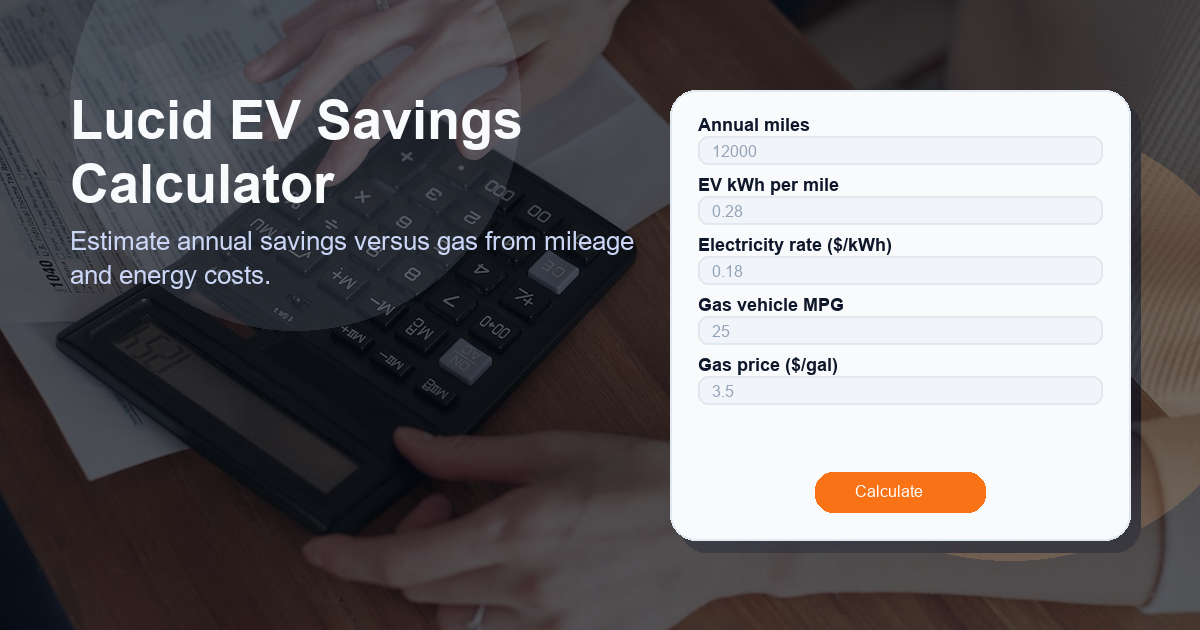
Lucid EV Savings Calculator
The Lucid EV Savings Calculator helps drivers estimate their annual savings when switching from a gasoline vehicle to an electric vehicle (EV), based on mileage and energy costs. This SEO-friendly guide explains what the calculator does, how to use it, how the underlying formula works, practical use cases, and additional factors you should consider when computing savings. Use this page to learn how small changes in driving habits, fuel prices, or electricity rates can affect your pocketbook.
What this Lucid EV Savings Calculator calculator does
The Lucid EV Savings Calculator performs a straightforward comparison between the annual cost to operate a gas vehicle and the annual electricity cost to operate an EV. It returns a single, clear result labeled Annual Savings. The calculation focuses exclusively on energy cost differences and does not include purchase price, incentives, maintenance, or depreciation—unless you factor them in manually or with a more detailed analysis.
Specifically, the calculator computes:
- Gasoline annual cost = (Annual miles / Gas vehicle MPG) * Gas price ($/gal)
- EV annual electricity cost = Annual miles * EV kWh per mile * Electricity rate ($/kWh)
- Annual Savings = Gasoline annual cost − EV annual electricity cost (or 0 if gas MPG is zero or invalid)
The intent is to provide a quick, actionable number you can use to evaluate whether switching to a Lucid or any EV makes sense from an energy-cost perspective.
How to use the Lucid EV Savings Calculator calculator
Using the Lucid EV Savings Calculator is simple. Gather the following inputs, then plug them into the calculator to get your Annual Savings estimate:
- Annual miles — The total miles you drive per year (e.g., 12,000).
- EV kWh per mile — The EV’s energy consumption in kilowatt-hours per mile (for example, 0.30 kWh/mile equals about 3.33 miles per kWh). Use your vehicle’s EPA rating, on-board display, or sample values for Lucid models.
- Electricity rate ($/kWh) — Your average cost of electricity. Use your utility bill or a national average. If you charge mostly at home at night or use a time-of-use rate, use an average or modeled value.
- Gas vehicle MPG — The miles per gallon for the gasoline vehicle you want to compare. Use the EPA combined rating or your real-world experience.
- Gas price ($/gal) — The price you typically pay per gallon. Use local or national averages.
Example (illustrative):
- Annual miles: 12,000
- EV kWh per mile: 0.30
- Electricity rate: $0.13/kWh
- Gas vehicle MPG: 25 MPG
- Gas price: $3.50/gal
Using these numbers, the calculator produces a single result: your Annual Savings. See the formula section below to compute the example.
How the Lucid EV Savings Calculator formula works
The core formula used by the Lucid EV Savings Calculator is written as a conditional expression to avoid invalid division by zero:
gas_mpg > 0 ? (annual_miles / gas_mpg * gas_price) - (annual_miles * ev_kwh_per_mile * electricity_rate) : 0Breakdown of the formula:
- Check gas_mpg > 0: Ensure the gasoline vehicle MPG is a positive number. If it is zero or missing, the calculator returns 0 to prevent invalid calculations.
- Gasoline annual cost: (annual_miles / gas_mpg) * gas_price calculates how much you spend on fuel per year based on miles driven, fuel economy, and gas price.
- EV electricity annual cost: annual_miles * ev_kwh_per_mile * electricity_rate calculates the electricity cost to drive the same miles in your EV.
- Annual Savings: The difference between the gasoline cost and the EV electricity cost is your annual savings: (gasoline cost) − (electricity cost).
Using the example inputs above, the calculation is:
- Gasoline annual cost = (12,000 / 25) * 3.50 = 480 * 3.50 = $1,680.00
- EV electricity annual cost = 12,000 * 0.30 * 0.13 = 12,000 * 0.039 = $468.00
- Annual Savings = 1,680 − 468 = $1,212.00
Result label: Annual Savings. This is the number you can use to estimate how much less you will pay per year to power an EV versus fueling a gas car, based solely on energy costs.
Use cases for the Lucid EV Savings Calculator
The Lucid EV Savings Calculator is helpful in many decision-making scenarios. Typical use cases include:
- Personal purchase decisions: Compare annual operating cost savings when considering buying or leasing a Lucid or other EV.
- Fleet transition planning: Estimate aggregate annual savings for fleets evaluating electrification to prioritize vehicle replacements.
- Cost-benefit analysis: Use the annual savings figure to calculate payback periods when combined with vehicle price differentials, incentives, and installation costs for chargers.
- Regional comparisons: Compare savings across different gas price and electricity rate scenarios or when relocating to areas with different utility rates.
- Behavioral sensitivity checks: Model how changes in annual miles, driving efficiency, or fuel prices affect your savings and break-even points.
Because this calculator focuses on energy costs, it is excellent for rapid comparisons and as an input into more comprehensive financial models that include upfront costs, incentives, maintenance, and resale value.
Other factors to consider when calculating savings
While the Lucid EV Savings Calculator yields an important baseline — the difference in energy costs — a realistic assessment of total ownership savings should consider additional elements:
- Purchase price and incentives: Federal, state, and local incentives or rebates can dramatically change total cost of ownership. EVs may have higher or lower sticker prices depending on model and options.
- Charging infrastructure: Home charging installation (Level 2 chargers) or public charging fees can add to the real cost of owning an EV.
- Time-of-use electricity rates: Charging at off-peak times can reduce electricity cost per kWh, increasing savings. Conversely, public fast charging prices can be much higher per kWh.
- Charging losses and efficiency: Charging is not 100% efficient. Losses and thermal conditioning (heating/cooling) can increase energy use.
- Maintenance and repairs: EVs typically have lower routine maintenance costs (no oil changes, fewer moving parts), which can improve total savings beyond energy.
- Depreciation and resale: Resale values vary by model and market demand. Battery health and warranty terms affect long-term value.
- Insurance and registration: Insurance premiums for EVs can be different from gas cars. Consider registration fees and any EV-specific surcharges.
- Driving patterns and climate: Cold weather reduces EV range and increases energy consumption, while aggressive driving reduces both EV and gas efficiency.
- Environmental and social value: Reduced greenhouse gas emissions and local air pollution are non-monetary benefits many buyers consider.
In short, use the Annual Savings from the Lucid EV Savings Calculator as a reliable energy-cost baseline, then layer these other factors into a complete ownership analysis.
FAQ — Lucid EV Savings Calculator
Q: What does the Lucid EV Savings Calculator include in the calculation?
A: The calculator compares only the annual energy costs: gasoline expense for a gas vehicle versus electricity expense for an EV, then outputs the difference as Annual Savings. It does not automatically include purchase price, incentives, maintenance, or other ownership costs.
Q: How accurate are the results?
A: Accuracy depends on the accuracy of your inputs: annual miles, EV kWh per mile, electricity rate, gas MPG, and gas price. The formula is mathematically correct for energy cost comparison, but real-world factors like charging losses, time-of-use rates, and driving conditions can affect the actual outcome.
Q: Can the calculator handle zero or missing MPG values?
A: Yes. The formula includes a guard: if the provided gas vehicle MPG is zero or invalid, the calculator returns 0 to prevent division by zero. Always supply a realistic MPG value for a valid savings estimate.
Q: Should I use home electricity rate or public charging rates?
A: Use the rate that reflects where you do most of your charging. For most owners that’s the home electricity rate. If you rely heavily on public fast chargers, include a blended rate or model both scenarios separately.
Q: How can I use the Annual Savings figure in broader financial planning?
A: Multiply the Annual Savings by expected years of ownership to estimate cumulative energy savings. Combine that with purchase price differences, incentives, and maintenance estimates to compute payback periods and total cost of ownership.
For a quick, conservative energy-cost comparison, start with the Lucid EV Savings Calculator and then expand the analysis to include the additional factors listed above. This approach gives you both a clear annual energy perspective and a foundation for full financial modeling.