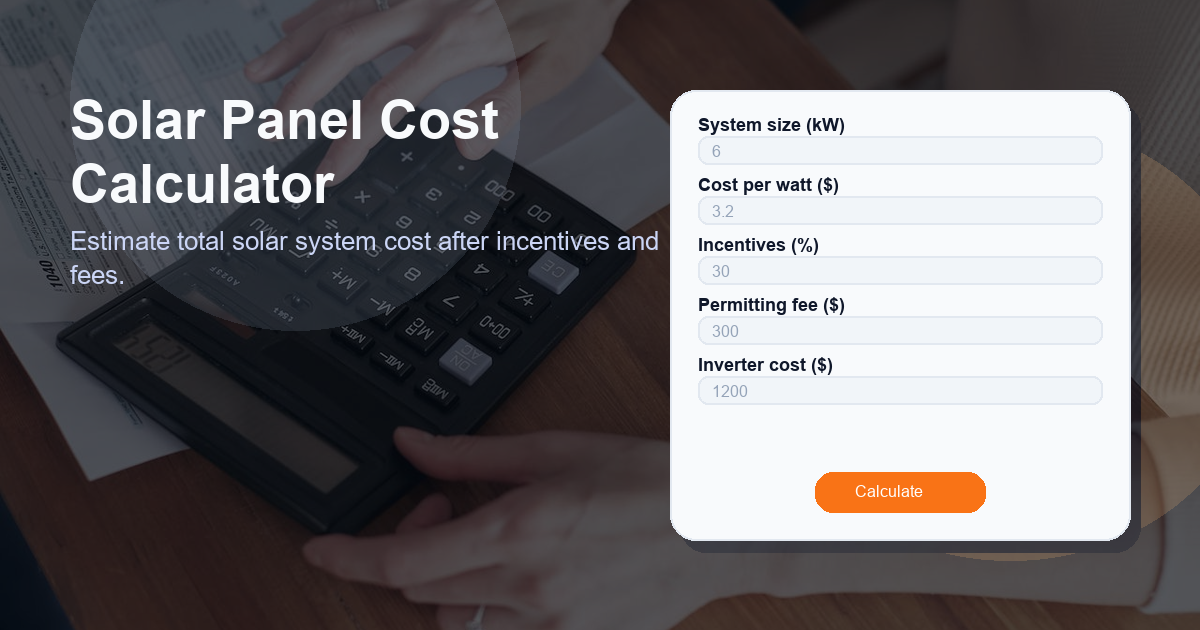
Solar Panel Cost Calculator
Use this Solar Panel Cost Calculator to quickly estimate the expected out-of-pocket cost for a residential or small commercial solar system after incentives and fees. This article explains what the calculator does, how to use it, how the formula works, common use cases, and additional factors you should consider when estimating the true cost of going solar.
What this Solar Panel Cost Calculator calculator does
This calculator provides a fast, straightforward estimate of the Total Cost to install a solar photovoltaic (PV) system based on a few user-provided inputs. It converts system size and per-watt pricing into a base equipment and installation cost, applies an incentive reduction, and then adds common fixed fees such as permitting and inverter replacement.
Specifically, the calculator works with these inputs:
- System size (kW) — the DC capacity of the solar array expressed in kilowatts.
- Cost per watt ($) — the installed cost per watt, typically including panels, racking, labor, and other variable expenses quoted as $/W.
- Incentives (%) — the percentage reduction from government rebates, tax credits, or local incentives that directly reduce equipment/installation cost. Enter as a number (for example, 26 for 26%).
- Permitting fee ($) — fixed local fees for permits and inspections.
- Inverter cost ($) — cost to purchase and install inverter(s) if not included in the $/W price.
The result is labeled Total Cost and gives you a single number representing the expected expense after incentives and after adding fees.
How to use the Solar Panel Cost Calculator calculator
Follow these simple steps to get an estimate:
- Enter the System size (kW) — e.g., 6.5 kW for a typical home system.
- Enter the Cost per watt ($) — use your installer quote or a local industry average. Typical ranges: $2.00–$4.00 per watt (installed).
- Enter Incentives (%) — include federal tax credits and local rebates that reduce upfront cost. For example, enter 30 for a 30% incentive.
- Enter Permitting fee ($) — a one-time fee such as $200–$1,000 depending on jurisdiction.
- Enter Inverter cost ($) — add the inverter cost if not in the per-watt number. For example, $1,500 for a residential string inverter.
- Read the Total Cost — the calculator returns a single dollar amount labeled Total Cost.
Tip: To compare quotes from different installers, keep all inputs consistent and only change the cost-per-watt or inverter line item to compare like-for-like estimates.
How the Solar Panel Cost Calculator formula works
The calculation uses a simple, transparent algebraic formula that models base system cost, incentive reduction, and fixed fees. The formula is:
system_size_kw * 1000 * cost_per_watt * (1 - incentive_percent / 100) + permitting_fee + inverter_cost
Breakdown of the formula:
- system_size_kw * 1000 — converts kilowatts to watts (kW → W).
- * cost_per_watt — multiplies by installed cost per watt to get the total installed price before incentives.
- * (1 – incentive_percent / 100) — reduces the installed price by the percent incentive (e.g., 30% incentive multiplies by 0.70).
- + permitting_fee + inverter_cost — adds fixed fees that usually are not reduced by the incentive percentage.
Example calculation:
- System size = 6.5 kW
- Cost per watt = $3.00/W
- Incentives = 26%
- Permitting fee = $500
- Inverter cost = $1,200
Plug into the formula:
Total Cost = 6.5 * 1000 * 3.00 * (1 - 26 / 100) + 500 + 1,200
Total Cost = 6,500 * 3.00 * 0.74 + 1,700
Total Cost = 19,500 * 0.74 + 1,700
Total Cost = 14,430 + 1,700 = $16,130
Result: Total Cost ≈ $16,130.
Use cases for the Solar Panel Cost Calculator
This calculator is useful in many real-world situations, including:
- Quick budgeting — homeowners and small businesses can estimate upfront expenses before getting formal quotes.
- Comparing installer quotes — normalize different quotes by converting them to a comparable cost-per-watt basis.
- Incentive planning — understand how federal, state, or local incentives impact final cost.
- Project feasibility — evaluate whether upfront costs align with expected savings, loan options, or payback periods.
- Pre-sales and marketing — solar providers and brokers can use the calculator to present transparent pricing scenarios to prospects.
Because the calculator isolates the incentive percentage and the key fees, it’s easy to run multiple scenarios—such as different incentive levels or inverter upgrade options—and see how each factor influences the Total Cost.
Other factors to consider when calculating solar system cost
While this Solar Panel Cost Calculator gives a solid estimate, several other factors affect the true cost and value of a solar installation. Consider the following before making decisions:
- Tax treatment vs. rebates: Some incentives are tax credits (applied to taxes owed), not direct rebates. A tax credit reduces tax liability and might not lower upfront payment unless financed or assigned.
- Sales tax and VAT: Depending on location, sales tax or VAT may apply to equipment or installation, adding to cost.
- Net metering and electricity rates: Expected savings from solar depend on retail electricity rates and net metering policies—these affect payback more than the initial price.
- Roof condition and upgrades: Repairs, structural reinforcement, or re-roofing may be required before installation and can be substantial.
- Maintenance and warranties: Inverter replacements, panel degradation, and maintenance plans influence long-term lifecycle costs.
- Financing costs: If you finance the system, interest charges and loan terms change the effective cost over time.
- System performance and oversizing: Oversizing equipment or adding battery storage increases upfront cost but may improve value in certain rate structures.
Use this calculator as a starting point. For a full financial analysis, combine the Total Cost estimate with projected energy production, local electricity pricing, and financing terms to calculate payback period, net present value (NPV), and internal rate of return (IRR).
FAQ
Q: Is the Solar Panel Cost Calculator accurate for every project?
A: The calculator provides a reliable high-level estimate but not a turnkey quote. It uses standard inputs (kW, $/W, incentives, and common fees). Unique project factors—roof complexity, interconnection costs, or special equipment—may change final pricing. Use it for budgeting and comparisons, and get detailed proposals for exact numbers.
Q: Should inverter cost be included in cost per watt or entered separately?
A: Either approach can work, but this calculator allows you to separate inverter cost to compare scenarios. If your cost-per-watt quote already includes the inverter, set inverter cost to $0 to avoid double-counting.
Q: How do I account for federal tax credits like the Investment Tax Credit (ITC)?
A: Enter the percentage equivalent of the tax credit in the Incentives (%) field. Note that tax credits reduce tax liability and may not always reduce the upfront cash payment unless you finance or assign the credit—consult a tax advisor for exact treatment.
Q: Can I include battery or energy storage costs in this calculation?
A: This basic calculator is designed for PV system costs. To include battery storage, add the battery purchase and installation cost in the inverter_cost field or in the permitting_fee field as an additional fixed cost. For more detailed storage modeling, include round-trip efficiency and separate incentives for storage.
Q: How can I use this calculator to compare installer quotes?
A: Standardize the inputs: convert each quote to a cost-per-watt where possible, list any additional fixed fees the installer provides, and enter consistent incentive assumptions. This produces comparable Total Cost numbers to evaluate price and scope differences.