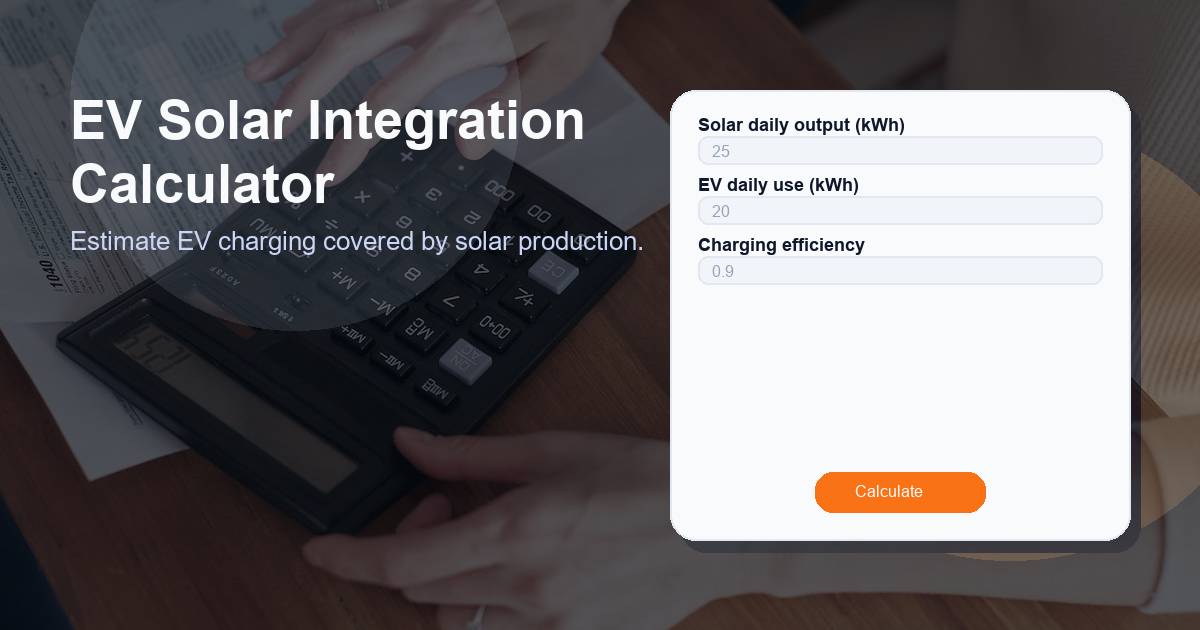
EV Solar Integration Calculator helps homeowners and fleet managers estimate how much of an electric vehicle’s daily charging needs can be covered directly by solar production. This article explains what the calculator does, how to use it, how the formula works, practical use cases, and other factors to consider when estimating solar coverage for EV charging.
What this EV Solar Integration Calculator calculator does
The EV Solar Integration Calculator provides a simple percentage estimate of the portion of an EV’s daily energy consumption that can be supplied by your rooftop (or ground-mounted) solar system. It compares the solar daily output (kWh) against the EV daily use (kWh), factoring in a charging efficiency parameter to reflect conversion and charging losses.
Key outputs and definitions:
- Solar daily output (kWh) — the average energy your solar array produces in one day.
- EV daily use (kWh) — the average energy your EV consumes in one day (based on miles driven and vehicle efficiency).
- Charging efficiency — the fraction of solar energy that actually reaches the EV battery (accounts for inverter losses, charging losses, and conversion inefficiencies).
- Result label: EV Charging Covered — the percentage of daily EV charging needs that can be covered by solar production using the calculator’s formula.
The calculator returns a percentage value and uses a safe check: if EV daily kWh is zero or negative, the result is set to 0 to avoid division errors.
How to use the EV Solar Integration Calculator calculator
Using the EV Solar Integration Calculator is straightforward. You need three inputs and then apply the formula. Follow these steps to get a reliable estimate:
- Gather solar production data: Use historical production data from your inverter or monitoring system to calculate average daily solar output in kWh. If you don’t have monitoring, estimate from system size and local solar irradiance (for example, 1 kW system producing ~4 kWh/day in some climates).
- Estimate EV energy use: Determine your EV’s average daily consumption in kWh. This can be derived from miles driven multiplied by the vehicle’s kWh/100 miles or kWh per mile rating.
- Set charging efficiency: Choose an efficiency value to account for losses. Typical charging efficiencies range from 80% to 95% depending on equipment and charging method—enter it as a decimal (e.g., 0.9 for 90%).
- Apply the formula: Compute the percentage using the calculator formula (see next section). The output is labeled EV Charging Covered.
Example: If your solar array produces 18 kWh/day, your EV consumes 12 kWh/day, and your charging efficiency is 0.9, then the calculator returns (18 * 0.9) / 12 * 100 = 135%. This suggests your solar production generates more energy than the EV needs, theoretically covering 135% of the EV’s daily charging demand (excess energy could charge other loads or export to the grid).
How the EV Solar Integration Calculator formula works
The basic formula used in the calculator is:
ev_daily_kwh > 0 ? (solar_daily_kwh * charging_efficiency) / ev_daily_kwh * 100 : 0
Breakdown of the formula:
- Numerator (solar_daily_kwh * charging_efficiency) — converts raw solar production into the usable portion that can actually reach the EV battery after accounting for losses.
- Denominator (ev_daily_kwh) — represents the daily energy requirement of the EV.
- Multiply by 100 — converts the result into a percentage representing the share of EV charging demand covered by solar.
- Safety check (ev_daily_kwh > 0 ? … : 0) — ensures you don’t divide by zero; if EV daily use is zero or negative, the calculator returns 0% coverage.
Interpreting results:
- Less than 100%: Solar only partially covers EV charging; you’ll still draw some power from the grid or need battery storage.
- Equal to 100%: Solar production (after losses) matches daily EV consumption — in ideal circumstances you could charge the vehicle fully from solar across a typical day.
- Greater than 100%: Solar produces more than needed for EV charging; excess can be used for other loads, stored in batteries, or exported to the grid.
Use cases for the EV Solar Integration Calculator
This calculator is valuable in multiple scenarios:
- Homeowners planning EV adoption: Estimate whether an existing solar system will cover a planned EV’s charging needs or whether system upgrades are required.
- Fleet managers: Quickly evaluate how many EVs a rooftop array or parking canopy can support, informing charging schedule and procurement decisions.
- Battery and storage planning: Determine if a battery is needed to shift daytime solar production to evening or overnight charging windows.
- Financial modeling: Combine solar coverage estimates with electricity rates to forecast savings from charging on-site versus drawing from the grid.
- Policy and sustainability reporting: Provide a simple metric (percentage of EV charging supplied by renewable generation) for sustainability dashboards and incentives.
Practical tips for these use cases:
- When designing EV charging schedules, prioritize charging during high solar production periods to increase the EV Charging Covered percentage.
- For fleets, stagger charging sessions to match peak solar hours and avoid overloading local transformers or feeders.
- Combine on-site solar with intelligent chargers that can respond to real-time solar output to maximize direct solar use.
Other factors to consider when calculating EV charging coverage
The calculator provides a quick estimate, but real-world results depend on several additional factors. Consider the following to refine your planning:
- Time alignment (solar vs. charging times): Solar produces during daylight. If you typically charge at night, direct solar coverage will be lower unless you have battery storage or bidirectional charging strategies.
- Net metering and export rules: If your utility credits exported solar energy at a different rate, the economics of oversizing solar for EV charging change. Also, some regions limit exports or charge fees.
- Seasonal variability: Solar output varies by season—winter days may produce much less energy, reducing coverage during those months.
- Panel degradation and soiling: Over years, panels produce less energy and dirt can reduce output—adjust long-term projections accordingly.
- Distribution and inverter limits: Inverter capacity, charger capacity, and electrical infrastructure can constrain usable solar for EV charging at any given time.
- Real charging behavior: Short trips followed by opportunistic charging will change daily averages—collect actual usage data where possible rather than relying on estimates.
To move from a high-level estimate to an implementation-ready plan, consider combining this calculator with monitoring data, time-of-use pricing, and a feasibility study of battery storage or smart charging hardware.
FAQ
Q: What is a realistic charging efficiency value to use?
A: Typical round-trip charging efficiencies range from about 80% to 95%. Use a conservative value (e.g., 0.85–0.9) if you want a margin for inverter and charger losses. If you have an efficient charger and minimal conversions, 0.95 is reasonable.
Q: Can the calculator return more than 100%?
A: Yes. The formula can yield values greater than 100% when solar production (after accounting for efficiency) exceeds EV daily energy use. This indicates potential excess energy for other loads, storage, or export to the grid.
Q: How should I handle seasonal differences in solar production?
A: Use monthly or seasonal average solar outputs rather than a single annual average if you need accurate coverage estimates across the year. This helps identify months when solar may not meet EV needs without storage.
Q: Does this calculator account for battery storage?
A: The basic formula does not explicitly include storage. However, you can factor storage indirectly by increasing effective charging efficiency for time-shifting or by adding the battery’s usable daily throughput to the numerator as additional available solar-derived energy.
Q: Is grid export considered in this calculation?
A: The formula itself only compares usable solar production to EV demand. Grid export rules and net metering affect economic outcomes and whether excess solar can offset other loads or be credited, so consider utility policies when interpreting results.
By using the EV Solar Integration Calculator as a first step, you can quickly assess how well your solar system aligns with EV charging needs and identify whether additional measures—like battery storage, system size changes, or smart charging—are needed to maximize on-site renewable use.