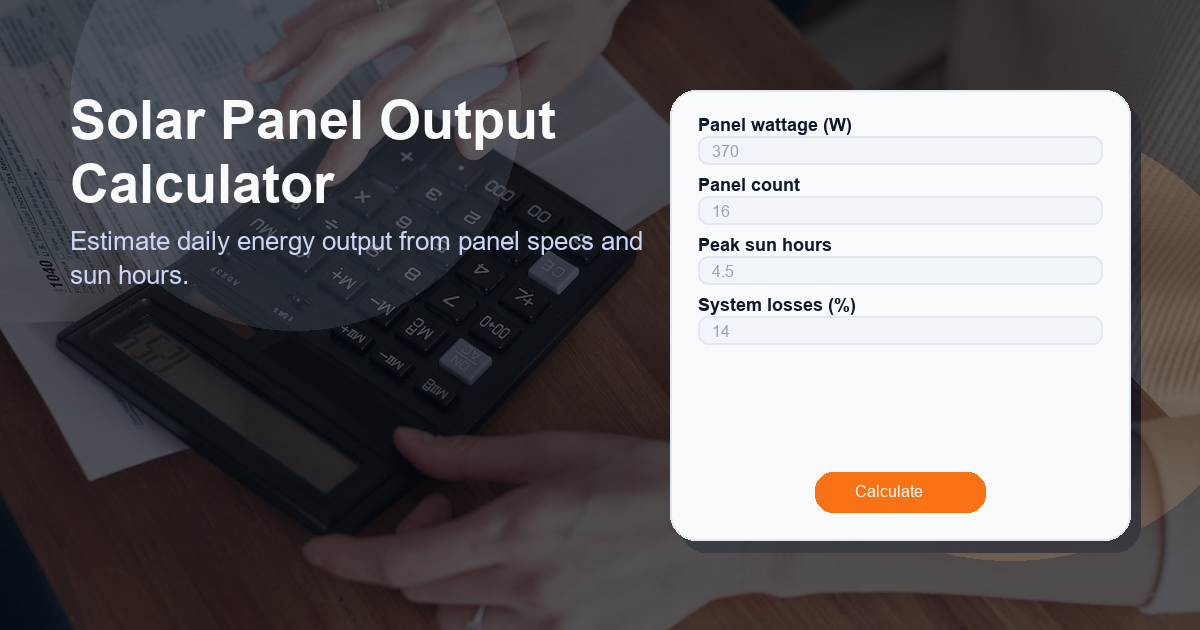
Solar Panel Output Calculator
Description: Estimate daily energy output from panel specs and sun hours using this Solar Panel Output Calculator. Enter your Panel wattage (W), Panel count, Peak sun hours, and estimated System losses (%) to get the expected Daily Output in kilowatt-hours (kWh/day).
What this Solar Panel Output Calculator calculator does
The Solar Panel Output Calculator provides a quick, practical estimate of how much energy a solar array will produce on an average day. It translates the technical specs of your solar panels and local sunlight conditions into a single, easy-to-understand number: Daily Output (kWh/day).
Specifically, this calculator takes four inputs:
- Panel wattage (W) — the nominal output rating of a single panel under standard test conditions.
- Panel count — how many panels are connected in the system.
- Peak sun hours — average number of equivalent full-sun hours per day at your location.
- System losses (%) — an allowance for real-world losses (inverter inefficiency, wiring, soiling, temperature, shading, etc.).
Using these inputs, the calculator produces Daily Output in kWh/day so homeowners, designers, or researchers can quickly evaluate system performance and plan energy use or storage capacity.
How to use the Solar Panel Output Calculator calculator
Using the Solar Panel Output Calculator is straightforward. Follow these steps to get a reliable estimate:
- Enter Panel wattage (W): use the panel’s rated wattage (for example, 330 W, 400 W).
- Enter Panel count: how many identical panels are in the system (for example, 10 panels).
- Enter Peak sun hours: find your location’s average peak sun hours (this varies by region and season; sources include PVWatts, local meteorological data, or solar maps).
- Enter System losses (%): estimate the percentage losses (common assumptions are 10–20% depending on system quality and maintenance).
- Calculate: the result appears as Daily Output in kWh/day.
Example: If you enter 330 W for panel wattage, 10 for panel count, 5 peak sun hours, and 14% system losses, the calculator returns the expected daily production in kWh.
How the Solar Panel Output Calculator formula works
The calculator uses a simple, transparent formula designed for practicality and clarity:
Formula: panel_watt * panel_count * sun_hours * (1 – system_losses_percent / 100) / 1000
Breakdown of the formula variables:
- panel_watt: rated power of one panel in watts (W).
- panel_count: number of panels.
- sun_hours: average peak sun hours per day (hours/day).
- system_losses_percent: percent of energy lost to system inefficiencies.
- The division by 1000 converts watt-hours to kilowatt-hours (kWh), which is the standard billing and comparison unit.
Step-by-step example calculation:
- panel_watt = 330 W
- panel_count = 10
- sun_hours = 5 hours/day
- system_losses_percent = 14%
- Calculation: 330 * 10 * 5 * (1 – 14 / 100) / 1000 = 3300 * 5 * 0.86 / 1000 = 14190 / 1000 = 14.19 kWh/day
Result label: Daily Output — in this example the array produces approximately 14.19 kWh/day. Multiply by 30 to estimate monthly output (~426 kWh/month) or by 365 for annual estimates (~5,178 kWh/year).
Use cases for the Solar Panel Output Calculator
The Solar Panel Output Calculator is useful in many scenarios for homeowners, installers, designers, and researchers. Typical use cases include:
- Preliminary system sizing: estimate how many panels you need to meet a target daily or monthly energy consumption.
- Budget planning: help compare different panel wattages and counts when shopping for systems.
- Energy storage planning: determine battery capacity needs by estimating daily production versus consumption.
- Feasibility studies: quickly test “what if” scenarios for shading, seasonal sun hours, or higher-efficiency panels.
- Educational purposes: teach basic solar PV math to students and stakeholders in an accessible way.
Because the calculator is fast and transparent, it is ideal for initial assessments before moving to detailed engineering, permitting, or economic analysis.
Other factors to consider when calculating Solar Panel Output
While the calculator gives a solid baseline, real-world solar output depends on several additional factors you should consider when making decisions:
- Orientation and tilt: panels facing true south (in the Northern Hemisphere) at an optimal tilt will produce more than panels with poor orientation.
- Shading: even small amounts of shading can disproportionately reduce output; consider microinverters or optimizers if shading is unavoidable.
- Temperature effects: panels are rated at 25°C; higher operating temperatures reduce efficiency, especially in hot climates.
- Soiling and maintenance: dust, pollen, snow, and debris lower production — regular cleaning matters.
- Inverter sizing and performance: inverter clipping, undersizing, or older inverter models can affect usable AC output.
- Degradation over time: panels gradually lose output (typically ~0.5–1% per year), which affects long-term estimates.
- Local weather variability: seasonal changes, cloud cover, and extreme weather events alter actual daily production.
For precise system design or financial modeling, pair this calculator with local irradiance data, detailed shading analysis, and vendor specifications.
FAQ
Q: What unit is the Daily Output expressed in?
A: The Daily Output is given in kilowatt-hours per day (kWh/day). The formula divides by 1000 to convert from watt-hours to kWh, which aligns with how utility bills and energy storage capacities are measured.
Q: How do I find the correct Peak sun hours for my location?
A: Use reputable sources like PVWatts, national meteorological services, solar maps, or solar resource databases. Peak sun hours represent equivalent full-sun hours per day and vary by location and season.
Q: What value should I use for System losses (%)?
A: Typical system loss assumptions range from 10% to 20%. A well-designed and maintained system might use 10–14%; older or poorly maintained systems, or those with shading and long DC runs, may be 15–25% or higher.
Q: Can this calculator account for shading or temperature losses?
A: The calculator includes a generic System losses (%) input to approximate shading, temperature, inverter inefficiencies, and soiling. For precise shading or temperature modeling, use detailed PV design software or a professional site assessment.
Q: How accurate is the Solar Panel Output Calculator?
A: This tool offers a practical estimate suitable for planning and comparison. Accuracy depends on the quality of input data (panel specs, correct peak sun hours, realistic loss estimate). For final system design, get a professional assessment and use site-specific irradiance and performance modeling.
Bottom line: The Solar Panel Output Calculator is a fast, transparent way to estimate expected daily energy production and support decision-making for solar projects. Use it as a first step, then refine with detailed analysis for installation and financial planning.