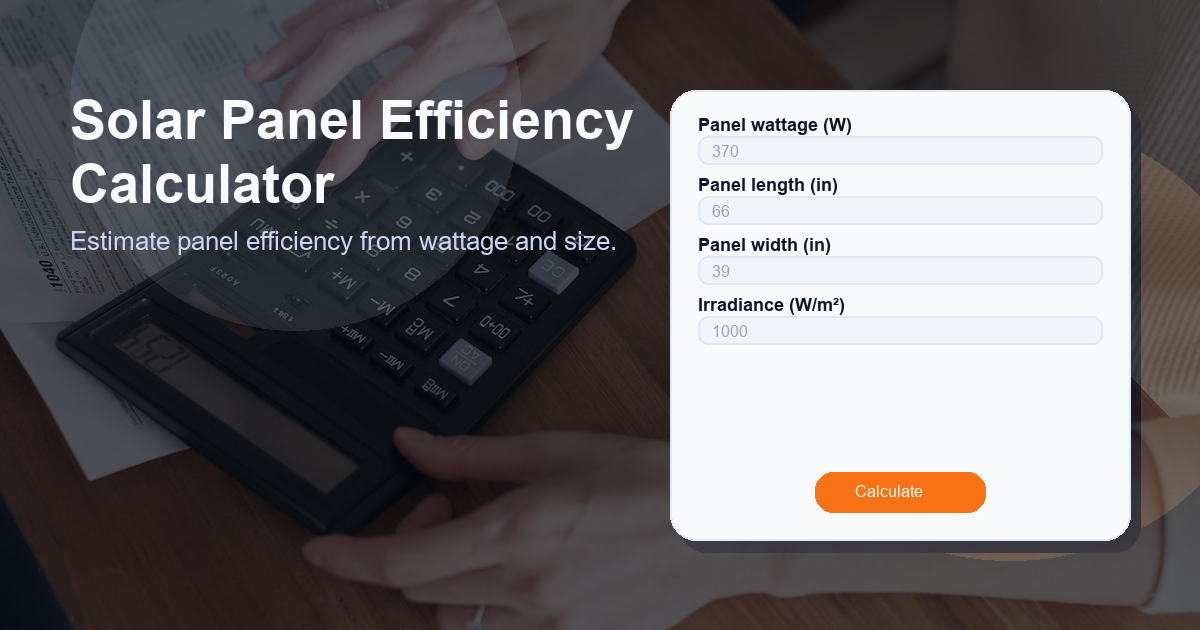
Solar Panel Efficiency Calculator
Estimate panel efficiency from wattage and size with this simple, accurate Solar Panel Efficiency Calculator. Enter the panel wattage, the physical dimensions in inches, and the irradiance (W/m²) to compute the conversion efficiency expressed as a percentage. This tool is ideal for homeowners, installers, engineers, and solar enthusiasts wanting a quick sanity check on solar panel performance.
Solar Panel Efficiency Calculator
Result: Efficiency: —
What this Solar Panel Efficiency Calculator calculator does
This Solar Panel Efficiency Calculator converts the physical panel size and incident solar power into a clear, actionable efficiency percentage. Specifically, it:
- Takes panel wattage (W) — the rated electrical output of the panel.
- Uses panel length and width (inches) to compute surface area.
- Applies irradiance (W/m²) to represent solar input power per unit area.
- Outputs an efficiency percentage — how effectively a panel converts incident solar energy into electrical power.
This makes it easy to compare panels, validate manufacturer claims, and gauge performance under different solar conditions.
How to use the Solar Panel Efficiency Calculator calculator
Using the calculator is quick and straightforward. Follow these steps:
- Enter the panel wattage (W): Use the rated power printed on the panel label or datasheet (for example, 300 W).
- Enter the panel dimensions in inches: Provide the length and width in inches — most panel datasheets list physical dimensions in mm or inches. If given in mm, convert to inches first (1 inch = 25.4 mm).
- Enter the irradiance (W/m²): Standard test conditions (STC) use 1000 W/m²; use that value to compare to manufacturer-rated efficiency. For real-world site conditions, use measured or modeled irradiance for the installation location and orientation.
- Click “Calculate Efficiency”: The tool will display the panel conversion efficiency in percent.
- Optional: Use the Reset button to clear inputs and start again.
Tips: For typical validation, use 1000 W/m² irradiance to compare against manufacturer specifications. For field measurements, use local irradiance sensors or reputable solar irradiance databases.
How the Solar Panel Efficiency Calculator formula works
The formula behind this calculator converts the physical input values into a simple efficiency ratio. The core idea: Efficiency = (Electrical Output) / (Incident Solar Power) × 100.
The calculator uses this expression in code form:
(panel_length_in * panel_width_in * 0.00064516 * irradiance_wm2) > 0 ? panel_watt / (panel_length_in * panel_width_in * 0.00064516 * irradiance_wm2) * 100 : 0
Explanation:
- panel_length_in * panel_width_in calculates panel area in square inches.
- 0.00064516 converts square inches to square meters (area factor).
- irradiance_wm2 is incident solar power per square meter (W/m²).
- Multiplying area by irradiance yields incident solar power (W) on the panel surface.
- Dividing the panel's electrical output (W) by the incident solar power gives a unitless fraction, multiplied by 100 to express as a percentage.
Example: A 300 W panel that is 65 in by 39 in under 1000 W/m²:
- Area = 65 * 39 * 0.00064516 ≈ 1.637 m²
- Incident power = 1.637 * 1000 ≈ 1637 W
- Efficiency = 300 / 1637 * 100 ≈ 18.33%
This calculation helps confirm whether a panel's real-world measured output aligns with expected performance.
Use cases for the Solar Panel Efficiency Calculator
This calculator is valuable for multiple stakeholders:
- Homeowners: Verify that installed panels are producing reasonable power compared to ratings and site irradiance.
- Installers and contractors: Quickly check panel efficiency during commissioning and troubleshooting.
- Designers and engineers: Compare different panel options and estimate system yield based on panel efficiency.
- Researchers and hobbyists: Run experiments with measured irradiance and output to study degradation or performance under varied conditions.
Because it uses simple inputs, the tool is also useful for education and demonstrations of energy conversion concepts.
Other factors to consider when calculating efficiency
While the calculator provides a solid baseline, real-world efficiency is influenced by a range of additional factors. Consider these when interpreting results:
- Temperature: Panel efficiency typically drops as temperature rises. Manufacturer datasheets list temperature coefficients that quantify this effect.
- Angle and orientation: Tilt and azimuth affect the effective irradiance on the panel. Use plane-of-array irradiance for the most accurate results.
- Shading and soiling: Partial shade, dirt, or dust can dramatically reduce output and lower apparent efficiency.
- Mismatch and wiring losses: Inverters, mismatch between modules, wiring resistance, and other system losses reduce delivered AC power versus ideal DC panel output.
- Measurement accuracy: Using inaccurate irradiance sensors or uncalibrated meters can skew calculated efficiency. Use reliable instrumentation or standardized test conditions.
- Degradation over time: Panels degrade over the years, typically losing a small percent of output annually. Compare measured efficiency to expected degradation curves.
FAQ
Q: What is considered a good solar panel efficiency?
A: Modern residential panels typically range from 15% to 22%. High-efficiency panels can exceed 22% under ideal conditions. Use the calculator with 1000 W/m² irradiance to compare to manufacturer ratings reported under Standard Test Conditions (STC).
Q: Why does the calculator use inches for panel size?
A: The calculator is designed for common datasheet units in which panel chassis dimensions are often listed in inches. The internal factor 0.00064516 converts square inches to square meters so the irradiance (W/m²) can be applied correctly.
Q: Can I use this for arrays of panels?
A: Yes. For an array, multiply the individual panel area or wattage accordingly and use the array's total wattage and total area in the same formula. Ensure irradiance is representative of the entire array (plane-of-array irradiance).
Q: How accurate is the calculated efficiency compared to lab measurements?
A: The calculator gives a practical estimate based on provided inputs. Lab STC measurements may yield slightly different numbers due to controlled conditions, spectral response, and precise instrumentation. For best accuracy in the field, measure actual irradiance and panel output simultaneously.
Q: What should I do if I get an efficiency above 100%?
A: An efficiency above 100% indicates an error in inputs (wrong units, incorrect irradiance, or incorrect area). Double-check wattage units, convert dimensions properly, and ensure irradiance is in W/m². If inputs are correct, this may indicate measurement or data problems.