EV Charging Time Calculator
Estimate charging time from energy added and charger power. Use this easy-to-follow EV Charging Time Calculator to quickly determine how long it will take to add a specific amount of energy (kWh) to your electric vehicle using a given charger (kW) and assumed charging efficiency. Whether you’re planning a road trip or scheduling overnight charging, this tool helps you plan battery top-ups with confidence.
Quick Calculator
Result — Charging Time: —
What this EV Charging Time Calculator calculator does
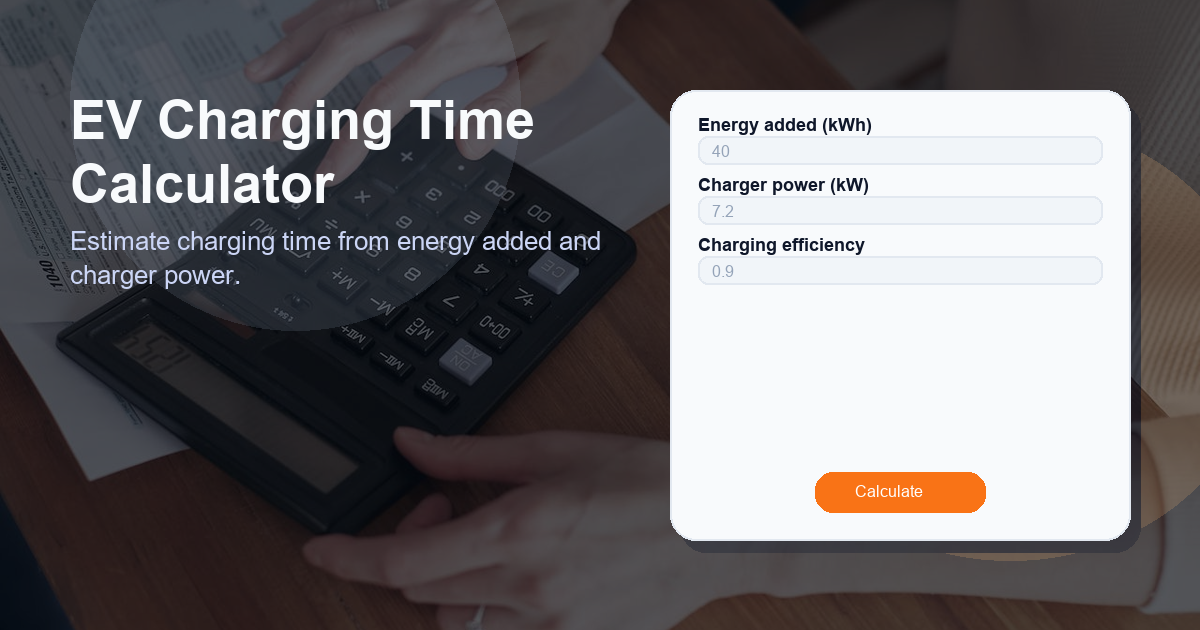
This EV Charging Time Calculator estimates how long it will take to add a specific amount of energy to an electric vehicle, expressed as a time duration in hours and minutes. The calculator uses three inputs:
- Energy added (kWh) — the amount of electrical energy you want to put into the battery.
- Charger power (kW) — the maximum continuous power the charger can deliver.
- Charging efficiency — the fraction of delivered energy that actually goes into the battery (to account for heat losses, conversion inefficiencies, and electrical losses).
Using these values, the tool returns a single output labeled Charging Time, showing the estimated time needed to complete the charge under the provided assumptions.
How to use the EV Charging Time Calculator calculator
Follow these simple steps to get accurate estimates:
- Enter the energy to add (kWh): For example, if you want to add 20 kWh to the battery, enter 20. This could correspond to going from 20% to 80% on a 60 kWh battery (0.6 × 60 kWh = 36 kWh, adjust accordingly).
- Enter charger power (kW): This is the rated power of the charging station or onboard charger. Examples: 3.7 kW (slow AC), 7.4 kW (overnight home), 11 kW / 22 kW (public AC), 50 kW / 150 kW / 350 kW (DC fast chargers).
- Enter charging efficiency (%): Most users should enter a percent like 90 for 90% efficiency. The calculator converts it to a decimal (0.9) internally. Typical efficiency ranges: 85–95% depending on temperature and charging profile.
- Press Calculate: The output labeled Charging Time will show the estimated duration in hours and minutes and as a decimal hour value.
How the EV Charging Time Calculator formula works
The calculation is straightforward. It uses the physical relationship between energy, power, and time:
- Energy (kWh) = Power (kW) × Time (hours) × Efficiency
Rearranging to solve for Time gives:
Time (hours) = Energy added (kWh) / (Charger power (kW) × Charging efficiency)
In code-friendly form (and used by this calculator):
charger_power_kw > 0 ? energy_added_kwh / (charger_power_kw * charging_efficiency) : 0
Notes:
- If the charger power is zero or negative, the formula returns 0 to avoid division by zero.
- Make sure charging efficiency is entered as a decimal (0.9) or as a percentage (90) — this calculator accepts percentages and converts them automatically.
- The result is an estimate because real-world charging power often varies over time, especially near battery limits.
Use cases for the EV Charging Time Calculator
The EV Charging Time Calculator is useful in many everyday scenarios. Examples include:
- Trip planning: Estimate how long a mid-journey stop at a DC fast charger will take to add the necessary range.
- Home charging scheduling: Determine whether a nightly charging session will fully recharge the battery given a particular home charger power.
- Cost and time comparison: Compare charging durations across different charger levels (AC vs DC) to decide whether to pay for faster charging or charge at home.
- Fleet operations: Plan charging windows for EV fleets and ensure vehicles are ready for shifts.
- Battery management: Understand how partial charges and slow charging strategies change the time required to reach desired battery levels.
Other factors to consider when calculating charging time
A basic calculation gives a useful baseline, but several real-world factors can significantly affect actual charging duration:
- Battery state of charge (SoC) and charging curve: Many EVs accept high power when the battery is low, then taper power as the battery fills to protect longevity. This means the average power may be lower than the charger’s peak rating.
- Temperature: Cold batteries charge slower. Battery thermal management systems can warm the pack, but that takes time and energy.
- Vehicle onboard limits: The car’s onboard charger or DC inlet may limit the power lower than the charger’s capability.
- Grid conditions and charger availability: Power sharing at busy stations or limitations at home circuits can reduce delivered power.
- Charging losses: Efficiency varies with power level and ambient conditions — real losses may differ from your assumed percentage.
- Battery health and age: Older batteries may accept charge differently than new ones, affecting effective charging time.
To get the most accurate estimate, combine this calculator’s output with manufacturer charging curves, on-site measurements, or real-world logs from your own charging sessions.
FAQ
1. Is the EV Charging Time Calculator accurate for fast chargers?
The calculator provides a good baseline for planning but may overestimate speed for real-world DC fast charging because many vehicles reduce power as the battery fills. Use the result as an estimate and consult vehicle-specific charging curves for precise planning.
2. How should I choose charging efficiency?
Typical values are between 85% and 95%. Use 90% (enter 90) as a practical default. For conservative planning, use a lower efficiency (e.g., 85%) to account for heat and conversion losses.
3. Can I use battery capacity instead of energy added?
Yes, but calculate the energy to add first. Example: a 60 kWh battery from 20% to 80% requires 0.6 × 60 = 36 kWh. Use that number as the Energy added (kWh) input.
4. Why does the calculator sometimes show longer times than expected?
Because it assumes constant power equal to the charger rating multiplied by efficiency. In reality, the vehicle might limit power, the charger may throttle, or ambient conditions may reduce efficiency, all of which increase charging time.
5. Does this tool account for power sharing at charging stations?
No — the calculator assumes the full charger power is available to your vehicle. If a station shares power among connectors, available power per vehicle may be lower and charging time longer.
Tip: For best results, combine this calculator with vehicle-specific charging data and real-world testing. Save this page as a quick reference when planning trips or evaluating charger upgrades.