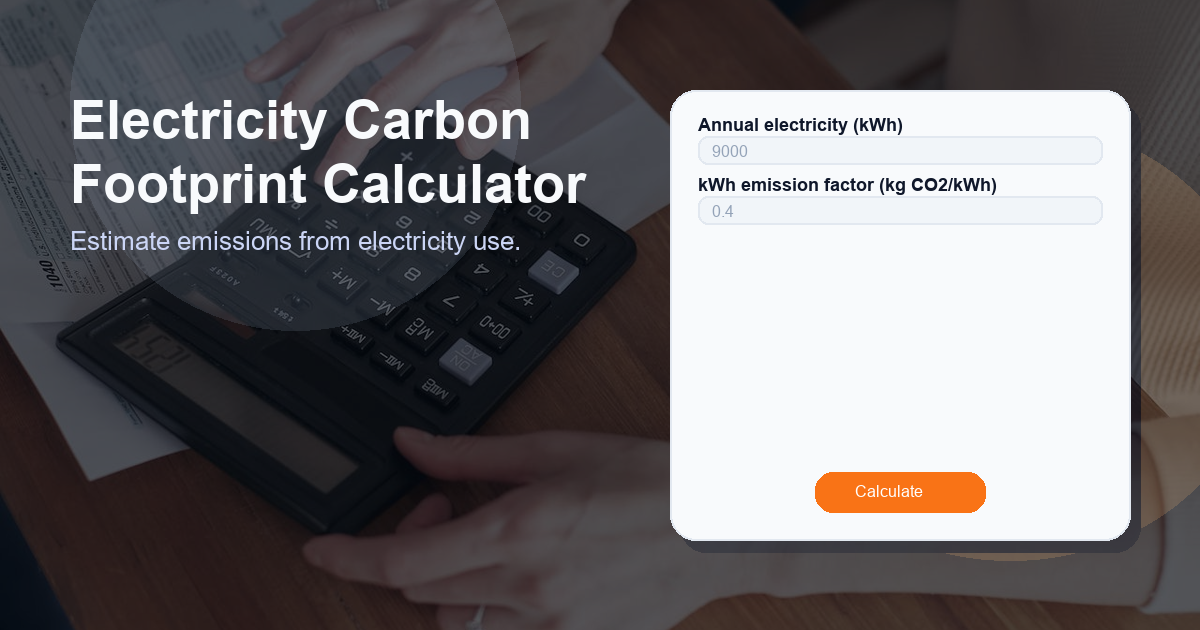
Estimate emissions from electricity use with a simple, transparent tool. The Electricity Carbon Footprint Calculator helps homes, businesses, and sustainability practitioners quickly convert electricity consumption into greenhouse gas emissions using a clear, auditable method. This article explains what the calculator does, how to use it, how the formula works, real-world use cases, and other factors that affect the accuracy of your estimate.
What this Electricity Carbon Footprint Calculator does
The Electricity Carbon Footprint Calculator converts annual electricity consumption into an estimate of annual carbon dioxide emissions. It takes two inputs:
- Annual electricity (kWh) — the total electricity you consume in a year, measured in kilowatt-hours.
- kWh emission factor (kg CO2/kWh) — a factor that indicates how many kilograms of CO2 are emitted for each kWh of electricity generated in your grid or supply mix.
Using the simple multiplication formula below, the calculator produces a single result labeled Annual Emissions, expressed in kilograms of CO2 per year (kg CO2/year). You can also convert that into tonnes of CO2 per year by dividing by 1,000.
How to use the Electricity Carbon Footprint Calculator
Using this calculator is straightforward. Follow these steps to generate a reliable estimate:
- Gather your annual electricity consumption: Find your energy bills, meter readings, or utility portal data to get the annual kWh figure. If you only have monthly bills, add them up for a year.
- Find an appropriate emission factor: Use a regional or national grid emission factor. Sources include national energy agencies, the International Energy Agency (IEA), EPA (for the US), or government carbon inventories. If you can’t find a local factor, use a published average for your country or region.
- Apply the calculator formula: Multiply Annual electricity (kWh) by the kWh emission factor (kg CO2/kWh).
- Interpret the result: The result appears as Annual Emissions in kg CO2/year. Consider converting to tonnes for easier comparison: 1 tonne CO2 = 1,000 kg CO2.
Example:
- Annual electricity = 4,000 kWh
- kWh emission factor = 0.5 kg CO2/kWh
- Formula result: 4,000 × 0.5 = 2,000 kg CO2/year → Annual Emissions = 2,000 kg CO2 (or 2.0 tonnes CO2/year)
How the Electricity Carbon Footprint Calculator formula works
The calculator uses a direct, physics-aligned formula that is easy to explain and verify:
Formula: annual_kwh × kwh_emission_factor
Where:
- annual_kwh is your total yearly electricity consumption (kWh/year).
- kwh_emission_factor is the emissions intensity of electricity generation (kg CO2/kWh).
This produces an output in kg CO2/year. To convert to tonnes of CO2 per year, divide by 1,000.
Why this formula is appropriate:
- Electricity emissions are, by design, proportional to the energy used when using an average emissions intensity per kWh.
- The emission factor encapsulates the mix of generation sources (coal, gas, nuclear, hydro, wind, solar) and their average emissions per unit of electricity supplied to the grid.
- The method is repeatable and auditable — you can change the emission factor to reflect cleaner or dirtier supplies and immediately see the impact on Annual Emissions.
Use cases for the Electricity Carbon Footprint Calculator
The Electricity Carbon Footprint Calculator is useful for a wide range of users and scenarios:
- Households — Estimate your home’s annual emissions to track reductions after retrofits, appliance replacements, or adopting new behaviors.
- Small businesses — Calculate scope 2 emissions from purchased electricity for reporting, sustainability plans, or voluntary carbon targets.
- Facility managers — Compare energy efficiency projects by translating kWh savings into CO2 reductions to prioritize investments.
- Policy makers and NGOs — Model the emissions impact of changes to the energy mix or adoption of renewable electricity programs.
- Carbon footprint reporting — Provide a transparent number for ESG reports, sustainability disclosures, or internal dashboards using the Annual Emissions label as a standard metric.
Other factors to consider when calculating electricity emissions
While the calculator is intentionally simple, several additional factors can affect the accuracy and relevance of your Electricity Carbon Footprint Calculator result. Consider these points when preparing data and interpreting outputs:
- Average vs. marginal emission factors: Average factors represent the whole-grid intensity; marginal factors reflect the emissions associated with adding or removing a unit of demand (useful for evaluating demand response or incremental renewable purchases).
- Temporal variation: Grid intensity can vary hourly or seasonally. If you have time-of-use data, using time-specific factors can provide a more accurate picture.
- Transmission and distribution losses: Some electricity is lost between generation and end use. Depending on the emission factor source, you may need to adjust for these losses.
- Scope considerations: This calculator estimates scope 2 (purchased electricity) emissions. It does not include upstream lifecycle emissions for generation equipment, fuel extraction, or embedded emissions in infrastructure.
- Renewable energy purchases and certificates: If you buy renewable energy certificates (RECs) or participate in green tariffs, your effective emission factor may be lower. Make sure to follow reporting guidance for how RECs affect your scope 2 emissions.
- Data quality and source: Use official, recent emission factors from government or trusted organizations. Emission factors change over time as grids decarbonize.
FAQ
Q: What units does the Electricity Carbon Footprint Calculator use?
A: The calculator uses kilowatt-hours (kWh) for energy and kilograms of CO2 per kWh (kg CO2/kWh) for the emission factor. The result is shown as Annual Emissions in kg CO2/year; you can convert to tonnes by dividing by 1,000.
Q: Where do I find the correct kWh emission factor for my area?
A: Check your national energy agency, the International Energy Agency (IEA), EPA (in the US), or official government publications. Utilities sometimes publish grid intensity figures. If unavailable, use a reputable regional average.
Q: Can this calculator account for on-site solar or battery storage?
A: You can account for on-site generation by subtracting self-generated kWh from your purchased electricity before applying the grid emission factor. For exported electricity and battery cycling, consider more detailed accounting or consult a specialist.
Q: Does the calculator include upstream or lifecycle emissions?
A: No. This calculator estimates direct emissions associated with electricity consumption using an operational grid emission factor. It does not include lifecycle emissions from fuel extraction, manufacturing, or infrastructure unless you add those separately.
Q: How can I reduce my Annual Emissions according to this calculator?
A: Reduce annual kWh through efficiency measures, shift consumption to lower-emission times, switch to a cleaner supply or green tariff, or invest in on-site renewables. Updating the emission factor to reflect cleaner procurement will also lower your calculated Annual Emissions.
Final tip: Keep your data sources documented and update emission factors regularly. The Electricity Carbon Footprint Calculator is a powerful first step to measure, compare, and reduce the climate impact of your electricity use.