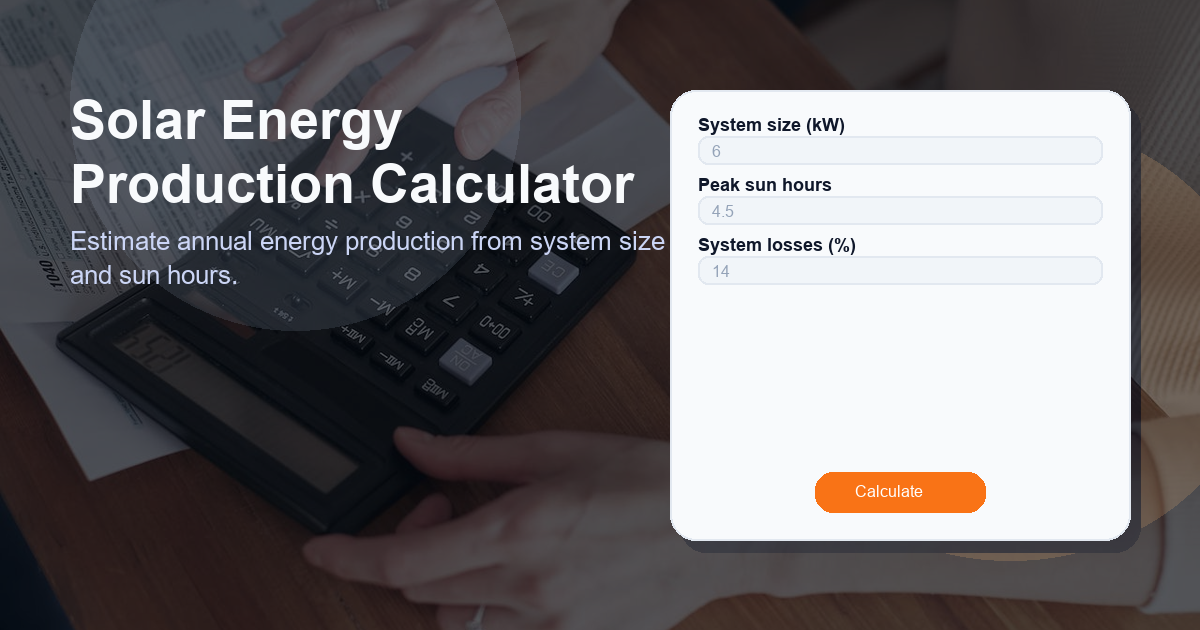
Solar Energy Production Calculator
Description: Estimate annual energy production from system size and sun hours using this simple, reliable Solar Energy Production Calculator. Enter your system size in kilowatts (kW), the average peak sun hours per day for your location, and an estimated percentage for system losses to get an immediate projection of annual kilowatt-hours produced.
What this Solar Energy Production Calculator calculator does
The Solar Energy Production Calculator provides a straightforward estimate of yearly energy output for a photovoltaic (PV) system. It is designed for homeowners, installers, energy consultants, and anyone evaluating solar potential. The calculator combines three key user inputs to produce a single, easy-to-understand metric: the system’s expected Annual Production in kilowatt-hours (kWh).
Inputs the calculator uses:
- System size (kW) — the installed DC capacity of the PV array (for example, 5 kW).
- Peak sun hours — the average number of equivalent full-sun hours per day at the location (for example, 4.5 hours/day).
- System losses (%) — an estimated percentage accounting for inverter losses, wiring, soiling, shading, temperature effects, and other inefficiencies (for example, 14%).
Formula used:
Annual Production = system_size_kW × sun_hours × 365 × (1 − system_losses_percent / 100)
Result label: Annual Production (kWh/year)
How to use the Solar Energy Production Calculator calculator
Using the Solar Energy Production Calculator is simple. Follow these steps to get an accurate first estimate of your system’s annual output:
- Enter the system size (kW): Provide the rated DC size of your solar array. Typical residential systems range from 3 kW to 12 kW.
- Enter the peak sun hours: Use a local solar resource map or site data to enter the average daily peak sun hours. Common values range from 3 to 6 hours depending on climate and latitude.
- Estimate system losses (%): Enter a percentage to cover losses. A conservative default is 10–20% depending on inverter efficiency, wiring, soiling, and shading.
- Read the Annual Production result: The calculator outputs the expected yearly energy production in kWh labeled as Annual Production.
Example calculation:
- System size = 6 kW
- Peak sun hours = 4.5 hours/day
- System losses = 14%
Annual Production = 6 × 4.5 × 365 × (1 − 14/100) = 6 × 4.5 × 365 × 0.86 ≈ 8,476 kWh/year
This quick estimate helps you compare system sizes, evaluate expected savings, or provide an initial figure for more detailed financial modeling.
How the Solar Energy Production Calculator formula works
The formula behind this Solar Energy Production Calculator is intentionally straightforward so it can be easily applied and understood:
Annual Production = system_size_kW × sun_hours × 365 × (1 − system_losses_percent / 100)
Breakdown of each term:
- system_size_kW: The rated capacity of the PV system in kilowatts (kW). This is usually the DC sum of module nameplate values.
- sun_hours: The average daily equivalent full-sun hours. This normalizes variable irradiance into a simple hourly number representing energy potential.
- 365: Converts daily production estimate to an annual total.
- (1 − system_losses_percent / 100): Reduces theoretical production to account for real-world inefficiencies like inverter conversion, wiring losses, temperature derating, soiling, and shading.
The multiplication of capacity, sun hours, and days gives the theoretical maximum energy if the system operated at nameplate output for the specified hours each day. The losses term scales this value to a realistic estimate, producing the Annual Production in kWh.
Why this works: Peak sun hours are widely used in solar planning because they convert varying sunlight intensity across a day into an equivalent number of hours at standard test conditions (STC). When combined with system size and losses, you obtain a useful approximation of yearly energy yield.
Use cases for the Solar Energy Production Calculator
The Solar Energy Production Calculator is versatile and useful in many scenarios. Common use cases include:
- Homeowners — estimate how much electricity a proposed rooftop system will generate and compare it to household consumption.
- Installers and designers — provide a quick on-site estimate for clients during initial consultations.
- Financial modeling — feed annual kWh estimates into payback, ROI, or NPV calculations to evaluate project viability.
- Feasibility studies — rapidly compare different system sizes, orientations, or locations to narrow design options.
- Policy and planning — support high-level assessments of aggregated rooftop potential across neighborhoods or municipalities.
Because the calculator is simple and transparent, it’s especially helpful during the early planning stages when you need quick, comparable figures rather than detailed simulation outputs.
Other factors to consider when calculating solar energy production
While the Solar Energy Production Calculator gives a robust baseline estimate, several additional factors can affect actual annual production. Consider these when refining your forecasts:
- Panel orientation and tilt: South-facing (in the Northern Hemisphere) and optimal tilt angles significantly boost output compared with poorly oriented arrays.
- Shade and obstructions: Trees, chimneys, or neighboring buildings can cause partial shading and disproportionately large energy losses.
- Temperature effects: Higher temperatures reduce panel efficiency; thermal losses are not explicitly modeled in the simple losses percentage unless you include them.
- Inverter clipping and DC/AC ratio: Oversizing arrays relative to inverter capacity can cause clipping during peak sun but improve overall production during lower irradiance—this nuance is not captured in the basic formula.
- Seasonal variation: Sun hours vary throughout the year. The calculator uses an average; for month-to-month planning, use a monthly model or PV simulation tool.
- Degradation over time: Module performance slowly declines (typically ~0.5–1% per year). For multi-year financial models, include degradation.
- Maintenance and soiling: Dirty panels and lack of maintenance reduce production. Regular cleaning and servicing help sustain output.
- Grid limitations and curtailment: Some sites may face export limits or curtailment which reduce usable energy.
For detailed project design or guaranteed production estimates, pair this calculator with site surveys, irradiance data, and professional PV modeling software. Use the calculator first to set expectations and guide decision-making.
FAQ — Solar Energy Production Calculator
How accurate is the Solar Energy Production Calculator?
The calculator provides a solid first-order estimate. Accuracy depends on the quality of your inputs (especially peak sun hours and loss percentage). Expect typical deviations of ±10–20% compared with detailed PV simulations if inputs are accurate; larger differences can occur if site-specific issues like shading or clipping are not accounted for.
What are peak sun hours and where can I find them?
Peak sun hours are the daily equivalent hours of full solar irradiance (1,000 W/m²). Use solar resource maps (NREL, PVGIS), local meteorological data, or installer-provided irradiance reports to find average peak sun hours for your location.
How should I estimate system losses?
System losses typically range from 10% to 20% for residential installations. Include inverter inefficiency, wiring, mismatch, soiling, temperature, and shading. Use a conservative higher percentage if you expect shading or poor maintenance.
Does this calculator account for batteries or self-consumption?
No. The calculator estimates raw energy produced by the PV system (kWh/year) labeled as Annual Production. It does not model storage losses, self-consumption patterns, or export limits. Use additional calculations to estimate usable energy and storage performance.
How can I convert Annual Production to monetary savings?
Multiply the Annual Production (kWh/year) by your electricity rate ($/kWh) to estimate annual bill savings. For net-metering or tiered tariffs, adjust for export compensation rates and time-of-use pricing.